Archery Angle Calculator for Slope Shots
Convert slope, distance, and arrow speed into a cleaner aim picture with holdover, gap, and effective range outputs.
Angle Output
| Shot Type | Distance | Angle | Correction |
|---|
| Bow Type | Speed | Drop Band | Use Case |
|---|
| Slope | Factor | Holdover | Notes |
|---|
| Factor | Value | Effect | Applied |
|---|
When an archer aim an arrow at a target located forty yard away on a hillside, the slope of the hill create changes in the arrow’s path to the target. If the archer aim up the slope at the target, the actual distance that the arrow must travel horizontally to reach the target are shorter than the distance from the archer to the target measured along the slope. If the archer aim down a slope at the target, the distance that the arrow will travel horizontally to the target may change.
Since the arrow follow a horizontal path from the bow to the target, the angle of the slope will dictate how much the arrow will drop. The angle of the slope can be measured with a rangefinder that measure the distance between the archer and the target. However, the archer must understand that the distance that is recorded with the rangefinder isnt the distance that the arrow will travel.
How Slope, Arrow Speed, Sight Height and Wind Affect Your Shot
This distance is known as the horizontal distance. If the archer wish to account for the angle of the slope, the archer can enter a positive angle into the rangefinder if the arrow is aimed uphill or enter a negative angle if the arrow is aimed downhill. With the input of the angle of the slope, the rangefinder will report the effective range of the arrow.
The effective range is the distance that the arrow will travel horizontally from the archer to the target. The faster the arrow, the less effect that the slope will have on the arrow. Arrows from compound bows travel at more higher rates than arrows from recurve bows or barebows.
Therefore, the slope affects arrows from recurve bows or barebows more than arrows from compound bows. Another factor that can affect the arrow’s path is sight height. Sight height is the distance between the arrow nock and the peep sight on the bow.
Sight height determine the zero of the arrow. The sight height must be accounted for in calculating the arrow’s path down the slope. If the zero of the archers arrows is to hit a specific target at forty yard, for instance, the archer will account for the sight height in that distance.
The archer can use the tools on the bow to factor in the arrow speed and the angle of the slope to determine how many inches the archer should aim above the target. If the archer does not take sight height into account in the aiming, the archer may feel that the distance at which the archer must aim his or her arrow is incorrect. Finally, the factor of wind drift will have an effect on the arrow’s path.
Wind drift is the movement of the arrow caused by the wind. The wind causes the movement of the arrow more difficult to manage on an open shooting course where the wind may blow across the slope. Any crosswind will push on the arrow.
The farther that the arrow travels, the more that the wind will push the arrow. The time of flight of the arrow will be longer on a slope than on even ground. Therefore, the wind will push the arrow more on a slope.
A person can also input the measurements of the wind into a calculator to adjust for the drift that the wind may cause to the arrow. Because compound bows have a flatter trajectory than longbows, compound bows require less adjustment for the wind than do longbows due to the higher arc of the longbow. Many people make the mistake of considering all slopes to be the same.
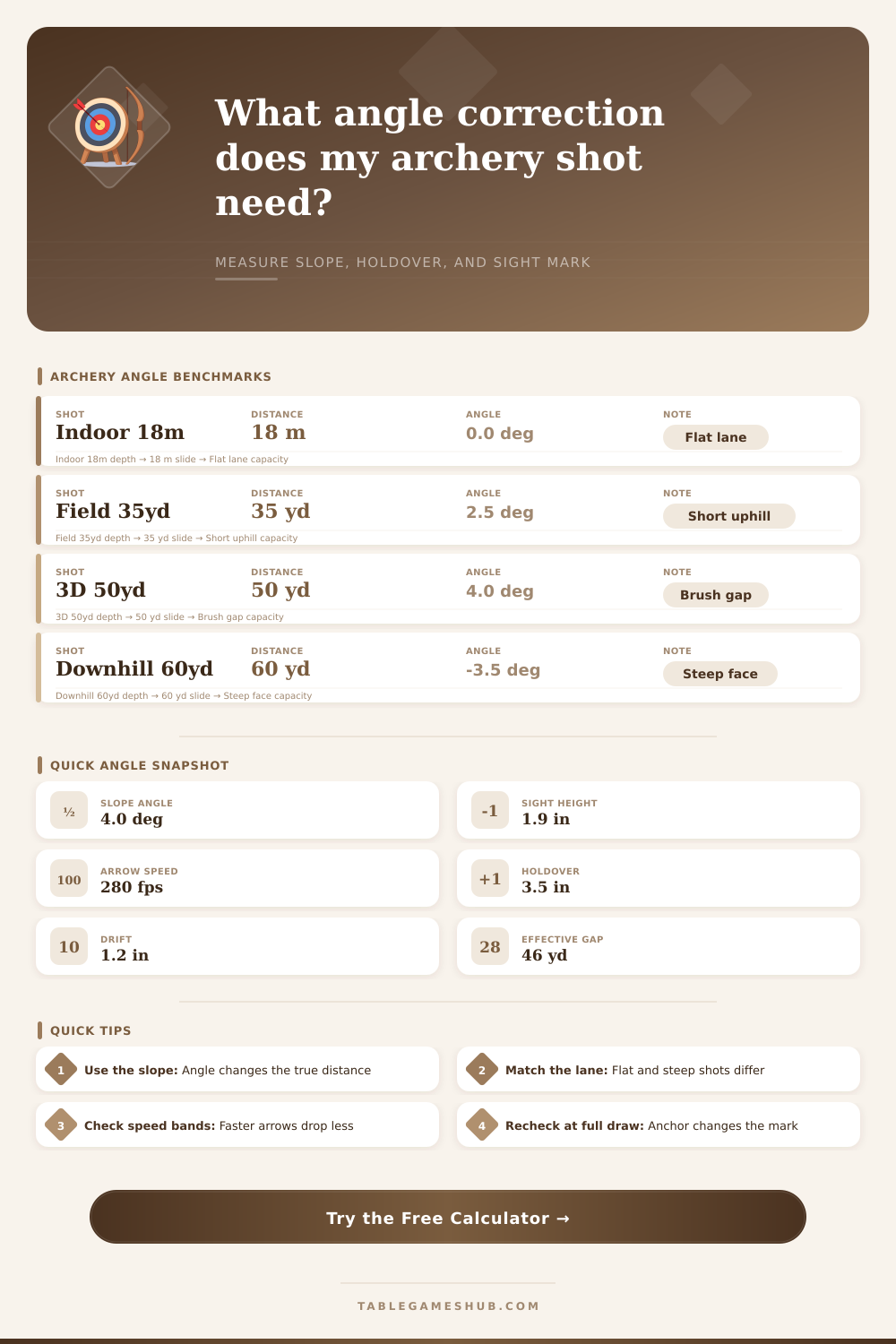
A two-degree slope will have a small effect upon the sight pins that are on the archery equipment, but a nine-degree slope will have a much larger effect upon the holdover that must be made when shooting at an angle. Using a rangefinder to measure the slant distance to the target, the archer may aim as if the ground were flat, but this will result in an inaccurate shot. Reference tables will allow the archer to determine where the arrow will land on a slope of a certain degree, such as a thirty-five yard shot with a two point five degree tilt.
A person can use preset scenarios in addition to calculating the adjustments that must be made for the target distance and environmental factors like wind and slope. For instance, the archer can load the settings for a compound bow setup at a fifty-yard distance with a six-degree slope to observe how the effective range change with changes in arrow speed. The faster the arrow, the less distance the arrow will drop, allowing for gaps between the sight marks to be wider for faster arrows than for slower arrows.
Additionally, the archer will need to check the settings again at full draw since the sight height may change with a different point of aim. Another mistake that archers may make is using the wrong units of measurement. Some archery sports enthusiasts may use Imperial units of measurement, such as yards or feet-per-second while others may use metric units of measurement of meters and meters-per-second.
Using the wrong units will make the calculation of the slope incorrect, leading to an incorrect holdover point for the arrow. Switching between imperial and metric units will allow the archer to ensure that the sight height is measured in the appropriate units, such as inches or centimeters. By practicing on uneven ground, archers of all skills can improve their accuracy with the bow.
Using a phone application to determine the angle of the slope, archers can shoot at distances with known drops. With practice with arrows of varying speeds, archers will notice that arrows with a faster traveling speed will drop less over longer distances than arrows with a slower traveling speed. Additionally, archers will find that slope angles affect longbows more than compound bows due to the higher arc of the longbow.
With an understanding of how to adjust for the slope angle, sight height, arrow speed and wind, archery sports enthusiasts will be able to better aim their arrows for accuracy.