Praga Caput Regni Calculator
Total a Praga Caput Regni score with editable Charles Bridge, cathedral, Hunger Wall, plaza, production mines, production quarries, eggs, technology, and end scoring inputs.
Pick a common end-game profile, then adjust every field to match the player board, tiles, and final scoring sheet.
| Track | Calculator input | What to count | Recount note |
|---|---|---|---|
| Charles Bridge | Level plus tile VP | Bridge spaces, chosen tiles, printed VP, end bonuses | Check one-time bridge tiles before entering the total. |
| Cathedral | Level plus bonus VP | Track height, cathedral rewards, tile VP, rank rewards | Confirm final position after all late-game moves. |
| Hunger Wall | Level plus bonus VP | Wall spaces, wall tiles, printed VP, defensive bonuses | Use the final wall token position, not the previous round. |
| Old Town Plaza | Tile VP plus sets | Plaza tile scoring, occupied spaces, corner or pattern bonuses | Enter direct VP separately from repeated set scoring. |
| Score source | Typical input | Calculator treatment | Best use |
|---|---|---|---|
| Production mines | Upgrade level and VP | Adds direct VP plus a small level-based engine marker | Separating mine upgrades from quarry upgrades. |
| Production quarries | Upgrade level and VP | Adds direct VP plus a small level-based engine marker | Checking whether production carried the final total. |
| Technology | Printed and conditional VP | Adds the entered technology total directly | Fast scoring when several tech tiles trigger at end game. |
| Golden eggs | Egg count and mode | Multiplies eggs by the selected score convention | Handling regular and house-rule egg scoring cleanly. |
| Preset | Primary pressure | Secondary scoring | Expected profile |
|---|---|---|---|
| Charles Bridge Builder | Bridge level and bridge tiles | Eggs and plaza | High visible track score with solid extras. |
| Production Mine Engine | Mine upgrades and technology | Leftover resources | Engine-heavy score with fewer track points. |
| Golden Egg Collector | Egg count | Cathedral and plaza | Final bonus swing depends on egg scoring mode. |
| Balanced 4-Player Final | All tracks | Plaza, tech, resources | Best baseline for a normal full-table score sheet. |
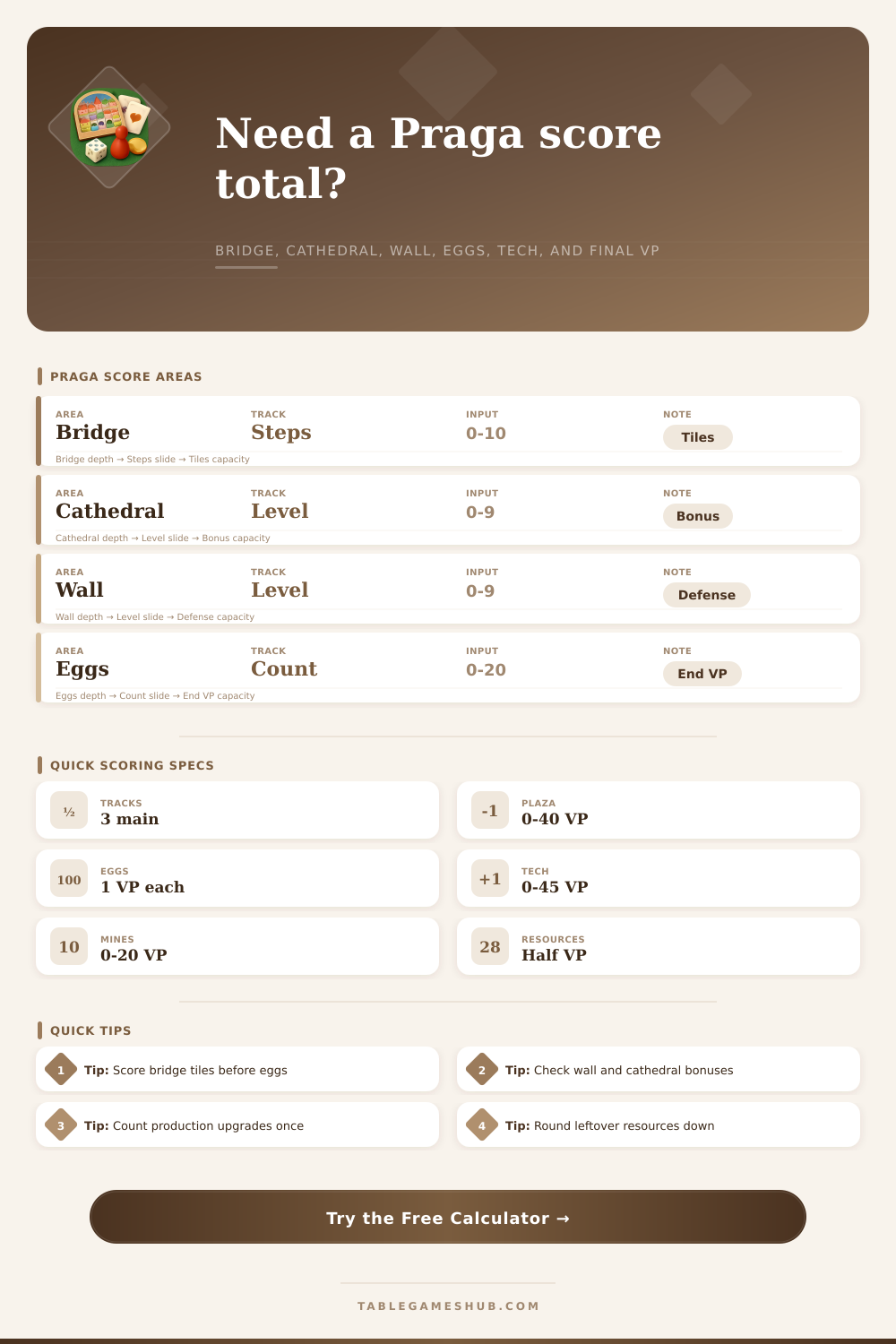
Bridge first: Count Charles Bridge tile VP before golden eggs, because some end totals hide one-time bridge rewards among other bonus tiles.
Split production: Keep mines and quarries on separate lines; it makes technology tile checks and final recounts much easier.
Praga Caput Regni is a resource-management, city-building game where a few bad numbers at game’s end can ruin everything. Hours of laying down tiles and optimizing resources to build medieval Prague are over. Time to add it all up, without any mathematical mistakes. Your total will tell you if all those clever engine-building moves scored points…or merely earned big bragging rights at the table.
Once you input value of each tile and your current placement on tracks, the calculator crunches numbers for you. You will no longer waste minutes calculating tricky end-of-game conversions. Just sit back and examine which decisions proved fruitful (and which missed the mark).
Why You Should Use This Scoring Calculator
Praga is filled with main tracks, the Hunger Wall, the Cathedral and Charles Bridge. But they’re not there as eye candy. Each is a unique way to score points designed to suck you into a different play style. Some prioritize bridge because it offers steady progression while others seek stability behind the wall or risk-reward bonuses at the cathedral.
What sets this tool apart is its ability to isolate those inputs in a way that reveals what engine generated your score. If you have too many points on a single track then you’re exposed to someone who spread theirs out over several location. That’s what people get wrong; they optimize for the highest single track rather than the most resilient overall position. In the end, that kind of production efficiency really counts.
Yes, mines and quarries creates resource output throughout the game, but they also contain secret victory points based off placement of tiles and upgrade levels. Because these sources typically don’t line up exactly, the calculator asks you to separate quarries from mines. This can be tricky. Someone who built a powerful quarry might have skipped out on some techs or ignored the wall. In contrast, a mine-building powerhouse has a solid engine, even though they may be trailing on the wall. Breaking this down on your score sheet highlight the economic strengths and weaknesses of each player. It is a small detail, but it is important for understanding why you couldn’t close the deal after dominating mid-game.
Little things matter, like golden eggs and plaza sets. You get points for completing plaza patterns at Old Town. It adds some spatial reasoning to the accounting. Bonus eggs are easy (one point apiece) but vary based on how many you spend now compared to how many you hold back. The tools’ reference tables can help you see the difference. They’ll prompt you to remember not to count direct tiles against plaza sets. That way, if you’re tired after extended play time, you won’t accidentally double count.
Resource conversion errors occur all the time. In most cases, the leftover stuff gets turned into gold and stone at some set ratio (usually rounded downwards). It’s meant as a punishment for bad use of resources. It is also an incentive for good planning. I designed my calculator so it will do that division for you; it won’t let you fool yourself about how much your leftover material is “worth”.
If you’re not using it, you’re only getting 50% of what’s on the box. Which is just how the system should of be; get your money’s worth out of it now instead of waiting until later! Presets can speed up scoring as well. For example, if you are mostly focused on technology or only built bridges, you can pick a profile and just input what matters. This means you don’t have to worry about entering zeros for all the categories you didn’t use. That makes it simpler and lets you compare your score to standard scores for strategies like that. Did building all those bridges actualy give you enough points to compensate for missing out on the main tracks? You know right away.
This is not purely an exercise in arithmetic. Scoring accurately means understanding the story of your game. How far did you push it? Were your engines powerful enough to carry out your ambitions? How did it feel when you took chances? When your final score comes in, you know whether or not it paid off. Instead of fumbling with paper and pencil to do math correctly, you get to ask those questions outright. No longer stuck in number crunching, you’re thinking about the tradeoffs you made during your time in Prague. It transforms what would otherwise be a tedious task into an instant of reflection on how well you performed.