Gugong Score Calculator
Total your final court score from jade, decrees, the Great Wall, travel, Grand Canal rewards, palace arrival, intrigue ties, destiny dice, and servant placement.
🎯Score Presets
📝Current Scoreboard
💎Final Scoring Sources
🧮Scoring Grid
📊Reference Tables
| Final source | Calculation | Timing | Calculator field |
|---|---|---|---|
| Great Wall | Most servants gains 3 VP and 1 palace step | First final scoring step | Wall winner toggle |
| Level 3 decrees | Flat, jade, servants, harbor, or 1 per 3 VP | Before palace and jade | Decree toggles |
| Palace arrival | Score the VP space claimed on arrival | After level 3 decrees | Palace arrival VP |
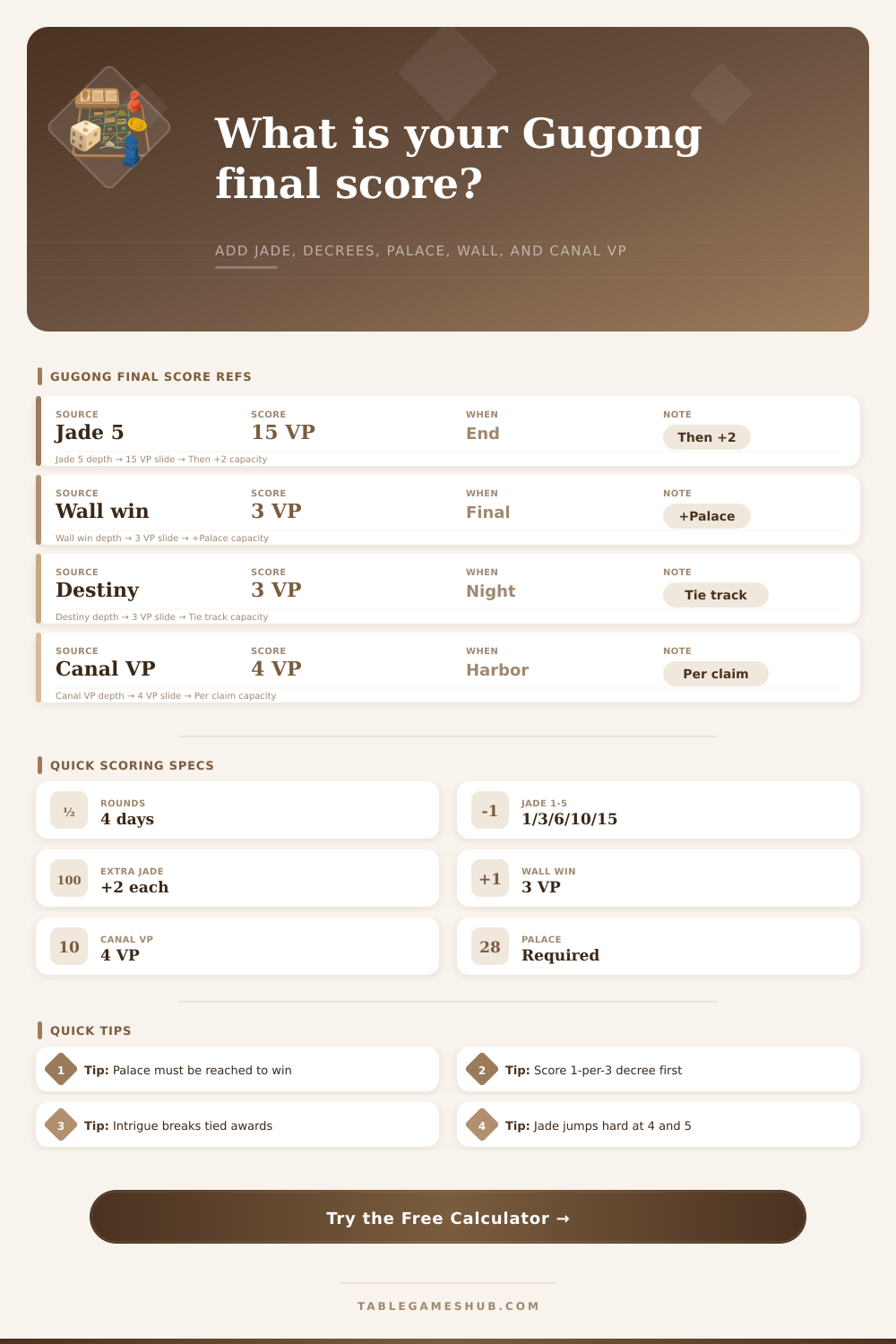
| Jade | 1/3/6/10/15 for 1-5, then +2 each | Last scoring source | Jade pieces owned |
| Jade owned | Base jade VP | With jade decree | Marginal gain |
|---|---|---|---|
| 0 | 0 VP | 0 VP | No jade score |
| 1 | 1 VP | 3 VP | Small opening |
| 3 | 6 VP | 12 VP | Solid bundle |
| 5 | 15 VP | 25 VP | Major end score |
| 7 | 19 VP | 29 VP | Extra jade continues |
| Level 3 decree | Formula | Cap | Best input to check |
|---|---|---|---|
| Progress score | 1 VP per 3 VP already scored | 10 VP | Track VP plus early final VP |
| Imperial favor | Flat 8 VP | 8 VP | Toggle if owned |
| Jade decree | 2 VP per jade | 10 VP | Jade count |
| Decree servants | 2 VP per servant on decrees | None listed | Servants on decrees |
| Harbor servants | 2 VP per harbor reward servant | None listed | Harbor servants |
| Player count | Wall completes at | Palace requirement | Intrigue use |
|---|---|---|---|
| 1-2 players | 4 servants | Reach final palace step | Break tied awards |
| 3 players | 5 servants | Reach final palace step | Break tied awards |
| 4 players | 6 servants | Reach final palace step | Break tied awards |
| 5 players | 7 servants | Reach final palace step | Break tied awards |
💡Score Check Tips
There’s something strange about how tense the last few minutes are during a game of Gugong. Four days ago, you were moving envoys through Silk Road and swapping silk for tea. And now? It’s time for some math.
Scoring doesn’t happen all at once, though; it happens as a series of events triggered by one another in ways that can catch even seasoned player off guard. Points is fed forward, so you want those points as soon as possible… But you only get them if you do it right. Rush it and you’ll forget to count one of your decrees (and end up missing the bonus) or miscount your jade.
How to Calculate Your Score Correctly
This calculator will list final VP from palace arrival, servants, intrigue tie notes, the Grand Canal, travel, the Great Wall, jade, decrees, and destiny bonuses. It ensures each variable are considered accurately without forcing you to worry about adding it all together manually.
Here are a couple of important notes. First, the Dependency Chain is key structure to understand here. The scoring order starts at great wall completed + level 3 decree active -> then palace arrives -> then jade accumulated. Why? Because some of these decrees gives points relative to how many points you’ve earned so far. That means that if you count your jade last (as in the actual rule set), you’ll undervalue those middle steps. By defaulting to jade first, you won’t account for how your early victories can affect the rest of the game through chain reaction multipliers. Forgetting these effects or accidentally double-counting something is one of the most frequent mistakes people makes while keeping score. The tool handles that order for you automatically. All you do is put in what’s happening right now, and let it figure out the rest.
The single most volatile portion of your score? Jade. Why? Because its value follows an uneven curve: One piece nets you just one point, which doesn’t feel like much when stacked up next to other ways to earn. But after you collect five, that curve spikes and every following piece is drastically more valuable then its previous counterpart for very little extra work. This is why so many players will max out at three or four. The extra gain isn’t worth it compared to spending that time on placing servants. That’s also what throws people off about jade. With the calculator, you can quickly plot out these break-even points and understand exactly how much those last few pieces adds up along with any active jade decrees.
One more wrinkle is Palace Arrival: it’s an eligibility rule and a potential scoring point generator. It doesn’t matter how many points you’ve earned elsewhere. If your envoy hasn’t arrived at the palace, you can’t win. In fact, the calculator checks precisely for this state, deeming a score “ineligible” if player hasn’t secured a space. Why? Because so many people gets caught up chasing short-term profit (which makes sense within the context of the game) that they overlook this binary condition to winning. Claiming a premium arrival position earns a bunch of points… and secures you a shot at winning. If you ignore this condition, then everything else is irrelevant.
They also add some strategic flavor by adding servant placement onto decrees. These range from ones that provide flat bonuses to those that scale based off what action(s) you’ve taken or what servants you already possess. The sheet has space to enter how many servants is assigned to certain decree types. This helps show the value of different strategy combinations without having to work through all the rules’ interactions. All of this is presented neatly in a reference table at the bottom of the page, where you can easily check which decrees are currently in play and how much they adjust your starting numbers. With that knowledge, you’re able to shift your plans mid-game instead of being locked into one hard-and-fast strategy.
The moral of the story is that Gugong is all about short term vs long-term play. Having a tool like the calculator helps eliminate human error in that mad dash for points at the end of the game. It guarantees that all points earned through intrigue connections, canals, and travel are factored in correctly. You should of used this earlier! It allows you to forget the math and instead spend time pondering which strategies were good and which ones didn’t stand up to the heat. Were you building a strong way to make decrees or going all-in with jade? Knowing exactly how many points you ended up with can tell you if that gamble paid off or not. Numbers don’t lie, but boy will they make you squirm if you use them wrong.