Catan Victory Point Calculator
Total settlements, cities, victory point cards, Longest Road, Largest Army, and expansion targets before the table debates the winning score.
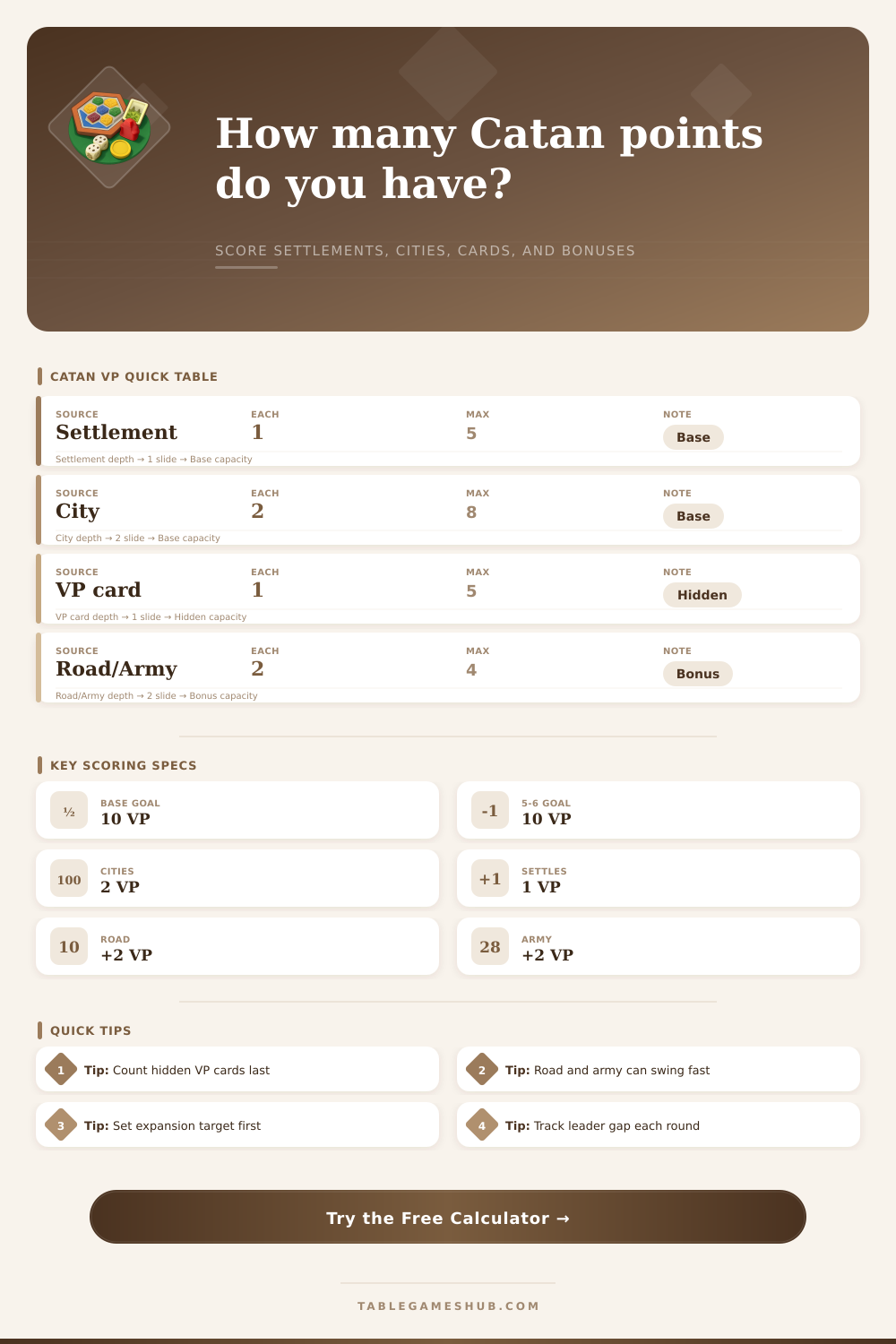
| Source | VP Value | Typical Limit | Calculator Field |
|---|---|---|---|
| Settlement | 1 point each | 5 pieces per color | Settlements on the board |
| City | 2 points each | 4 pieces per color | Cities on the board |
| Victory point card | 1 point each | 5 in base deck | Revealed and hidden VP cards |
| Longest Road | 2 points | Needs at least 5 roads | Longest Road held now |
| Largest Army | 2 points | Needs at least 3 knights | Largest Army held now |
| Scenario or expansion VP | Varies | Scenario dependent | Expansion or scenario VP |
| Mode | Common Target | Extra VP Logic | When to Use |
|---|---|---|---|
| Base Catan | 10 VP | Settlements, cities, dev cards, road, army | Standard 3-4 player game |
| 5-6 Player Base | 10 VP | Same scoring, wider board pressure | Extended base setup |
| Seafarers | 12 VP | Scenario awards and island discovery | Island and sea route games |
| Cities & Knights | 13 VP | Metropolises and defender points | Progress card expansion games |
| Explorers & Pirates | 17 VP | Missions, settlements, and scenario awards | Long scenario campaign boards |
| Check | Threshold | VP Effect | Risk Note |
|---|---|---|---|
| Longest Road eligibility | 5 continuous roads | +2 if held | Can move to another player immediately |
| Largest Army eligibility | 3 played knights | +2 if held | Only played knights count |
| Hidden VP card | Card in hand | +1 each | Often revealed only on winning turn |
| Road or army pressure | Opponent close | Possible 2 point swing | High pressure can change the leader |
| Status | Points From Target | Table Meaning | Calculator Signal |
|---|---|---|---|
| Winning now | 0 or less | Declare if it is your turn and score is legal | Total meets target |
| One build away | 1 point | Settlement, VP card, or small scenario award wins | Needs 1 VP |
| Big swing away | 2 points | City, road, army, or two VP sources can win | Needs 2 VP |
| Still building | 3 or more | Track production, space, and bonus contests | Needs several VP |
Suddenly the chatter stops and the table fall silent as one of the players hits ten points. You’re getting good, but who has how many? Trying to settle up while people argue is no way to win. Just use tool above to get answer. It’ll do all the calculations for you.
Now you can think about where you should put your city down or whether you want to play that development card. This isn’t a math exercise, it’s about knowing what you need to win in advance of your competition make their move. Start with what’s out on the board. Cities count for 2 and settlement for 1.
How to Count Your Points and Win
Your hand is where things can get tricky. You don’t show anyone your victory point cards until end of game. This means you could be right at the edge but have several hidden in your hand. If you’re playing solo or trying to figure something out, you can plug those private values into the calculator. There is no guesswork; you’ll know exactly how much you have. That way it prevents you from over building because you simply forgot that card you actualy own.
Finally think about benefits of leading. You get two points for Largest Army and Longest Road, but they are fleeting. You could hold both today and lose them on the same turn your opponent play three knights and lays a few extra roads. The tool makes it easy to track those bonus points, and know whether or not your lead is secure.
If you have one point on lead sheet with those advantages included, then you’re still in danger. Those cards turn the leaderboard upside-down faster then you can blink an eye. One minute you’re winning and the next, you’re losing. Separate them out and know where you stand versus your competition.
The win condition change with expansions. In base game, it’s ten points; with Cities and Knights, thirteen points; with Explorers and Pirates, it’s seventeen. Many people uses the wrong number as their win condition. They might panic when they hit ten instead of thirteen, or get overconfident if they are at ten before end of the game. The default settings will adjust this number so that it fits rules you’re playing. Because in a game of Explorers, stopping at ten means you’re far behind, while stopping at thirteen in a base game means wasting supplies on a settlement that never pays off. And knowing where finish line is is basic strategy (it’s just easy to forget when playing).
Preparation meets action in the end game. How much do you need? Do you need one more point, are you just revealing a victory card, or will one more settlement get you there? Or maybe you’re down by three with two turns to go…you should of pull out all the stops. That typically involves playing several dev cards as fast as possible, or taking Longest Road from someone else.
Seeing where that gap puts you let you determine how to defend yourself and when to push forward aggressively. No more guessing, now it’s math: calculating your probability of success based off dice odds and remaining cards. You can use hope as a real plan.
What trips up most people isn’t losing points. They lose because they underestimate how far behind (or ahead) everyone else is. With the leader comparison, see exactly how many points away from top spot you are. This doesn’t seem like much. But it does make all the difference. Once that goes to 0 or in the negatives, you know it’s time to wrap things up. Until then, count, trade and build.
The board lies. The math do not.