Above and Below Score Calculator
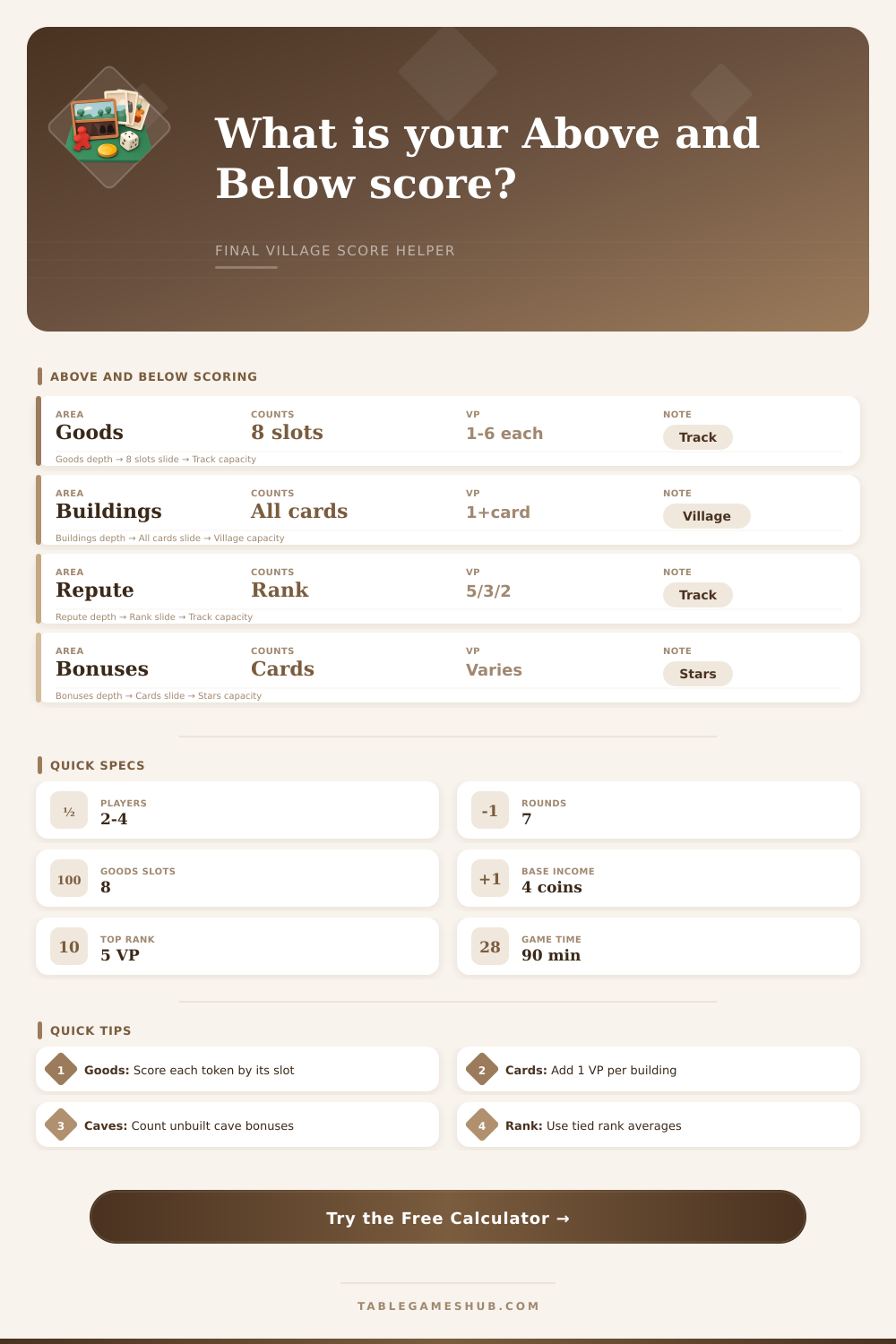
Total your final village points from advancement goods, buildings, reputation, caves, villagers, and bonus cards.
Use the point value printed beside your reputation cube.
Every house, key building, star building, and outpost adds 1 VP.
Score Breakdown
| Track slot | Point value per good | Income marker if furthest filled | Calculator field |
|---|---|---|---|
| First good type | 1 VP each | 5 coins | Slot 1 goods |
| Second good type | 1 VP each | 6 coins | Slot 2 goods |
| Third good type | 2 VP each | 6 coins | Slot 3 goods |
| Fourth good type | 3 VP each | 7 coins | Slot 4 goods |
| Fifth good type | 4 VP each | 7 coins | Slot 5 goods |
| Sixth good type | 4 VP each | 8 coins | Slot 6 goods |
| Seventh good type | 5 VP each | 8 coins | Slot 7 goods |
| Eighth good type | 6 VP each | 8 coins | Slot 8 goods |
| Situation | Use in calculator | Village point effect | Scoring note |
|---|---|---|---|
| Cube on positive track space | Reputation marker VP | Add printed value | Can be separate from rank |
| Cube on negative track space | Reputation marker VP | Enter negative value | Low reputation can reduce score |
| Highest in 3-4 players | Rank bonus 5 | Add 5 VP | Use tie average if tied |
| Second in 3-4 players | Rank bonus 3 | Add 3 VP | Third normally scores 2 VP |
| Two-player leader | Rank bonus 3 | Add 3 VP | No second place rank bonus |
| Score item | What to count | Typical calculator input | Why it matters |
|---|---|---|---|
| Building base point | Every built card | Total buildings built | Each card adds 1 VP |
| Printed building points | VP icons and printed bonuses | Printed building and card VP | Includes star or key card text |
| Outposts | Built cave-side cards | Below-ground outposts built | Used by several bonus cards |
| Unbuilt caves | Cave cards not built on | Unbuilt cave cards kept | Some bonus effects score these |
| Adventurers | All villagers in your village | Villagers in your village | Some cards score workers |
| Loose goods | Goods, potions, cider outside track | Loose counted items | Only count when a card says so |
| Profile | Goods plan | Village shape | Likely score source |
|---|---|---|---|
| Balanced Village Finish | Six slots with small stacks | Mixed houses and outposts | Goods plus printed cards |
| Full Goods Engine | All eight slots filled | Harvest buildings online | High advancement score |
| Deep Outpost Builder | Middle track filled | Many below-ground builds | Outpost bonus card |
| Adventurer Hall Count | Moderate goods | Large villager roster | Villager bonus card |
| Reputation Leader | Enough income to build | Clean rank lead | Reputation marker and rank |
| Empty Cave Survey | Late goods only | Explored but unbuilt caves | Survey-style cave bonus |
Above and Below’s final round tends to be more audit than race. Seventy minutes of tracking down resources, placing structures and ascending tracks has passed. Here’s the moment when everybody remember something they didn’t account for. This is a notoriously complex scoring game.
There are eight slots with goods. There are different types of buildings that scores individually and differently. Reputation markers change values according to how high your rank go. Bonus cards inspect nearly everything you’ve collected. To save yourself the difficult tallying process that often results in bitter debates about winning by two points, calculator above does it for you after you input the end-state of your board.
How to Score Points in Above and Below
So where do most players stumble? It is the advance track. They don’t see that those spots aren’t just about making money throughout the game. It’s a great way to get VP as well. Each spot holds various amounts of point value depending on your goods in there (six for the rare late-game stuff and one for the cheap early ones). The tool will let you input the number of goods in each of its eight spaces.
Why separate them? Because it matters if you have lots of goods in space one or only a few in space five. One provide steady income but few points, while other costs more but yields many more points. Knowing that trade-off can help you prioritize your strategy: should I focus on getting some good tokens for the later part of the game or should I save my tokens to get max value at the end?
And then there are the buildings. That’s when things get complicated. Every single building card you have built gets you one victory point simply by being there. Also, many of them print their own victory points onto the card. Some buildings score based off how many villagers you have in your village; others scores based on how many outposts you have dug underground. These is entered separately into the calculator (it wants to know each number individually so it can properly apply the multipliers).
So for instance, you’d enter how many buildings you built for the base points and you’d enter how many VP were printed on those building separately. Why? Because a player who built five really high value buildings could easily beat a player who build ten lower value buildings. You tend to focus on the large numbers printed on the card and forget that they all earn you one point apiece.
On top of all that, there’s an additional wrinkle called Reputation which will depend entirely upon other persons present at the table. For instance, if it’s just two players, how many points do you recieve for having the highest amount? What about three players? Or four? Thankfully, this calculator allows you to choose your rank bonus yourself. So if you’re tied with someone else for 2nd and 3rd, then you’ll average out their points accordingly. Yeah, it sounds trivial, but believe me: That half-point could of what decides the winner of a close game.
The other thing that most folks don’t catch when rushing to score near the end of the night is that the reputation marker itself are worth points. They’re printed right on the board! You must add the marker value to the rank bonus.
Then there are the wild cards: some people have several cave cards that they keep unbuilt specifically due to game effects that reward having an empty space; other players put all their extra potions and loose goods into their own storage spot instead of on the track. There is fields for those kinds of fringe tactics as well, where they won’t get lost in the total. It makes you think about every nook and cranny of your village and give it a number. And that’s when you realize how intertwined everything is.
That villager you brought out early on to gather resources may turn out to be worth points towards your victory in three separate ways. Seeing the numbers add up like that helps you understand why the middle game feel so chaotic, you begin to see all those points you were amassing without even knowing it, and that was the whole purpose behind a scoring round.