Pipeline Score Calculator
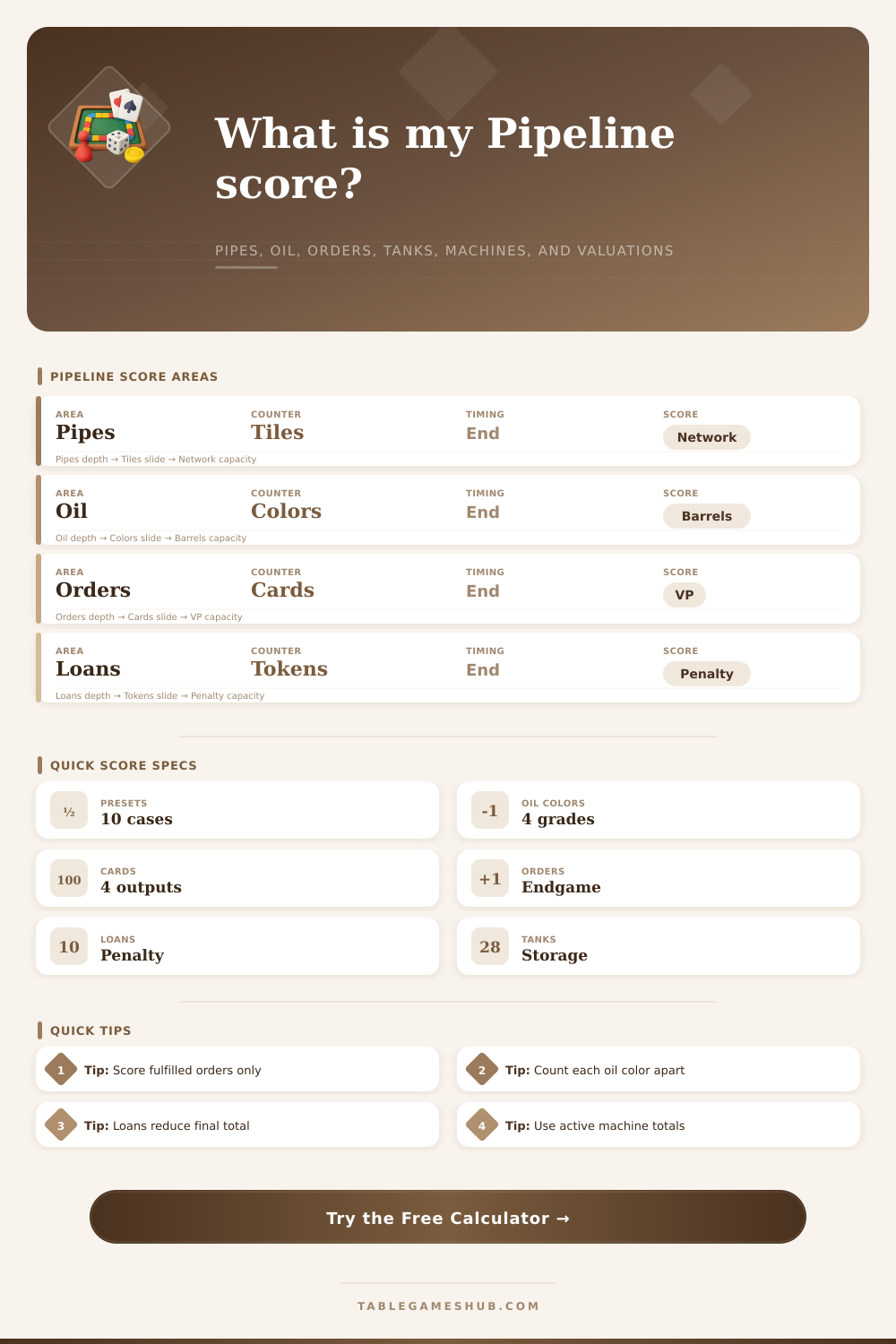
Estimate final Pipeline standing from pipe network quality, refined oil colors, contracts, endgame orders, machines, tanks, valuation cards, loans, and penalty counters.
| Score Area | Input Used | Calculator Formula | Board Check |
|---|---|---|---|
| Pipe network | Connected tiles and longest run | tiles x 1.5 plus run x 2, then efficiency | Trace only connected pipe sections |
| Refined oil | Yellow, orange, red, black barrels | 1, 2, 3, and 4 points per barrel | Count stored and usable refined barrels |
| Contracts | Completed contract card total | Printed completed contract points | Exclude unfulfilled contracts |
| Endgame orders | Fulfilled order card total | Printed fulfilled order points | Confirm color requirements were met |
| Valuation cards | Satisfied valuation point total | Printed valuation card points | Apply only achieved valuation conditions |
| Refined Oil Color | Point Weight | Typical Use | Endgame Note |
|---|---|---|---|
| Yellow refined oil | 1 point each | Low tier fulfillment | Useful filler for small orders |
| Orange refined oil | 2 points each | Middle tier contracts | Good storage conversion value |
| Red refined oil | 3 points each | High tier contracts | Often drives late card scoring |
| Black refined oil | 4 points each | Premium orders | Protect for endgame orders |
| Network Shape | Efficiency Choice | Best For | Calculator Effect |
|---|---|---|---|
| Fragmented refinery | 0.85 modifier | Disconnected pipe groups | Reduces pipe and machine value |
| Usable refinery | 1.00 modifier | Most normal boards | Keeps raw network value |
| Efficient refinery | 1.15 modifier | Several repeatable routes | Rewards strong routing |
| Highly tuned refinery | 1.30 modifier | Long connected engine | Rewards elite endgame layout |
| Preset Scenario | Core Focus | Strong Result | Risk Counter |
|---|---|---|---|
| Training Game Two Contracts | Small network and two cards | 50 to 70 points | Missing order cards |
| Efficient Refinery Network | Pipe length and machines | 80 to 110 points | Thin oil storage |
| Endgame Order Sprint | Late order fulfillment | 95 to 130 points | Loan counters |
| Valuation Card Push | Card conditions | 90 to 125 points | Weak pipe value |
A pipeline score calculator is an tool that helps to calculate the final score of the pipeline game. Pipeline game allow players to manage the number of pipes, oil, contracts, and loans. A calculator transforms these into a single numbers.
The calculator is necessary as each component of the game yield a different score for each player. The number of tiles that a player placed to make up their pipe networks and the length of the longest continuous run of pipes in the network calculates the score from the game’s pipe network. A longer continuous run of pipes are awarded more points than a player with many separate section of pipes.
How to Use the Pipeline Score Calculator
The player must enter the number of tiles and the length of the longest run of continuous pipes into the calculator for the tool to determine the score for this component of the game. The second component of the score is based off the oil barrels that the player produced. Oil barrels of different colors earns different amount of points for the player.
The player must count the number of yellow oil barrels separately than the number of black oil barrels. If a player combine the two types of oil barrels, they will receive the wrong score for this component of the game. The number of each color of oil barrel that the player produced will determine the score for this component.
The score from the contracts that a player completed is the third component of the game score. The number of contracts that are completed do not yield the same score as the number of contract cards that the player has collected during the game. A player should only include the score from the contracts that they have completed in the calculator.
A player might earn a higher point value from one completed contract then they would from many small contracts. The total of these contract point values is the score for this component of the game. The fourth component of the game score are the penalty tokens from loans that the player made during the game.
The loans that the player took out can reduce the score for the game. Each loan token yield a penalty value that will be deducted from the total score for the player. These scores are entered into the calculator to determine the score for this component of the game.
The fifth component of the game score is the utilization of the storage tanks that hold the oil that the player produced. The score for this component is given based on the relationship between the oil barrels that are produced and the tanks that holds that oil. If the tanks are filled with oil from the barrels, the storage tanks has a high score for the game.
If the tanks are empty of oil, the storage tanks score littlely for the game. This component uses the same value as the oil barrels to calculate this portion of the score for the game. Many players make mistake when they calculate their score.
A common mistake is to treat all of the component of the game the same. For example, a player might count the number of oil barrels of each color together rather than calculating each color separately. In this case, the score will be wrong.
Another mistake is to include each contract card rather than only including the contracts that the player completed. This mistake will result in the player receiving a higher score than they earn during the game. Players might also make the mistake of not including the penalty score for loans that they made during the game.
This will result in the player having a score that does not reflect the loans that they made. A pipeline score calculator allows a player to compare the different ways of playing the game. For example, a player might focus on building their pipeline to earn a high score from their pipe network.
Another player might focus on earning high-value contracts. A player can load the game states into the calculator to determine which player earned the highest score in their game state. The calculator can reveal which game strategy was the most successful for each player when using the game.
Finally, the total score for the game will reveal whether the player’s pipes, oil, and contracts successfully made up a high score for the game. If the player does not manage their resources well, their total score for the game will be lower than players that manage their game elements more successful.