Viticulture Victory Point Calculator
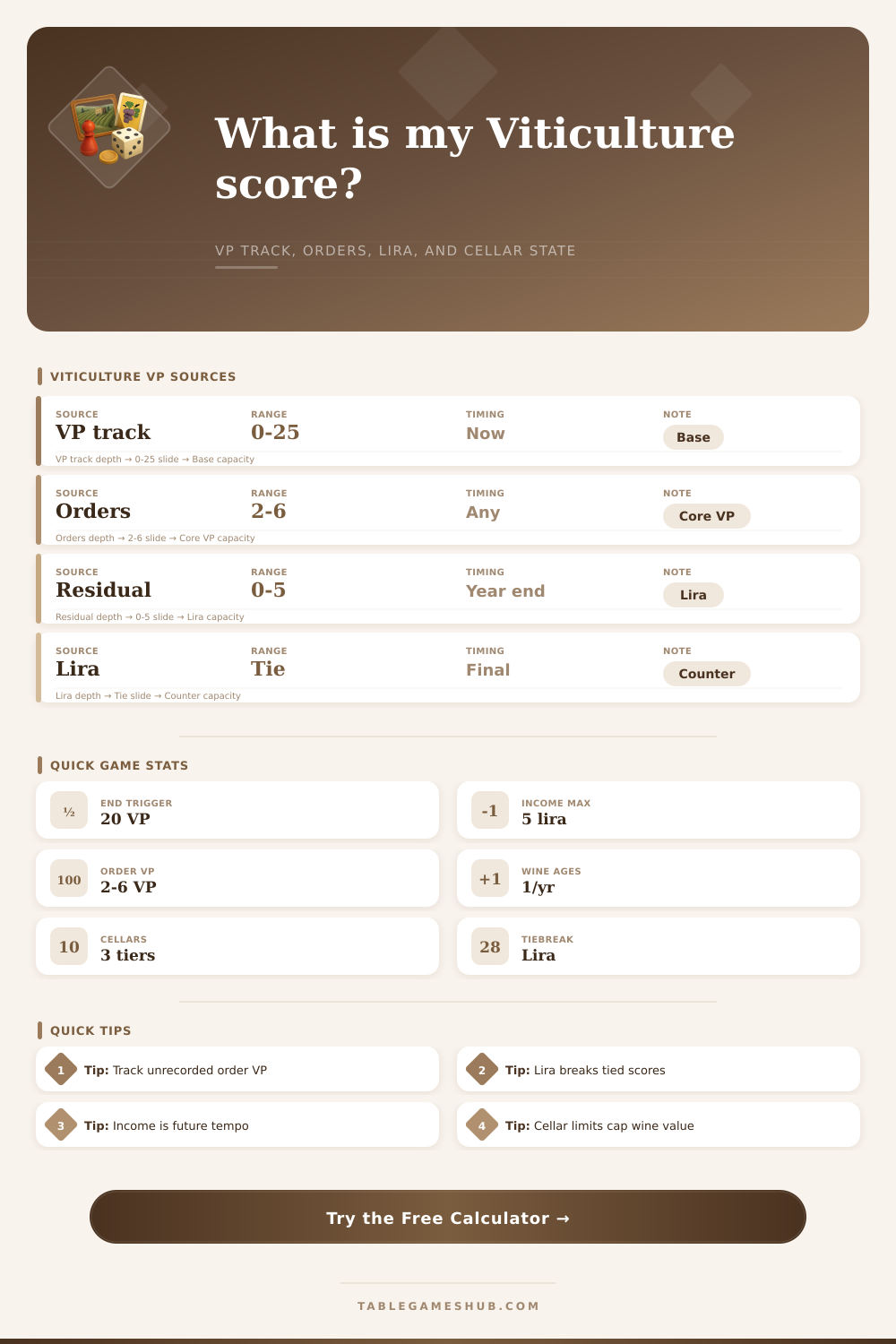
Total your VP track, wine orders, visitor bonuses, structures, residual income, lira counter, cellar state, and end-trigger distance.
Use this score check when a vineyard is nearing the end trigger and you need one view of recorded points, unrecorded bonuses, order tempo, lira, and cellar readiness.
| Wine Order Band | Typical VP | Cellar Need | Calculator Use |
|---|---|---|---|
| Early simple order | 2-3 VP | Small cellar often enough | Good for quick trigger progress and income start. |
| Balanced midgame order | 3-5 VP | Medium cellar usually needed | Use when wine value reaches 4-6. |
| Premium late order | 5-6 VP | Large cellar often needed | Best for final leap and tiebreak planning. |
| Blush or sparkling order | 4-6 VP | Mixed wine requirements | Check grapes, wine tokens, and cellar ceiling together. |
| Residual Income Level | Year-End Gain | Max Track | Score Meaning |
|---|---|---|---|
| 0-1 income | 0-1 lira | 5 income | Low tiebreak cushion unless lira is already saved. |
| 2-3 income | 2-3 lira | 5 income | Healthy midgame economy after one or two orders. |
| 4 income | 4 lira | 5 income | Strong counter pressure with one harvest remaining. |
| 5 income | 5 lira | 5 income | Maximum recurring lira for endgame ties. |
| Cellar State | Wine Value Range | Order Readiness | Risk Flag |
|---|---|---|---|
| Small cellar | 1-3 | Low-value orders only | High orders may stall until upgraded. |
| Medium cellar | 1-6 | Most midgame orders | Premium 7-9 wine is still capped. |
| Large cellar | 1-9 | Full wine range | Needs enough grapes and aging time. |
| Mixed wine stock | Depends on tokens | Best for blush or sparkling | Track both color mix and value ceiling. |
| Endgame Position | VP Gap | Lira Counter | Calculator Cue |
|---|---|---|---|
| Behind the leader | 4+ VP short | Secondary | Find order or visitor VP before counting lira. |
| Near leader | 1-3 VP short | Important | One visitor point or extra order may swing the table. |
| Tied on VP | 0 VP | Primary counter | Project residual income and saved lira carefully. |
| Past end trigger | 0 to trigger | Final counter | Confirm all unrecorded VP before final year ends. |
The Viticulture score calculator is a helpful tools that allows individuals to calculate they projected score within the game of Viticulture. Many players feels uncertain regarding there actual score within the game, especially during the final rounds. Players may be uncertain in their score due to various factor, such as the existence of wine orders that have yet to be scored for the round, the presence of visitor bonuses on the player’s cards, and the inclusion of residual incomes on the player’s records for the game that will provide additional income at the end of the year.
Should any of these factors be present in a player’s score, it is possible for a small amount of uncertainty to still have a larger impact upon the outcome of the game; hence, the value of the score calculator is again present. The score calculator ask for a variety of different inputs from the players to accurately reflect the player’s score within the round. The player must enter the player’s current points on the victory point track into the calculator.
How to Use the Viticulture Score Calculator
Additionally, the player’s unrecorded orders may provide additional victory points to the player, so the player must also enter those victory points into the score calculator. The player’s visitor points and structure bonuses must also be entered into the score calculator into separate field, as those two values is obtained from separate sources. Additionally, the player must enter the value of the player’s residual income, as well as the number of years that remain within the game, into the score calculator for the same reason that player income is calculated within the game: it determines the value of the player’s lira at the end of the game, which is the main value used to determine the winner of ties between players.
Beyond these initial categories of score, the score calculator also includes field related to the player’s cellar contents. Such fields allow for the player to enter the number of grape tokens and wine tokens that the player still controls at the end of the game. These values are used to determine whether any orders are still possible to fulfill during the game; orders that require values of wine that are higher than the value of the player’s cellar are not possible for fulfillment.
The player can enter the size of their cellar into the calculator to determine if their drawn orders are realistic or if they may still be waiting for additional aging of wine before fulfilling those orders. Beyond the field for cellar size, the score calculator also includes a field related to the end of the game for the round. This field allow the player to set the score for the end of the game, in case the score calculator is being used in a game that has different rules to the standard game of Viticulture.
For instance, some players may have set a target score of twenty points for the game, however others may have selected an alternate length of play. Additionally, other groups may use Tuscany cards, which have different rules at the beginning of the final year of play. By entering the target score and the current score of the leader, the player can determine how many additional points is necessary to win the game.
Reference tables within the score calculator can be used to determine the residual income and cellar fields related to the score calculator. Finally, the score calculator can help to highlight some of the most common mistakes that occurs within the game of Viticulture. One common mistake by players is treating each victory point as if it is of equal value to every other victory point.
For example, six points from a wine order may appear to be a valuable score, but if the cellar for that wine is not of a size that can age the wine to fulfill that order, that victory point are not earned. Additionally, while players may feel as if they have very little residual income at the middle of the game, those players will often overtake their opponents if they score five lira per year. Lira does not convert into victory points, but lira is the only counter used when the victory point totals of two or more player are equal.
Another of the most common mistakes by players is the double counting of their orders. Any victory points that are already on the track must not be combined with any other victory points from orders that have yet to be fulfilled; combining these two values will result in an overestimation of a player’s score. Such a mistake is avoided by the score calculator, which keep these two values separate.
Understanding the difference between recorded victory points and potential victory points can allow players to make better decisions during the last few actions of the game. For instance, rather than focusing upon fulfilling their remaining visitor points, a player may instead focus upon fulfilling the one order that they can fulfill with their remaining wine and cellar tier. Thus, the score calculator may assist players to fulfill their final orders and protect their lira from being overdraw at the end of the game.
Additionally, each wine placement during the final year of the game can help to impact the outcome of the game, so it is important for each player to have a clear understanding of their potential score.