🏭 Brass Birmingham Score Calculator
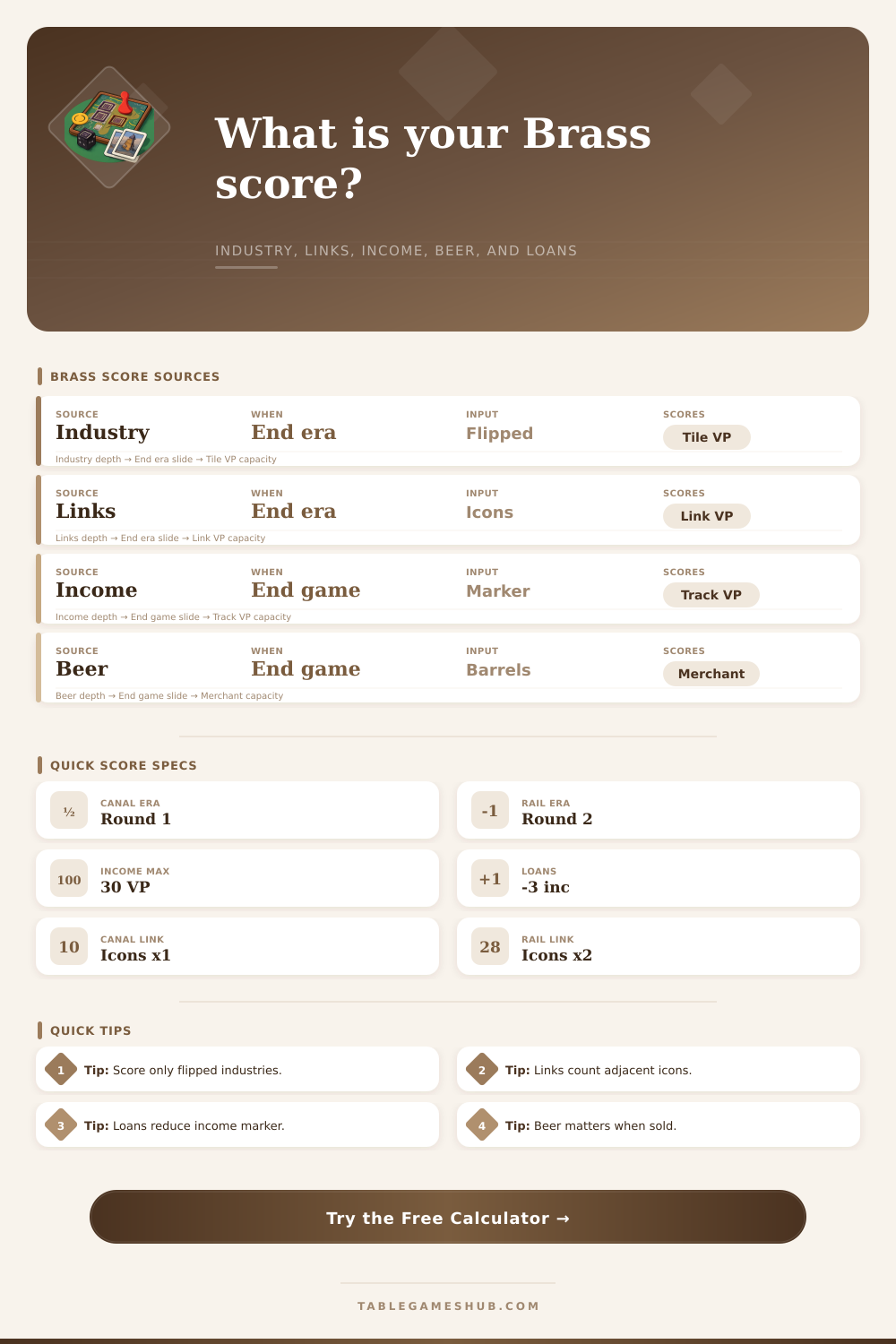
Total final victory points from flipped industries, canal and rail links, income marker, merchant beer, remaining counters, and loan penalties.
| Score category | Input | Formula | Victory points |
|---|
| Industry type | Level range | Scoring trigger | Calculator use |
|---|---|---|---|
| Coal mine | I through IV | All coal cubes removed | Count flipped mines and choose typical level. |
| Iron works | I through IV | All iron cubes removed | Iron often flips from distant demand, so count actual flips. |
| Cotton mill | I through IV | Cotton sold to market or merchant | Sold cotton mills score tile VP and may use beer. |
| Manufactured goods | I through VIII | Goods sold to market or merchant | Manufacturer VP varies by tile level. |
| Pottery | I through V | Pottery sold to merchant | High-level pottery strongly affects final totals. |
| Brewery | I through IV | Beer barrel consumed | Scores tile VP after beer is used. |
| Scoring area | Canal era note | Rail era note | Common audit mistake |
|---|---|---|---|
| Link icons | Count icons touching canal links | Count icons touching rail links | Counting unflipped adjacent industries. |
| Industry tiles | Only flipped canal-legal tiles | Only flipped rail-era tiles | Adding unflipped tile printed VP. |
| Income marker | Canal review is interim | Final marker contributes score | Forgetting loan-box income penalties. |
| Beer | Merchant beer helps early sales | Beer also supports rail building | Counting beer twice as tile and merchant mark. |
| Money counter | Operational resource | Tie-break style counter | Treating counter value as normal VP. |
| Tile family | Low level VP | Middle VP | High level VP |
|---|---|---|---|
| Coal mine | 1 to 2 | 3 | 4 |
| Iron works | 3 | 5 | 7 |
| Cotton mill | 5 | 8 to 12 | 18 |
| Manufactured goods | 3 to 5 | 7 to 10 | 12 to 16 |
| Pottery | 10 | 11 to 15 | 20 |
| Brewery | 4 | 5 to 7 | 9 |
| Player count | Typical winning band | Network pressure | Calculator read |
|---|---|---|---|
| 2 players | 120 to 165 VP | Open routes, lower block pressure | Industry efficiency often matters more than sheer link count. |
| 3 players | 135 to 185 VP | Moderate congestion | Balanced industry and rail icon scoring usually leads. |
| 4 players | 150 to 210 VP | High congestion | Merchant timing and dense rail icons can swing the finish. |
| Final tie read | Close totals | Counter comparison | Use money and debt boxes as supporting in-game counters. |
| Component | Primary score role | Era sensitivity | Tracking method |
|---|---|---|---|
| Industry tiles | Printed VP after flipping | Canal clears before rail | Count by family and typical level. |
| Canal links | Adjacent flipped icon VP | Era one only | Link tiles plus touching icons. |
| Rail links | Dense network icon VP | Era two only | Rail tiles plus touching icons. |
| Income marker | End-game VP contribution | Builds across both eras | Marker position after loan penalty. |
| Merchant beer | Sale support marker | Both eras | Resolved beer bonuses entered separately. |
| Money and debt | Counter pressure and tie read | Mostly final-state read | Recorded without direct VP conversion. |
Flipped-Tile Check
When auditing a final board, cover every unflipped industry tile first. The calculator assumes all industry counts entered are flipped and eligible for printed tile VP.
Link Icon Check
For each canal or rail tile, count only the adjacent flipped industry icons that score that link. Dense city edges can make rail links outperform a single high-value industry tile.
Brass Birmingham is a game that rewards the players who approach scoring in the game with a sense of discipline. Brass Birmingham require the management of many different scoring methods for the game. Because of the interactions between these many methods for scoring, it is difficult for many of the players to get an accurate sense of the total score of the game as it fills up.
A score calculator can help the players to account for each of the scoring methods individually, rather than trying to keep track of the total score of the game. Through playing the game, the players gain an understanding of the value of each of the input in the game. Flipped industry tiles is one of the primary component of the scores that is calculated for each of the players.
How to Use the Brass Birmingham Score Calculator
Only industry tiles that have sold their goods are considered to be “flipped,” and only those flipped industry tiles contribute to the player’s score. Additionally, the majority of the industry tiles that the players flip early in the game are coal and iron industry tiles, both of which have relatively modest value compared to some of the other industry tiles (such as cotton mills or potteries). These separate values are asked for in the score calculator as a means of determining each player’s total score…
Such differences are crucial to the decision of whether to construct one high-level pottery tile instead of a few of medium-level potteries. Links adds another scoring component to the game. Canal links provide the player with points when the icons of the industries that were constructed during the first era of the game touch the links.
Rail links score points during the same way, but the value of the links is doubled for each industry icon that is adjacent to the rail link. These separate inputs for rail link and canal link figures allow the players to determine how many score points came from each of these link networks. The separate sections for canal links and rail links are essential for avoiding mistakes when scoring the game.
Income movement can have a significant effect on the winning scores of each player. As income is sold or as industry tiles are flipped, the income indicator moves up the track. When the player takes loans out of the player’s balance, though, the indicator moves backward by three steps.
As the income indicator moves up the track, the player earns more victory points for each victory point that they score. Thus, each loan has the potential to cost more victory points than a missed link or an unflipped industry tile. As such, the score calculation asks for the number of loans that were taken out prior to converting the income indicator to victory points.
Additionally, when the beer reaches the merchants in the game, an additional victory point is gained for each barrel of beer that reaches the merchant, though this victory point is easily forgotten after the game. Alot of the values of the counters for money and debt are not directly converted to victory points for each player, the counters can still have an effect upon the victory point totals for each player. For example, players can earn victory points through the use of money to outbid other players for the desired industry links during the final stage of the game.
However, taking out loans for the game results in debt that may prevent a player from making many of these bids for industry links. As such, the score calculator records the counters for money and debt; but they are not converted to victory points. In cases where the difference between victory points is extremely slight between the players, the player with the most money at the end of the game will win the tiebreaker.
The game includes presets for common strategies that the players may use to score victory points within the game. For instance, those who use a strategy that focuses upon the building of breweries will have an increased number of points in the merchant beer and link counters, but their industry tile totals will be relatively low. In contrast, those players who use a strategy that focuses upon the building of potteries will score more victory points from industry tiles, but have relatively low scores in the other categories.
Thus, each player can use the preset strategies to determine the effect that small changes in their strategy will have upon there total victory point score. Some of the most common mistakes in scoring the game are those that result from the players tendency to consider all numbers on the game as equal. The most common mistakes are using the victory point values for unflipped industry tiles, counting only the links to their own industry icons, and forgetting that the rail links will replace the scores made by the canal links.
The score calculator for the game is designed to avoid these common mistakes for the players; it asks for each of the separate inputs, and provides an alert message for players whose entered scores appear to be inconsistent with the selected playing era. Overall, Brass Birmingham rewards the players who pay attention to all of the scoring methods for the game, instead of focusing upon only a few of the scoring categories. Each of the scoring methods (industries, links, income, merchant beer) respond to different decisions that are made during the first and second eras of the game.
Thus, using a score calculator allows the players to focus upon each of these separate methods without having to remember all of the variables in their heads during the game. When the game is over, and each player has reviewed their total score, those scores can be correlated to each of the strategy choices that were made during the game. You should of used the calculator to be sure.