🎲 Backgammon Doubling Cube Calculator
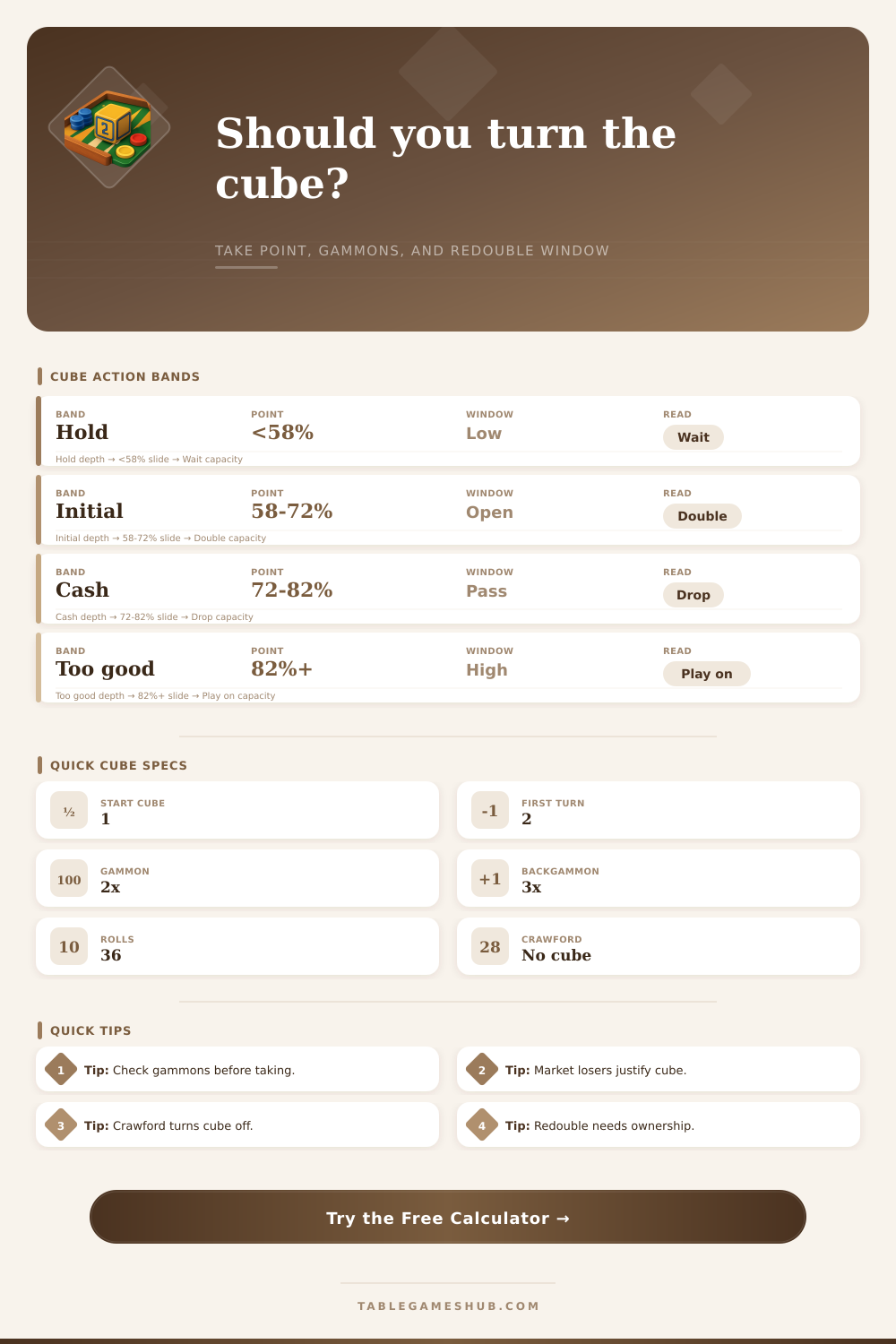
Assess cube value, match score pressure, take point, gammon leverage, market losers, redouble window, and cash/drop recommendation from one position profile.
| Metric | Value | Formula | Interpretation |
|---|
| Position Type | Typical Volatility | Gammon Pressure | Cube Note |
|---|---|---|---|
| Pure race | Low to medium | Low | Cube decisions rely heavily on pip-count efficiency. |
| Contact position | Medium | Medium | Market losers matter when shots or anchors can vanish. |
| Prime position | Medium-high | Medium | Timing and trapped checkers widen the cube window. |
| Blitz position | High | High | Gammon wins can move a take into a pass quickly. |
| Back game | High | Mixed | The favorite may have many wins but also sharp reversals. |
| Cube State | Who Can Turn | Offered Value | Key Check |
|---|---|---|---|
| Centered at 1 | Either player | 2 | First double if market losers are meaningful. |
| Owned at 2 | Cube owner only | 4 | Redouble when equity and volatility both justify it. |
| Owned at 4 | Cube owner only | 8 | Match score can dominate ordinary take points. |
| Crawford | No player | Unavailable | Standard match rules disable cube action. |
| Post-Crawford | Trailing side often | Usually early | Cube access depends on match-away score. |
| Result Type | Cube Units | Model Treatment | Use In Calculator |
|---|---|---|---|
| Single win | 1x cube | Base game result | Sets the main cubeless equity line. |
| Gammon win | 2x cube | Single plus one extra unit | Raises gammon value and pass pressure. |
| Backgammon win | 3x cube | Single plus two extra units | Included as a rare but high-leverage result. |
| Dropped cube | Current cube | Opponent declines offered cube | Used as the comparison line for take point. |
| Match Score Pattern | Cube Effect | Gammon Value | Practical Read |
|---|---|---|---|
| Even score | Close to money cube | Balanced | Use normal take point with modest match adjustment. |
| Leader holding edge | Pass point may rise | Lower for leader | Leader avoids giving efficient recube access. |
| Trailer behind | Cube can be urgent | Higher for trailer | Trailer often values volatility and gammons. |
| Opponent one-away | Cube may be dead or limited | Score-specific | Check Crawford and post-Crawford state first. |
Separate wins from gammons
A 68% win chance can be a take in a quiet race but a pass in a blitz if many wins are gammons. Always enter the conditional gammon rates before reading the action.
Use market losers as timing evidence
If many next rolls jump beyond the cash point, the position can lose its market quickly. Low market-loser counts usually support waiting for clearer equity.
The doubling cube is a critical component of backgammon strategy, and most player encounter the doubling cube during there first backgammon match. Even if you are playing a quiet holding game, the opposing player may use the doubling cube to double or even triple the value of the match with one turn. As with many tool in backgammon, the doubling cube is more complex than simple pip counting.
You need to have a way to test your instincts with the doubling cube so that you can make better in-game decisions with the doubling cube. There are several input that you will want to understand when using the doubling cube calculator. These inputs are the length of the match, the score, the value of the doubling cube ownership, the position type on the board, and the rate at which the player can win gammons or backgammons.
How to Use the Doubling Cube in Backgammon
All of these will have an influence on your decision to turn in the doubling cube or not to turn in the doubling cube. The calculator will do the math for you once you have entered all the variable. It will save you from having to guess at coefficients or other mathematical conversions for the doubling cube.
The calculator will compare the equity of your position if there is no doubling cube to the offered doubling cube value. It will factor in the value of the recube to show you the adjusted take point for the match score. Finally, it will provide an estimate of how many of the next roll will allow you to pass the cash point on the doubling cube.
Many backgammon players have learned how to use the doubling cube by making mistake. The most common mistake is to offer the doubling cube too early in the game. Often, players treat the doubling cube as a means of creating equity in their position rather than a tool for timing their turn to use the doubling cube.
In a low-volatility position, players can afford to wait to turn in the doubling cube. In a contact position, a single die roll can create an opportunity for the opponent to take the doubling cube. The market-loser count provides information for players about how many roll will create a position where the player with the doubling cube gain extra value by turning in the doubling cube now rather than later in the game.
The score has an influence on the doubling cube, but many backgammon beginners dont pay much attention to the score. A trailer who is four away from winning the match may feel more pressure to create a swing in their favor than the leader who is two away from winning the match. Although the calculator accounts for this through the score inputs for the players, the player must use some judgment to decide if the opponent will have recube access after they take the doubling cube from the opponent with the dice.
If the player with the doubling cube after the take, it is justifiable for the player to take the doubling cube even in a marginal position. The reference table for the doubling cube shows information about how different type of positions on the backgammon board will create swings in the doubling cube. A prime position will create more swings with the doubling cube than a pure race on the board.
A pure race will offer more volatility in the doubling cube because fewer rolls are required to change the outcome of the match. Back games will create more volatility in the doubling cube than a front game even with a larger win percentage because the player with the back game can lose it very easily. Mistakes with the doubling cube is common in two areas.
One is the player’s valuation of their win percentage. This can occur due to not accounting for the chance of winning gammons or backgammons. Another mistake with the doubling cube is using it as a weapon that should be used in every instance when the player feel they have an edge in a match.
These mistakes will become less common with time as the backgammon player learns how to value their win percentage as a weighted result that includes their chance of winning both gammons and backgammons. Some factor in a real match will not be accounted for by the doubling cube calculator. For instance, the player’s level of fatigue will influence how accurately they can evaluate take points for the match.
As the game goes on and the player begins to fatigue, their ability to accurately evaluate the doubling cube will dwindle. Another factor that can impact the game is the table image of the opponent. If the opponent is aware of the player’s doubling cube tendencies, they may respond differently to the player’s doubling cube decisions.
The variance of the physical dice cannot be accounted for in any calculation. Finally, despite the player’s ability to calculate the best decision with the doubling cube, the decision always belongs to the player who makes the decision with the clock. The most useful habit for backgammon players is to run the numbers after the match rather than during the match.
By running the numbers after the match, backgammon players train their intuitions about the doubling cube without disrupting their live play of the match. Over time, the model that is set up with the doubling cube and your intuitions will converge on the same questions. You will begin to notice positions that have more market losers than the win percentage suggest.
Additionally, you will begin to notice positions where the match score has shifted the take point for the match. At this point, the player will no longer find the doubling cube to be a mysterious component of backgammon but one that can be used to their advantage.