⛳ Golf Peoria System Calculator
Turn hidden-hole scores into a Peoria handicap allowance, capped net score, six-hole audit, and blind Peoria variant comparison for outing scoreboards.
| Measure | Value | Formula | Read |
|---|
| Peoria method | Hidden-hole sample | Multiplier | Handicap factor |
|---|---|---|---|
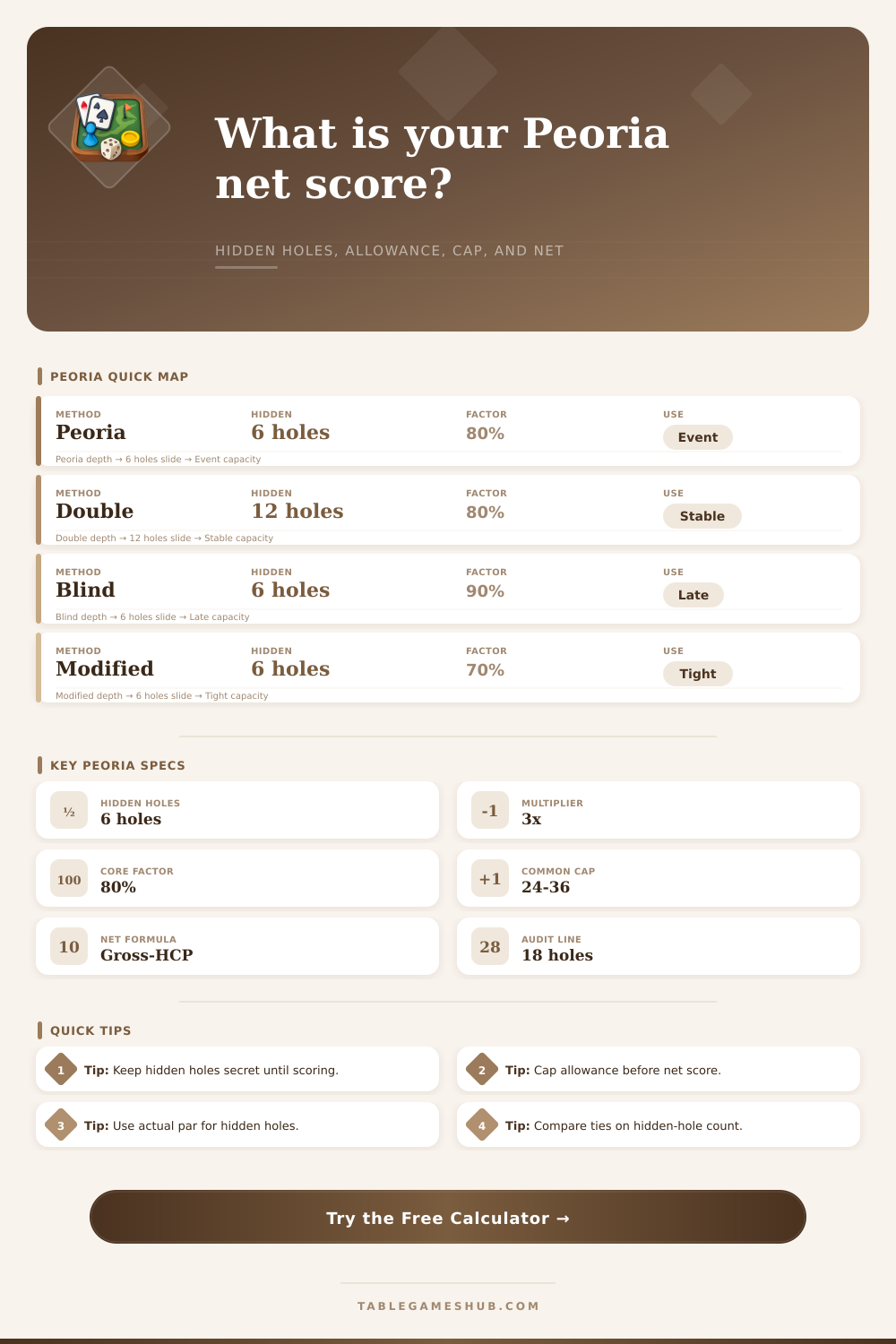
| Standard Peoria | Six holes, usually mixed par values | 3.0x | 80 percent of projected over-par strokes |
| Blind Peoria | Six holes revealed after play | 3.0x | 80 to 90 percent, set by event committee |
| Double Peoria | Twelve hidden holes for less sample swing | 1.5x | 80 percent is common for full rounds |
| Nine-hole Peoria | Three hidden holes on a nine-hole card | 3.0x | Often 80 percent with a lower cap |
| Formula step | Calculation | Example | Scoreboard meaning |
|---|---|---|---|
| Hidden score total | Add capped scores on selected holes | 34 strokes | The player score on the secret sample. |
| Hidden par total | Add par values for the same holes | 26 strokes | The baseline for the selected sample. |
| Projected spread | (Hidden score minus hidden par) times multiplier | 8 times 3 = 24 | Estimated strokes over par across the round. |
| Peoria allowance | Projected spread times handicap factor, then cap | 24 times 80% = 19.2 | The handicap amount subtracted from gross. |
| Hidden-hole mix | Typical count | Why it matters | Calculator field |
|---|---|---|---|
| Balanced full-round mix | Two front, four back or three and three | Prevents one side from over-shaping the sample. | Hidden hole numbers |
| Par-value mix | Include par 3, par 4, and par 5 holes | Par total determines the hidden-hole over-par spread. | Par values for hidden holes |
| Difficulty spread | Avoid only hardest holes | Extreme samples create unstable projected allowances. | Hidden scores and cap |
| Double sample | Twelve hidden holes | More holes reduce the luck of a small sample. | Format and multiplier |
| Comparison item | Standard Peoria | Blind Peoria | Double Peoria |
|---|---|---|---|
| Reveal timing | Can be known by scoring staff | Announced after scorecards | Usually preselected internally |
| Sample size | Six holes | Six holes | Twelve holes |
| Variance | Medium | Medium to high | Lower |
| Best use | General outings | Casual events with varied skill | Larger fields needing steadier net scores |
Choose hidden holes before scoring
For a clean Peoria event, select the secret holes before any scorecard review and reveal them only after the cards are submitted.
Audit par values carefully
The allowance depends on score over par, not score alone. A wrong hidden-hole par line can shift every net result.
The Peoria system is a method of creating a handicap for golf outings. The Peoria system allow for players of different skill level to compete against each other more fairly. The system selects a small number of holes to serve as a sample of the player’s skill on the course.
These holes are referred to as the hidden holes because the players dont know which holes will be used to calculate the player’s handicap. After the players complete their rounds of golf, the scores on these hidden holes are used to calculate what score the player would have had for the full round of 18 holes. The difference between the player’s gross score and this calculated score is referred to as the allowance.
How the Peoria System Works
The organizer subtracts the allowance from the player’s gross score to determine their net score. The calculator on this page will calculate each of these components for you. To use the calculator, you will need to enter each player’s score on each of the hidden holes, and the par for each of those holes.
The advantages of the Peoria system is that it does not require collecting handicap indexes from each of the players. Many organizers prefer the Peoria system because it is simple to implement, and because the organizer does not have to announce in advance which holes will be the hidden holes. If the organizer announces the hidden holes after the players have submitted their scores, this is referred to as a blind Peoria system.
Organizers often prefer the blind Peoria system because it prevents the players from changing their play on certain holes to improve their handicap. When selecting the hidden holes, organizers are encouraged to use a variety of holes that include each of the different types of par values, and to ensure that the holes include both the front nine and back nine of the course. Using a variety of holes of different types and difficulties will allow the organizer to more accurately calculate each player’s skill level.
There are several inputs that must be made within the calculator to determine each player’s allowance. Each of these inputs can impact the player’s calculated allowance. One input that must be made is the player’s score on each of the hidden holes.
Each player’s score can be used to calculate the player’s over-par spread. That over-par spread will be multiplied by a specific number to determine the projected total for the round. For example, if six holes are used for the hidden round, the calculator will multiply the calculated total by three because three times six is eighteen.
Another calculation that is performed is the calculation of the player’s handicap factor. The handicap factor is often eighty percent. Additionally, a cap is applied to the player’s projected total.
This cap will prevent the player’s allowance from being too high. Both the handicap factor and the cap can be adjusted on this page, and adjusting these two factors will impact the calculated net scores for the players. The selection of the holes for the players to use for the calculation of the players’ allowances is an important part of the system.
Using certain holes instead of others may significantly impact the final calculation of each player’s allowance. For instance, if only par three holes are used for the hidden round, the calculated allowance may not accurately reflect the player’s skills on the full course. Similarly, if only the most difficult holes on the course are used for the hidden round, the calculated allowance may be too high for that player.
To avoid these scenarios, a variety of holes can be used for the hidden round. For example, two par three holes, three par four holes, and one par five hole may be used for the hidden round. This type of mix will ensure that the calculation of each player’s allowance is steady and reliable.
In addition to using only six hidden holes for each player, there is also a variation of the system that uses twelve hidden holes. Using twelve hidden holes means that the multiplier will be one point five because twelve times one point five is eighteen. This version of the system is referred to as the Double Peoria system.
Some organizers use the Double Peoria system if they have a large number of players at the course, or if there are significant gaps in skill among the players. In the calculator on this page, you can switch between the single Peoria system and the Double Peoria system. When you switch between systems, the calculator will automatically calculate each player’s new allowance.
Nine-hole golf outings can use a variation of the Peoria system as well. In nine-hole games, three hidden holes are used. For these three holes, the multiplier will be three because three times three is nine.
Additionally, a lower cap will be used for nine-hole games. Otherwise, the principle is the same for nine-hole games as there is for eighteen-hole games. Players on nine-hole courses will recieve a net score from this system.
There are a few possible mistakes that can be made when using the calculator. One mistake that can be made is to believe that the scores on the hidden holes are the only scores that matter; the gross score for each player is still required. Another mistake that can be made is entering the wrong par for each of the hidden holes.
For instance, if a player enters the value of four for a par three, that player will have a higher over-par spread than they should have; that higher over-par spread will result in a higher allowance. The calculator will let the organizer know if there are any errors in the number of holes, gross scores, and pars. Correcting those errors will ensure that each player’s allowance is accurate.
The rule for rounding the calculated scores is another factor in the calculation that must be considered. Some organizers may desire to use whole numbers for the players’ scores, while others may want to use a decimal place. The calculator allows the organizer to set the number of decimal places for the scores.
That decimal place will be used after calculating the handicap factor and cap. The main advantage of using the Peoria system is that it allows the players to focus on the game of golf instead of the paperwork that goes along with each player having a handicap. The system allows the players to avoid worrying about their handicap or their skills on the course; the system accounts for the differences in skills.
Additionally, because the hidden sample of holes is used to calculate each player’s allowance, there is a balance between the system’s requirements and the natural variability of the game of golf. For instance, if two players have the same net score, there are tie-breaker options to decide the winner of the round. The system works for both casual games and formal golf championships.
Additionally, the calculator removes the need for players to perform any calculations themselves.