⛳ Golf Callaway System Calculator
Convert an 18-hole gross score into a Callaway handicap, net score, deduction ledger, adjustment-table result, and field rank helper.
| Measure | Value | Formula | Read |
|---|
| Gross score band | Worst-hole deduction | Adjustment cycle | Calculator treatment |
|---|---|---|---|
| 70 or lower | No worst-hole deduction | 0 | Scratch Callaway row; net equals gross unless alternate style is selected. |
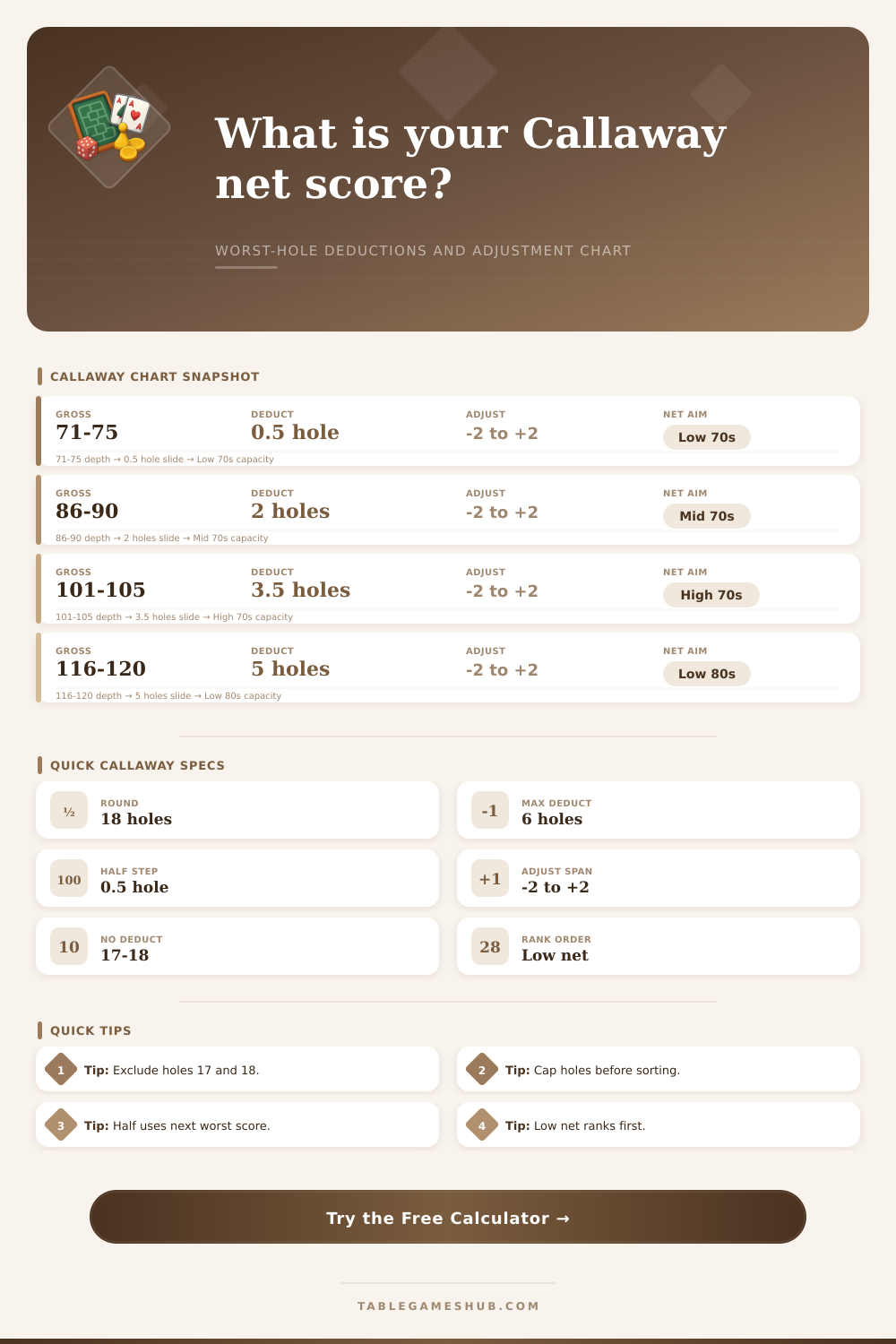
| 71 through 75 | One-half worst eligible hole | -2, -1, 0, +1, +2 | Half score is taken from the highest eligible capped hole. |
| 76 through 90 | One to two worst eligible holes | -2 to +2 per five-score band | Full holes are deducted first, then adjustment is applied. |
| 91 through 110 | Two and one-half to four holes | -2 to +2 per five-score band | The half-hole row uses the next highest score after full deductions. |
| 111 through 125 | Four and one-half to five and one-half holes | -2 to +2 per five-score band | Large gross scores receive deeper deduction lists before net ranking. |
| 126 or higher | Six worst eligible holes | +2 in this calculator | Six-hole ceiling prevents the handicap from expanding without limit. |
| Deduction rule | Default setting | Why it matters | Audit signal |
|---|---|---|---|
| Exclude final holes | Holes 17 and 18 excluded | Common Callaway cards protect the closing holes from deduction selection. | Audit grid marks those holes as not eligible. |
| Cap at double par | Enabled | Very high single-hole scores should not dominate the handicap calculation. | Capped score column shows the value used for sorting. |
| Half-hole row | Exact half | A half deduction needs the next worst eligible hole after full holes are chosen. | Breakdown shows the half-hole contribution separately. |
| Adjustment table | Classic cycle | The chart adds or subtracts two, one, zero, one, or two from the deduction. | Adjustment card shows the signed value. |
| Chart style | Best use | Adjustment handling | Net-score effect |
|---|---|---|---|
| Classic 71-125 chart | Most Callaway score sheets | Uses the standard five-score adjustment cycle. | Net reflects deduction total plus signed adjustment. |
| Conservative adjustment floor | Events wanting less generous outcomes | Negative adjustments are set to zero. | Higher net scores for low end of each band. |
| Scratch through gross 70 | Low gross rounds | Gross 70 or lower receives no Callaway help. | Prevents low rounds from gaining deductions. |
| Deduction only | Simple manual audit | Adjustment table is ignored. | Net equals gross minus capped hole deductions only. |
| Tie helper | Compared segment | Lower value means | Calculator note |
|---|---|---|---|
| Back-nine gross | Holes 10 through 18 | Better closing nine | Useful when two players finish with the same net score. |
| Last-six gross | Holes 13 through 18 | Better closing stretch | Shows a narrower segment after the back-nine check. |
| Last-three gross | Holes 16 through 18 | Better final three holes | Works as a compact scorecard playoff helper. |
| Net score only | No secondary segment | Shared rank remains tied | Use when the event does not break equal net scores. |
Check eligibility before sorting
Callaway deductions should be selected from eligible holes only. If your event excludes holes 17 and 18, remove them before choosing the worst holes.
Audit caps before final net
Caps change the deduction list when one large hole appears on the card. The grid shows raw score, cap, eligibility, and selection status together.
The Callaway system is a method that helps to calculate a player’s net golf score from there gross golf score. A player’s gross golf score is there actual score for the round of golf. However, the Callaway system calculates a player’s net golf score in a way that allows for players of any skill level to compete against each other in a round of golf.
The Callaway system calculates a player’s net golf score by first finding their worst holes on their scorecard and subtracting those hole from their gross score. Additionally, the Callaway system can make a small adjustment to that score to ensure that it is balanced. The logic behind the Callaway system is that a high score for a player usually indicate that the player had several hole that were difficult to play during the round of golf.
How to Calculate a Callaway Net Score
Therefore, by removing a certain number of hole from a player’s score, the system ensures that a difficult hole does not contribute to a high gross score. Additionally, the number of hole that are removed from a player’s score increases with the player’s gross score. This prevents the net golf score from being too high or too low for the player.
This scoring system aims to even out the net golf score of each player for the round of golf that was played. In order for the Callaway system to work, the group of golfers that are playing must establish certain rules. For instance, many groups of golfers choose to exclude the final two hole of a round as candidates for being the worst holes.
Golfers often do this because the final two holes are played under the most pressure during the round of golf. Additionally, many groups of players also establish a cap on the individual score for each hole. Such a cap is necessary because a single high score on one of the players holes could significantly even out their gross score.
In the case that the number of holes that are deducted from a player’s gross score comes in a fraction (or half-hole), the system will remove one of the worst holes and half of the value of the next worst hole. Half-hole deductions are used to ensure that there are no wide gap between players with scores that are otherwise similar to each other. A player can choose to calculate the half-hole to the exact score or to round it.
However, rounding the half-hole will only change the decimal portion of the player’s score. Another component of the Callaway system is the adjustment that is made to a player’s score after the deduction of their worst holes. This adjustment ensures that the player’s net score does not deviate too much from their gross score.
The adjustment even out players’ scores to ensure that no player scores significantly more or less than others within a given round. This adjustment will even out to between minus two strokes and plus two strokes. The player’s gross score and the number of strokes that they score within five-stroke groups determines this adjustment.
The adjustment does not account for the skill level of a player or the score of the round but ensures that the player’s net score does not sit on the edge of the deduction. Once the players calculate the net score of each player in a round of golf, the players can rank each player according to their net score. The player with the lowest net score wins the round.
If there are ties in the net score among players, a tiebreaker will be used to determine the winner of the round. Some groups use the gross score for the back nine as a tiebreaker. Others use the gross score for the last six holes or the last three hole.
A tiebreaker will not impact the calculation of the players’ net scores but will help to rank the players with the same score. The Callaway system is a practical scoring system for a round of golf because it requires little equipment to operate. All that is required is a scorecard and a calculation chart to calculate a player’s net score.
Additionally, many groups of golfers popularly use the Callaway system because it is easy to use. Furthermore, the system is applicable to different types of golf courses. This is because the Callaway system is based off the gross score for each player.
A player could use the same Callaway system chart on a course with a par of seventy as on a par of seventy-two. Despite the benefits of the Callaway system, there are some limits to the system that a player should be aware of. For example, the Callaway system is specifically designed for players on an 18-hole round of golf.
Therefore, a player who plays a round of golf that has fewer than 18 holes may find that the Callaway system is not as fair for that player. Additionally, the system may not account for a player’s skill level in that a player with a high skill level and consistent game may score a net score that is similar to a player with a low handicap who had a bad hole. Some of the most common mistakes with the Callaway system include either excluding too many holes as the worst holes or the player forgetting to use the cap for a player’s hole score.
If a player excludes too many of the worst holes, their handicap may be significantly more higher than the handicap that the Callaway system calculated for them. Additionally, if the player forgets to use the cap for one of the player’s hole scores, then the player may have a high gross score that does not even out their net score. To avoid these mistakes, players must run the numbers through the Callaway system every time that they play a round of golf.
In order to calculate a player’s net score, the calculator will take the player’s gross score, their individual hole scores, and the rules of the Callaway system. The calculator will use the player’s chosen cap score for each individual hole and will use the player’s gross score to determine which holes are the worst. Additionally, the calculator will make the adjustment to the player’s score and will place the player’s net score in a list of net scores for the players who participated in the round of golf.
This list will display the rank of each player. Using a calculator will ensure that a player does not make a mistake in setting up the Callaway system. The reference tables on this page allow a player to verify the net scores that the calculator calculates for each player.
The Callaway system rewards players for certain types of golf scores. For example, a player should avoid having a few holes that are very high in score because the Callaway system will even out those holes from the player’s gross score. A player should also care for the final few holes of a round of golf because many groups of players do not allow for the worst holes to include the final few holes.
Additionally, a player should be aware of which holes are used to break ties for players who have the same net score because the player does not want to be surprised as to why the player did not win the round of golf with their teammates. Even though the Callaway system is not a replacement for a player’s handicap, the Callaway system will work to calculate a player’s net score for that round of golf.