Dice Notation Parser Calculator
Parse XdY+Z notation, multiple dice terms, keep/drop suffixes, flat modifiers, exact averages, variance, target odds, and distribution tables.
| Total | Probability | At Most | At Least | Visual Share |
|---|---|---|---|---|
| Parse a notation to see its distribution. | ||||
| Pattern | Meaning | Valid example | Parser note |
|---|---|---|---|
| dY | One die with Y sides | d20 | Same as 1d20 |
| XdY | X dice summed | 3d6 | All dice are kept |
| XdY+Z | Dice plus flat modifier | 2d8+4 | Use -Z to subtract |
| XdYkhK | Keep highest K dice | 2d20kh1 | Advantage-style rolls |
| XdYklK | Keep lowest K dice | 2d20kl1 | Disadvantage-style rolls |
| XdYdhK | Drop highest K dice | 5d6dh1 | K must be below X |
| XdYdlK | Drop lowest K dice | 4d6dl1 | Classic ability roll |
| Notation | Typical table use | Minimum to maximum | Average before targets |
|---|---|---|---|
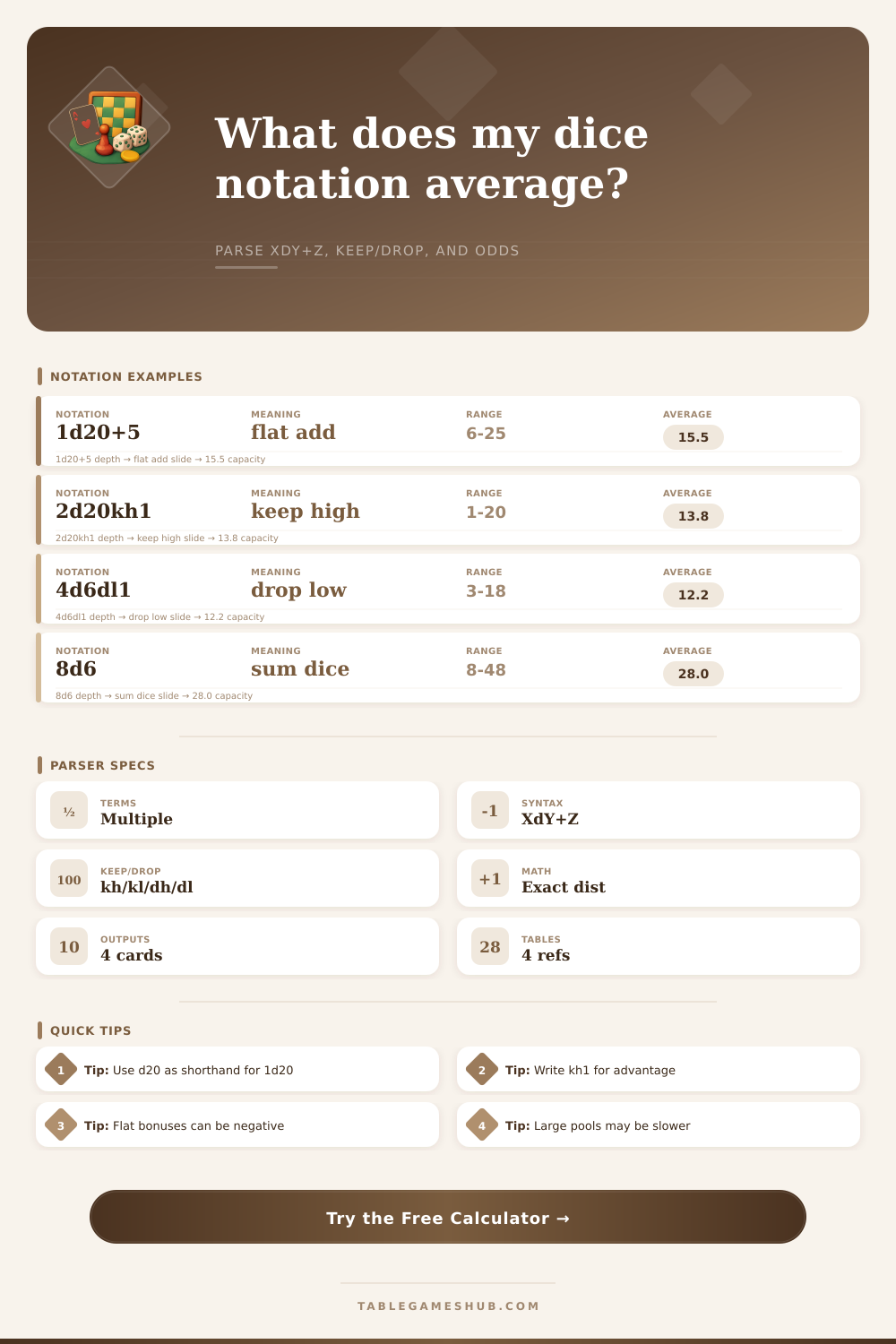
| 1d20+5 | Single d20 check with modifier | 6 to 25 | 15.50 |
| 2d20kh1+5 | Advantage check with modifier | 6 to 25 | 18.82 |
| 2d20kl1+5 | Disadvantage check with modifier | 6 to 25 | 12.18 |
| 4d6dl1 | Drop-low ability generation | 3 to 18 | 12.24 |
| 8d6 | Large pool damage total | 8 to 48 | 28.00 |
| 1d20+1d4+2 | Main die plus bonus die | 4 to 26 | 15.00 |
| Check | Allowed range | Warning trigger | Why it matters |
|---|---|---|---|
| Dice per term | 1 to 10 | More than 10 | Prevents heavy exact states |
| Sides per die | 2 to 100 | Outside range | Keeps totals meaningful |
| Terms per notation | 1 to 12 | More than 12 | Keeps the breakdown readable |
| Keep/drop count | Within dice count | Invalid K value | A term cannot drop all dice |
| Distribution buckets | Up to 3000 | Large output | Tables become hard to scan |
| Mode | Question answered | Example | Probability included |
|---|---|---|---|
| Exactly | How often is the total equal? | Exactly 15 | Only total 15 |
| At least | How often do I meet or beat? | 15 or higher | 15 through max |
| At most | How often do I stay under? | 15 or lower | Min through 15 |
| Between | How often inside a band? | 12 through 18 | Both ends included |
Dice notation represent the number of dice to roll and the number of sides of those dice. A notation parser translate this representation into a mathematical distribution of the possible results of a games dice rolls. A notation parser allow the user to understand the probability of the outcomes of a games dice rolls as the notation parser calculate the likelihood of each possible total.
It is more efficient to use the notation parser than to manually roll a games dice numerous times. A notation parser allow the user to understand the difference between a games standard dice roll and a roll with special rules. A roll of a single d20 is a standard roll.
How a Dice Notation Parser Works
However, rolling a d20 with advantage is a different roll with a different distribution of outcomes. For instance, introducing rules such as a keep-highest rule will change the frequency distribution of the outcomes of the rolls. The notation parser can display these different frequency distributions to give the players a clear understanding of how the special rules will mathematicaly change the games outcomes.
Keep and drop rules is examples of special rules for dice rolls. For instance, dropping the lowest die from a pool of four d6 die will raise the average roll total and will make extremely low rolls less common. Similarly, keeping only the highest die from a pool of two d20 die will raise the average roll total and will make rolls in the middle of the distribution more common.
The notation parser can display both the new average roll total and the new distribution of the rolls created by these keep-drop rules. The variance of a dice roll is a mathematical concept that measure how spread out the outcomes of the roll are from the average roll. Two different dice notations can have the same average roll total but have a different variance.
For instance, one roll distribution might have a high variance and spread out over a wide range of numbers, while another distribution might have a lower variance and remain closer to the average number. High variance can be considered a risk in game play, whereas low variance is more easy relied upon. A notation parser can display the variance of a games dice roll.
The target probabilities of a games dice roll can be used to answer specific questions about the roll. For instance, target probabilities can be used to find the chance of rolling a total of a games dice “at least” a certain number, or “between” two numbers. Changing the target mode of a games dice roll will change the information provided by the dice notation.
A notation parser allow players to easily change the target mode of the dice notation. If a games dice notation has two terms, such as d4+d20, the notation parser calculate the distribution of the two groups of dice separately and combines the two distributions. Each term in a dice notation is a distribution of values, and the notation parser find the distribution of the individual dice rolls to create a final distribution.
Adding an extra die to a games roll will widen the distribution of possible totals of that games roll. Additionally, adding one or more dice will raise the minimum total that the game can roll. Using a notation parser eliminate the need to guess how the individual terms of a games dice notation will interact with each other.
A notation parser also contain warning systems that alert players when the distribution of the roll may become too long to read or too extensive to be of use. Using large pools of dice may create a distribution that is too long to be of use. The warning system alert the player when using unusually large pools of dice for a games dice notation or when using keep-drop rules that may eliminate all of the dice in a pool.
Such a warning system ensures that the players remains within the parameters of a usable game and that the information that is displayed remains easy to use for the player. Through playing games with a notation parser regularly, the player can develop an intuitive understanding of how the notation works. For instance, the player can learn that flat bonuses to a games dice roll will shift each possible total of the roll by that same number, but keep-drop rules will shift the shape of the distribution of possible rolls.
The notation parser allow for players to compare different notations of dice rolls to see the differences between them. By comparing the individual rolls of a games dice notation, a player can learn about the differences between them quickly. Additionally, by using the same dice notation and changing the target probabilities, a player can identify the reliability of a games notation.
Playing games with a notation parser will eventually allow a player to understand the implications of a games notation on the rolls without having to manually calculate the numbers involved.