🎲 Fate Fudge Dice Probability Calculator
Exact Fate/Fudge dice odds for 4dF rolls, skill ladder ratings, opposition, invokes, target shifts, and success with style.
| Dice Result | Ways | Probability | Final Shifts | Outcome Band |
|---|---|---|---|---|
| Calculate to fill the exact distribution. | ||||
| Needed Shifts | Dice Roll Needed | Success Odds | Style Odds | Use Case |
|---|---|---|---|---|
| Calculate to compare common target shifts. | ||||
| Rating | Ladder Name | Typical Opposition | 4dF vs Equal |
|---|---|---|---|
| -2 | Terrible | Serious flaw or impaired approach | 61.7% at 1 shift when equal with +1 target |
| -1 | Poor | Weak skill or minor obstacle | 61.7% at 1 shift when equal with +1 target |
| 0 | Mediocre | Default untrained action | 61.7% at 1 shift when equal with +1 target |
| 1 | Average | Routine trained attempt | 61.7% at 1 shift when equal with +1 target |
| 2 | Fair | Competent challenge | 61.7% at 1 shift when equal with +1 target |
| 3 | Good | Notable professional difficulty | 61.7% at 1 shift when equal with +1 target |
| 4 | Great | Strong named opposition | 61.7% at 1 shift when equal with +1 target |
| 5 | Superb | Major scene obstacle | 61.7% at 1 shift when equal with +1 target |
| 6 | Fantastic | Exceptional specialist challenge | 61.7% at 1 shift when equal with +1 target |
| 7 | Epic | Campaign-level pressure | 61.7% at 1 shift when equal with +1 target |
| 8 | Legendary | Mythic or peak tier opposition | 61.7% at 1 shift when equal with +1 target |
| Final Shifts | Fate Result | Calculator Meaning | Aspect Note |
|---|---|---|---|
| Less than 0 | Fail | Actor total is below the opposition or target. | Consider a cost, concession, or different approach. |
| 0 | Tie | Actor total equals the opposition or difficulty. | Often means a minor cost or temporary boost. |
| 1 to 2 | Succeed | Actor clears the target but not the style gap. | Invoke only if the extra shifts matter. |
| 3+ | Succeed with style | Actor clears the target by the style threshold. | Great place for a boost or stronger effect. |
| Scenario | Skill vs Opposition | Invoke Plan | Target Shifts | Why It Matters |
|---|---|---|---|---|
| Careful overcome | Fair vs Average | No invoke | 1 | Shows the baseline edge from a +1 rating advantage. |
| Attack exchange | Good vs Great | One invoke | 1 | Tests whether spending an aspect turns a hard attack around. |
| Create advantage | Average vs Fair | Free +2 tag | 0 | Checks at-least-tie odds when a boost is enough. |
| Big style push | Great vs Fair | Two invokes | 3 | Models a dramatic roll that needs extra shifts, not just success. |
| Desperate defense | Average vs Superb | Two invokes | 1 | Shows how much aspects can offset a steep ladder gap. |
| 4dF Roll | Combinations | Exact Chance | Cumulative At Least |
|---|---|---|---|
| -4 | 1 | 1.23% | 100.00% |
| -3 | 4 | 4.94% | 98.77% |
| -2 | 10 | 12.35% | 93.83% |
| -1 | 16 | 19.75% | 81.48% |
| 0 | 19 | 23.46% | 61.73% |
| +1 | 16 | 19.75% | 38.27% |
| +2 | 10 | 12.35% | 18.52% |
| +3 | 4 | 4.94% | 6.17% |
| +4 | 1 | 1.23% | 1.23% |
Count the ladder gap first
A +2 skill edge is already strong because 4dF clusters around zero. Spend invokes when the target shifts or style gap actually need them.
Use style odds for dramatic stakes
Success with style is not just a better success chance. It asks whether the roll clears the opposition by the style threshold, usually 3 shifts.
Fudge die faces
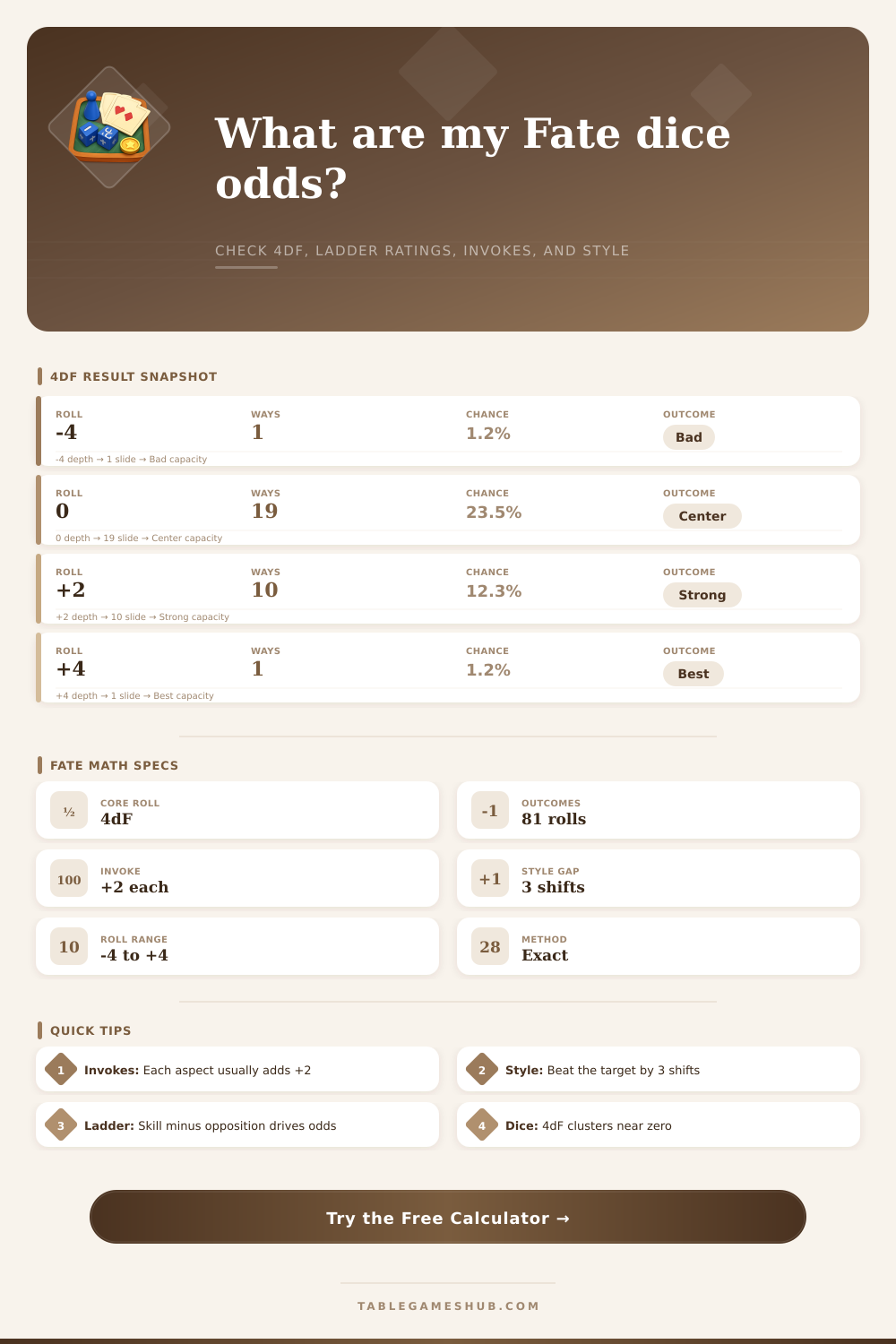
Each die has three equally likely faces: -1, 0, and +1. Standard Fate uses four of these dice.
Total shifts
Shifts equal dice roll plus skill and bonuses minus opposition. Target shifts set the success cutoff.
Invokes and aspects
Each paid invoke normally adds +2. Free invokes, boosts, stunts, and aid can be entered as extra bonuses.
Style threshold
Success with style usually requires clearing the target by at least 3 shifts, though the input can be changed.
The fate dice is made up of four dice, each of which can roll a value of minus one, zero, or plus one. Because there are three possible roll for each die, the four dice creates a bell curve distribution that is evened around the value of zero. Such a distribution creates the understanding that most roll will result in a number close to zero, which indicate that a roll with a single fate die will not often create significant change to the outcome of an action.
Additionally, small bonus to a characters skills will be more likely to create change in the outcome of an action with this distribution of possible rolls. Finally, the fact that most rolls will result in a middle value means that a character with an advantage in a particular skill will succeed without spending they resources on invokes. The calculator can be used to determine the probability of success for a roll of the fate dice.
How to Use the Fate Dice Calculator
To employ the calculator, you must input each of the variable for that roll into the calculator to determine the probabilities of success for that type of roll. Such variables include the skill ladder rating for the character, the opposition to that characters roll, the number of invoke to be used in that roll, and the shift that are to be achieved with that roll. The calculator will provide the probability of achieving those shifts for the roll, as well as the probability of achieving success with style for that roll.
Success with style is achieve when the shifts achieved by a roll are in excess of the basic shifts required to make the roll successful. Success with style allows the player to earn an extra benefit from the roll of the fate dice. Each of the variables for the calculator are used to calculate the shifts for an action.
Shifts can be calculated for all type of rolls with the fate dice, regardless of the type of action that is to be performed. The variables for each type of roll are the same, so the calculations is the same. However, the weight of the action may differ.
Regardless, it is recommended for players to calculate the shifts for the most likely form of opposition that will be encountered in a scene. Based off those calculations, a player and the gaming group can determine whether it is better to spend invokes or to take the risk of using only the roll of the fate dice to determine the outcome of the action. Additionally, the probabilities of success with style can be calculated and compared to the probability of success without style.
The skill rating is a relative skill that is calculated against the opposition. An opponent of average skill will be overcome by a character of great skill, but an opponent of superb skill may overcome a character of great skill. Additionally, although a character is likely to roll success on the fate dice with favorable modifier for themselves, it is still possible for the roll to result in a low score or a high score.
A low score indicates failure, but a high score indicate success with style. The fate dice will always have the same probabilities in any situation, but a player who understands those probabilities can better plan there action. By using the calculator to determine the probabilities of success for a roll, the gaming group can better prepare for game tensions.
While the math behind the game does not remove the drama from the game, the math does remove the guesswork of the outcome of a roll. The shared clarity of the gaming group before rolling the fate dice will allow the story to continue without interruption, and the players will better understand the outcome of the rolls.