Contract Rummy Score Calculator
Total the current round by contract, sets, runs, deadwood cards, joker penalties, drops, and running multi-player scores.
| Rank | Player | Contract | Round Points | New Total | Score Note |
|---|---|---|---|---|---|
| Calculate to update the scoreboard. | |||||
| Round | Typical Contract | Sets Required | Runs Required | Scoring Check |
|---|---|---|---|---|
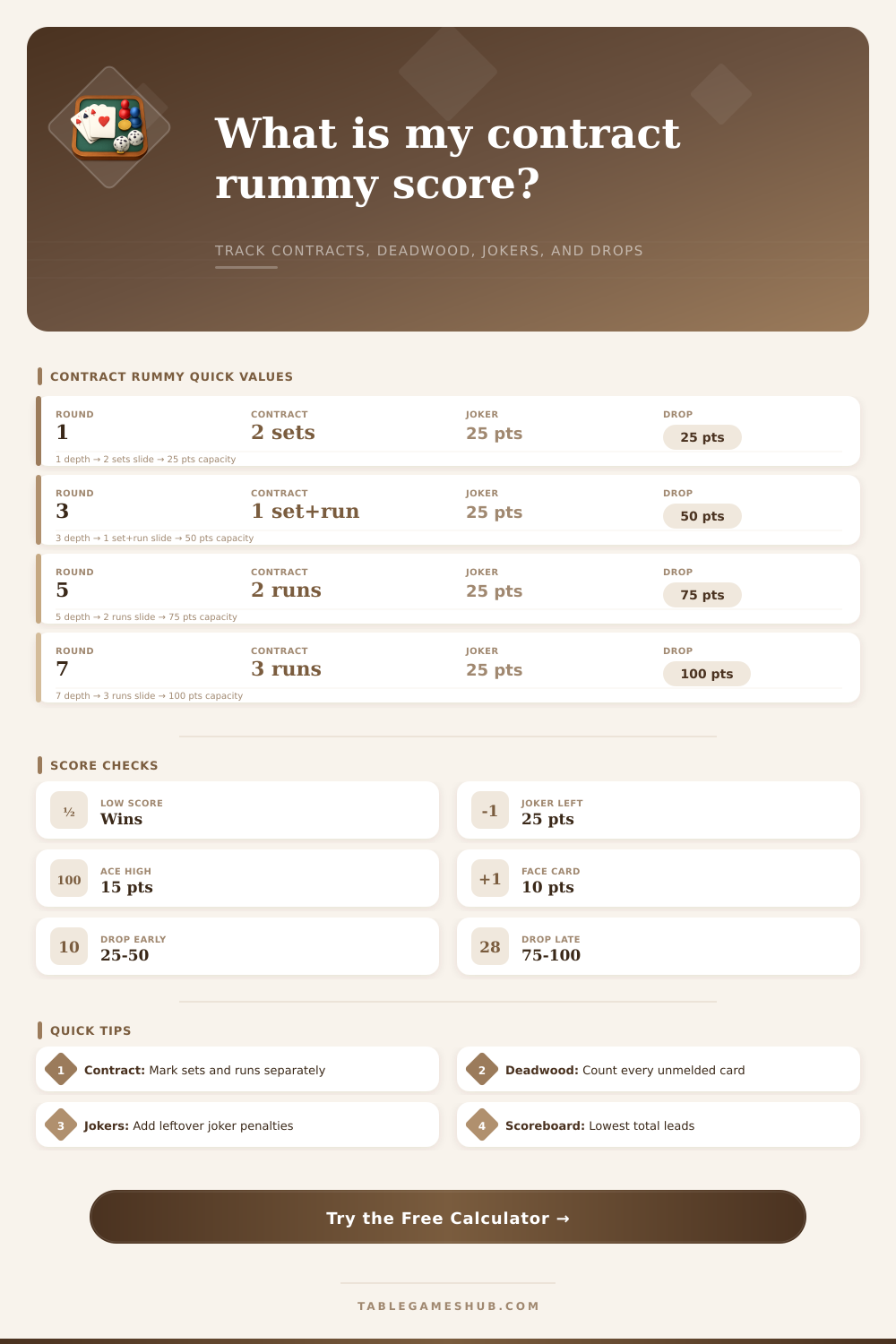
| 1 | Two sets | 2 | 0 | Both sets complete before going out |
| 2 | One set and one run | 1 | 1 | Separate set and sequence counts |
| 3 | Two sets and one run | 2 | 1 | Short contract adds selected penalty |
| 4 | Three sets | 3 | 0 | Jokers left count after deadwood |
| 5 | Two runs | 0 | 2 | Sequence-heavy round; watch gaps |
| 6 | One set and two runs | 1 | 2 | Most mixed scoring sheets use this late |
| 7 | Three runs | 0 | 3 | High deadwood swings final totals |
| Deadwood Card | Common Value | When to Add | Calculator Entry |
|---|---|---|---|
| 3 through 9 | 5 points each | Unmelded number cards | Add to deadwood field |
| 10, jack, queen, king | 10 points each | Unmelded face or ten cards | Add to deadwood field |
| Ace | 15 points each | Unmelded ace, unless house rule differs | Add to deadwood field |
| Joker or wild card | 15 to 50 points each | Jokers left outside completed melds | Use jokers left field |
| Drop penalty | 25 to 100 points | Player leaves or misses the hand | Select drop amount |
| Score Component | Input Used | Formula | Round Effect |
|---|---|---|---|
| Deadwood cards | Deadwood field | Card penalties already totaled | Adds penalty points |
| Leftover jokers | Jokers left field | Jokers x selected joker value | Adds wild-card penalty |
| Missing contract | Sets and runs made | If short, add selected penalty | Marks contract not complete |
| Drop penalty | Drop selector | Drop amount replaces contract check | Adds table-agreed drop amount |
| Went out | Player who went out | Subtract selected bonus, floor at zero | Rewards the hand winner |
| Running total | Prior score | Prior + adjusted round points | Lowest total ranks first |
Contract rummy is a card game in which a person must complete a specific contract in order to avoid penalties. A contract is a set of required combination of cards that a person must complete during their turn in contract rummy. If a person dont complete the contract, the person must count the value of the cards that they do not have as part of the contract.
These remaining cards are referred to as deadwood, and the value of a persons deadwood cards is scored into the player’s total score as penalties. Deadwood values include number cards that are of a value between three and nine, which is each worth five point, face cards that are worth ten points each, and aces that are worth fifteen points each. Additionally, if a person has a joker in their hand that is not part of a completed contract, that joker is also considered deadwood; jokers is worth twenty-five points or more depending on the established house rules for the game.
Keeping Score in Contract Rummy
Because deadwood values can be high for a player, it is important for each person to correctly count there deadwood cards. If a person should forget to count a single ace or joker in their deadwood, a person’s deadwood score will be incorrect; the same with their total score for the game. A calculator can assist a player in fulfilling the calculation for deadwood values.
A player may use a calculator to both enter the details for the contract for the game, as well as to enter the deadwood values for each player. By entering these variables, the calculator will perform the calculations for the player, thus eliminating the likelihood of making error in calculating the deadwood values in there heads. Using the calculator will ensure that the game owner knows the deadwood values for each player, as well as that the contract status is correctly recorded.
In contract rummy, there are certain instances in which players may “drop” out of the game. A drop is an instance in which a player exit the game prior to completing their contract, and incurs a penalty for dropping out of the game. For some houses and group of players, dropping out of the game incurs a small penalty for each player who drops out; other house rules assign large penalties for dropping out of the game.
Taking a drop may prevent players from accruing deadwood, but also prevents them from completing their contract. The calculator is one tool that helps a player decide whether dropping out of the game is a wise choice for that player by factoring in the drop amount for the player. The score for the game is calculated through the use of a running total score for each player.
A running total score accumulates the scores that each player incurs each round. Should one player accumulate a large number of deadwood penalties in one round, it is possible for them to catch up in later rounds if they accumulate small penalties with the later contracts. Conversely, should a player score small amount in each round, they can fall behind in the total game score if the difficulty of each contract increase.
The scoreboard for the game displays the total score for each player after each round of contract rummy. The scoreboard allows each player to understand how many points each player has scored into their total score, and how many points a player must earn to win the game. Some of the most common mistakes made while playing contract rummy are failing to combine the contract status of each player with their deadwood values.
For instance, a player may succeed in completing their contract but forget to score their deadwood values. In such a case, they will experience an inaccurate score for the round. Any bonus that is awarded to a player for successfully completing their contract will reduce their round score, but will not convert a loss of points into a gain in points for that round.
The calculator will prevent these common mistake by requiring each player to enter both the contract details for the round and the deadwood values of each player. The house rules for contract rummy may change how the game is played. For instance, the house rules may change the value of each ace, as may the value of a joker, or the bonus awarded to each player for completing their contract.
These house rules may differ between groups of players. Therefore, the house rules should of been established prior to beginning the game. By establishing the house rules for the game prior to play, there are no arguments regarding the scores of each player, and the players are all aware of the deadwood values and bonuses for the game.
The difficulty of the contracts change throughout the game. In the beginning of the game, the contracts assigned to each player are of relatively high difficulty with high penalties for each player; later contracts, however, are of increasing difficulty with higher penalties for each player if they are unable to successfully complete their contracts. A person who adjusts their level of risk as the difficulty of each contract increases will have a more steadier score throughout the game; a player who does not adjust their risk of accruing deadwood will experience their score for the game swinging wild.
The calculator allows for each group of players to have a shared record of the score for each player in contract rummy. This shared record of the contract status, deadwood counts, and total scores for each player remove the potential for disputes between the players. Additionally, by having such a shared record of each player’s score, each player can continue to play the game.