Ninepins Distance Calculator
Calculate foul-line distance, delivery path, lane width, target offset, and the 1-2-3-2-1 pin diamond for ninepins layouts.
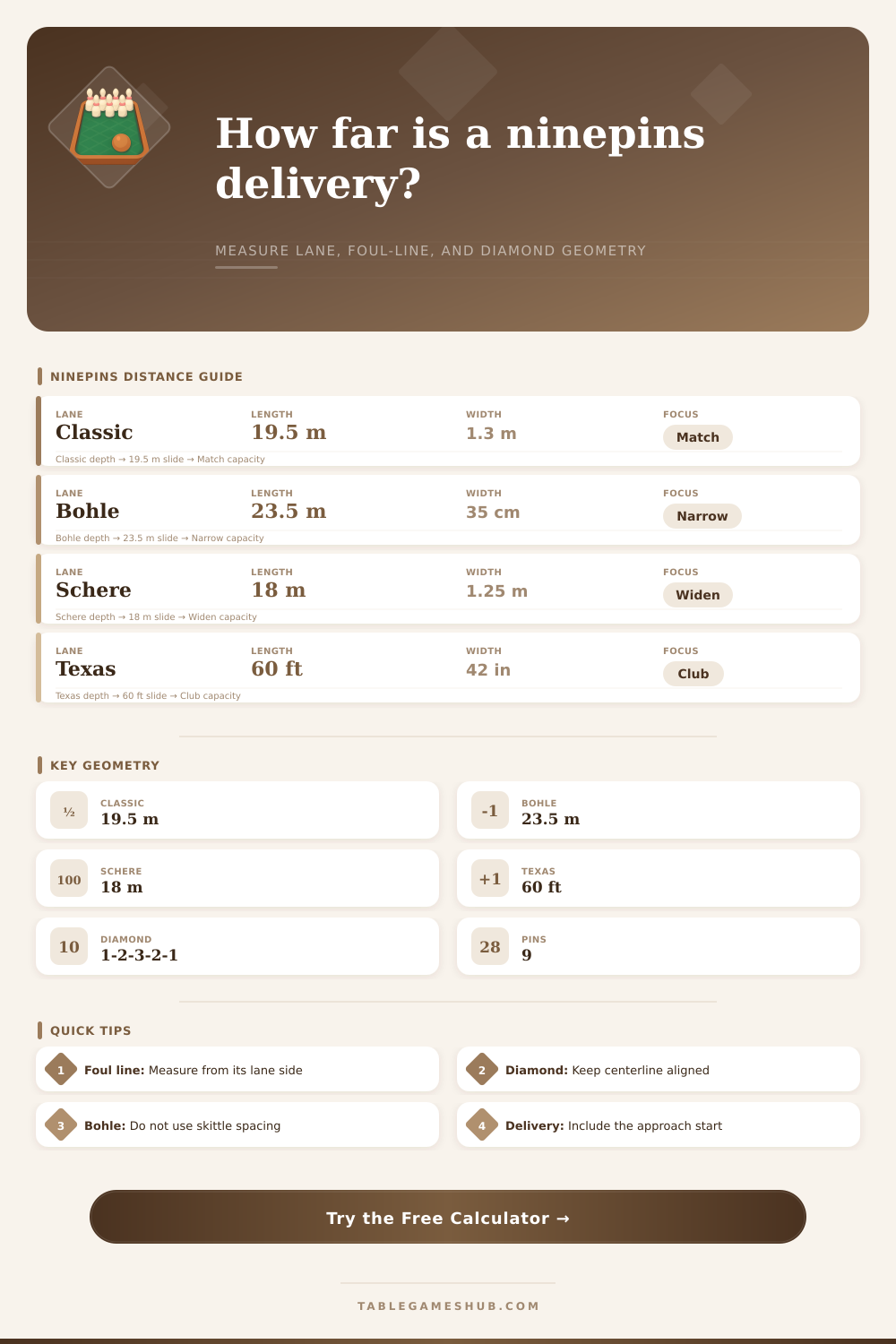
| Ninepins lane | Foul-line to pins | Width pattern | Calculator use |
|---|---|---|---|
| Classic / asphalt | 19.5 m reference run | Wide, even lane | Full match-distance planning |
| Bohle | 23.5 m reference run | Narrow concave strip | Long straight-line delivery checks |
| Schere | 18 m reference run | Narrow start, widening end | Target mark and widening checks |
| Texas ninepin | 60 ft bowling-lane reference | Tenpin-style lane width | Club halls using diamond pins |
| Pin diamond item | Geometry | Input to use | Why it matters |
|---|---|---|---|
| Front head pin | Centerline at lane end | Head-pin offset | Sets final contact point |
| Middle row | Three pins across | Pin spacing | Controls diamond width |
| King or red pin | Center of diamond | Centerline offsets | Checks alignment through the middle |
| Back pin row | Deepest diamond point | Back clearance | Confirms stop or pit space |
| Delivery check | Formula used | Good for | Result shown |
|---|---|---|---|
| Ball path | Lane distance plus lateral offset | Foul-line-to-pin travel | Result card 1 |
| Total delivery | Start distance plus ball path | Stance-to-contact planning | Result card 2 |
| Target segment | Release offset to target mark | Chalk gates and aiming boards | Breakdown row |
| Entry segment | Target mark to head pin | Final line into diamond | Breakdown row |
| Layout type | Distance basis | Pin arrangement | Do not confuse with |
|---|---|---|---|
| Ninepins classic | Foul line to 9-pin diamond | 1-2-3-2-1 diamond | Tenpin triangle layout |
| Ninepins Bohle | Long narrow lane run | Diamond at pin end | Backyard skittle rings |
| Ninepins Schere | Widening lane geometry | Diamond at wide end | Single-width mini alleys |
| Texas ninepin | Bowling lane length | Diamond with center pin | European small-ball lanes |
Ninepins requires an specific lane setup for teh game to function properly. Several factor go into setting up the lane for ninepins, including distance from the foul line to the pins, the width of the playing surface, and shape of the diamond. If a person make a mistake in these measurements, the game can be challenging to control.
To help with that, people can use a calculator to ensure that all the measurements is correct before setting up the lane for play. Several inputs is required for the calculator to perform the mathematics that will allow for a proper lane setup for ninepins. These inputs includes the lane family, the foul line distance, the usable width, and several offset value.
How to set up a ninepins lane
The foul-line distance is essential because it determine the length that the ball has to travel. The lane width determine the room that a player has for movement lateral on the lane. The approach depth and the delivery start value determine the total space that a player has behind the foul line for their approach.
If the values are too small, the space may feel too small for the player; if the values are large enough, the space will feel more comfortable for the player. Offset value are necessary because people do not always use a straight path to play ninepins. The release offset determine where the ball will leave the player hand.
The target mark offset show where a player aim the ball down the lane. The head pin offset allow the player to shift the point of contact on the ball to create an angle shot. Based off these three value, the calculator will calculate the target angle that the ball should travel.
A small target angle is easier to hit consistent, but a larger angle might be necessary to create a specific target drill. There is different types of lane families that allow ninepins to have different properties. Classic ninepins feature a wide playing surface and a foul-line distance to the pins that are standard for the game.
Bohle lane feature a narrow playing track so that the ball will hit the edge of the lane if it takes a lateral movement. Schere family use a narrow playing track at the start but create a wider track later on the lane. For this reason, the target mark that a player select must account for the extra space later on the playing lane.
Texas hall use the length of a tenpin lane but use the ninepin diamond at the end of the lane. This lane family feature properties of both games but require that people check the distances correctly. The pin diamond is consistent for all ninepins lanes because nine pins are always arranged in a 1-2-3-2-1 pattern.
The spacing between pins can vary, as well as the back clearance behind the last row of pins. If the pins are close together, more precision are required for the angle that the ball enter the lane. If there is extra space behind the pins, the ball will have more room to travel later on the lane.