Golf Club Head Speed Calculator for Driver Baselines
Estimate normalized head speed and compare session-to-session performance using strike quality, launch context, and weather-adjusted reference values.
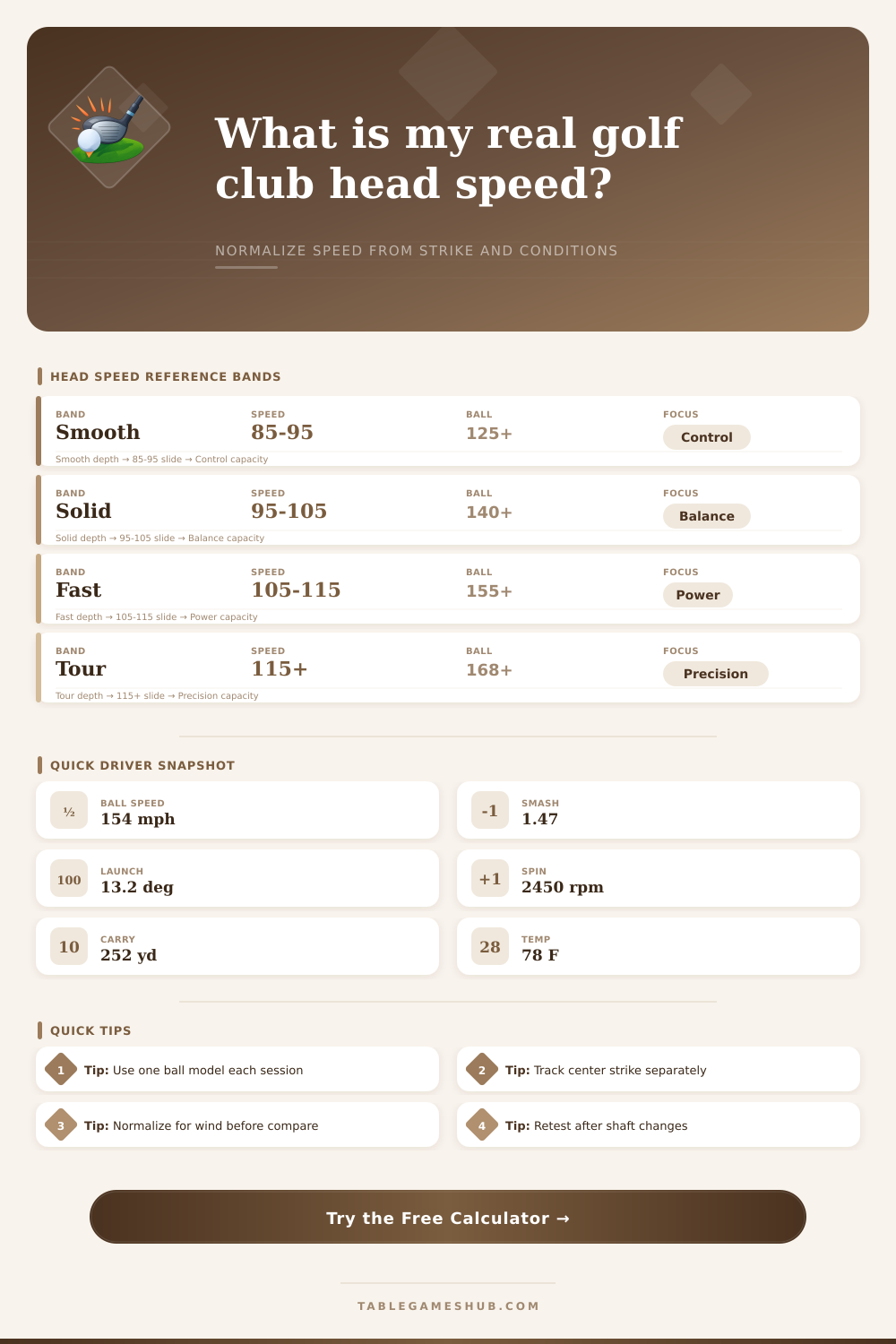
| Head Speed | Ball Speed Range | Carry Window | Priority |
|---|---|---|---|
| 85-95 mph | 125-138 mph | 195-225 yd | Center contact |
| 95-105 mph | 138-153 mph | 225-255 yd | Launch tune |
| 105-115 mph | 153-168 mph | 255-285 yd | Spin control |
| 115+ mph | 168+ mph | 285+ yd | Dispersion |
| Condition | Speed Impact | Carry Impact | Action |
|---|---|---|---|
| Low strike quality (<88%) | -2.0 to -4.5 mph | -8 to -20 yd | Face tape session |
| Launch below 10 deg | -0.8 mph eq | -6 to -12 yd | Loft adjust |
| Spin above 3000 rpm | -1.2 mph eq | -10 to -18 yd | Strike height tune |
| Spin below 1900 rpm | -0.4 mph eq | -4 to -9 yd | Stability check |
| Factor | Reference | Adjustment Rule | Typical Shift |
|---|---|---|---|
| Temperature | 70 F | 0.03 mph per F delta | +/-1.2 mph |
| Altitude | 0 ft | 0.0003 mph per foot | +0.9 at 3000 ft |
| Head/Tail wind | 0 mph | -0.07 mph per wind mph | -1.4 at 20 mph |
| Shaft length | 45.0 in | 0.45 mph per inch delta | +/-0.7 mph |
Club head speed are a measurement of how fast a golf club move when swung. Club head speed is a primary consideration in determining an amount of energy that is transferred from a golf club to a golf ball. While launch monitor may be used to measure the speed of the ball and the smash factor of the club shot, these measurements may not provide an accurate measurement of the club head speed of the golfer.
A golfer may be able to achieve high ball speed with a lucky strike on the toe of the club; however, this dont represent the club head speed of the individual. Various environmental and technical factor must be accounted for in order to arrive at an accurate measurement of club head speed. The quality with which a golfer strike the ball is one of the most important factors that must be accounted for in measuring club head speed.
How to Find Your True Club Head Speed
Club head speed is highest when a player hit the ball right in the center of the club. Should the ball be hit high or low on the club, the club head speed will be lower despite the speed of the club head. A player who consistently miss the center of the club will have a club head speed that is higher then the ball speed.
In order to calculate the true club head speed of a player, the strike quality must be accounted for. Other variables to account for include the launch angle of the club and the rate at which the ball begins to spin after being struck (backspin). The launch angle and backspin of the club determine how far the ball will travel and how far it will roll on the ground after traveling a certain distance through the air.
The optimal launch angle for a driver club is 13.5 degrees, and the optimal backspin rate are 2400 rpm. The environmental factors in which the ball travels after being struck can alter the club head speed that is calculated for a player. For instance, air temperature will impact the density of the air.
Cold air is denser than air that is warmed by the sun. The club head speed will be lower in cold environments as the ball will encounter more drag move through the air. Similarly, air density will alter at different altitudes from sea level.
At high altitudes, the air density are lower. Thus, club head speed will be higher at high altitudes. The third environmental factor is wind.
Headwinds will slow the ball and decrease the distance that it travels. To find a true club head speed, these environmental factor must be normalized. The technical factor of the length of the shaft of the club will alter the club head speed as well as the strike quality.
A longer shaft will allow the club head to travel at higher speeds due to the leverage create by the club. However, longer shafts will make it more difficult for the player to strike the ball in the center of the club. Thus, there is a trade-off between club head speed and strike quality.
A player who increase the length of their club shaft may experience an increase in club head speed; however, strike quality will decline. A balance between club head speed and strike quality must be maintain. The method for calculating a player’s normalized club head speed include four main steps.
The first step is to determine the raw club head speed of the player by dividing the ball speed by the smash factor. The second step is to account for strike quality. Third, the launch angle and backspin of the club must be accounted for.
Finally, the player must normalize the club head speed for the weather conditions in which the player hits the ball. Through these steps, a player can calculate their normalized club head speed. The normalized club head speed of a player can allow for the categorization of golfers into various groups.
Golfers with a club head speed below 95 mph should prioritize their club control skill. Golfers with a club head speed between 95 mph and 105 mph should focus on their launch angle. Golfers with a club head speed between 105 mph and 115 mph should focus on their backspin control.
Golfers with a club head speed above 115 mph should focus on their dispersion control. These categories will allow each player to focus on the skills that will provide the most greatest improvement in their performance on the course. Data will have to be tracked over many club swing to find the true club head speed for each player.
The player should swing the club at least 12 times in a session. The player’s data should be tracked over many club swinging sessions to ensure that it is accurate. The player should use the same model of golf ball in each session.
Various model of golf balls have different spin rate. Should the player change the model of the clubs, the spin rates will change. Thus, the player’s data will no longer be accurate if different models of clubs are used.
By tracking the player’s data under consistent variables, a true club head speed can be established for each player.