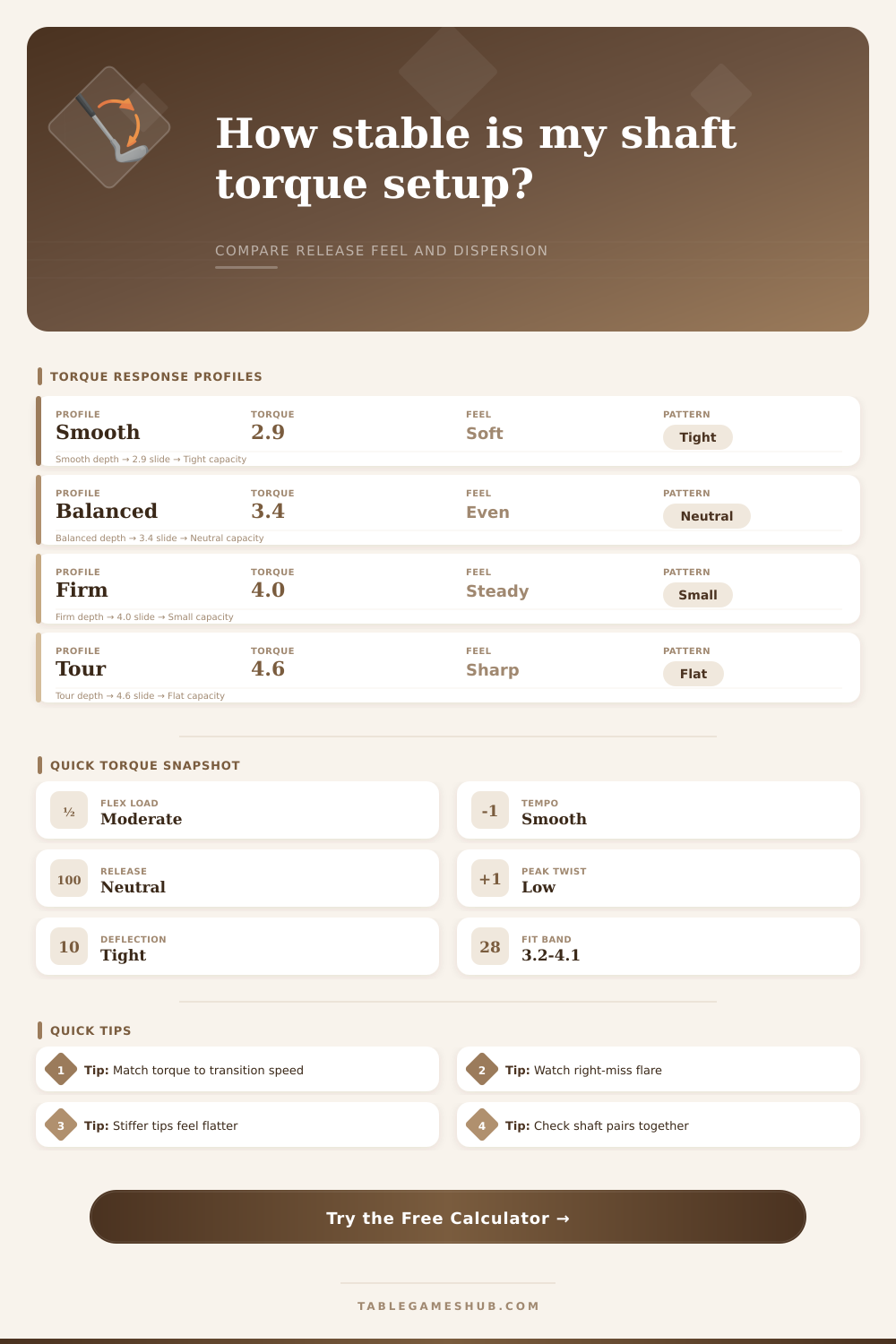
Golf Club Shaft Torque Calculator
Measure release feel, tip twist, and dispersion stability with torque-aware fitting.
Torque Fit Results
| Torque | Feel | Launch | Dispersion |
|---|---|---|---|
| 2.4-2.8 | Very firm | Lower | Tight |
| 2.9-3.3 | Firm | Mid-low | Controlled |
| 3.4-3.8 | Balanced | Mid | Neutral |
| 3.9-4.4 | Soft | Mid-high | Wider |
| Tempo | Load | Best Torque | Miss Shape |
|---|---|---|---|
| Smooth | Light | 3.8-4.2 | Soft fade |
| Balanced | Medium | 3.3-3.7 | Flat |
| Quick | Heavy | 2.9-3.4 | Push |
| Aggressive | Very Heavy | 2.5-3.0 | Right leak |
| Strike | Twist Bias | Feel | Correction |
|---|---|---|---|
| Center | Low | Stable | None |
| Heel | Higher | Soft | Stiffer |
| Toe | Lower | Firm | Soften |
| High | Medium | Neutral | Check loft |
Use this torque calculator to compare feel, stability, and strike response so your shaft choice matches tempo and dispersion without guesswork.
Shaft torque is a measurement of how much the tip of the shaft rotate during a golf swing. The twisting of the shaft can cause the club’s face to move away from a square position. When the club face moves away from a square position, the ball will travel offline from the target line.
Clubs with low torque values will allow the club to experience less twist during the swing. Clubs with low torque values offer a firmer feel to a golfer. Clubs with high torque values allow more twist in the club shaft.
How Shaft Torque Affects Your Golf Swing
These clubs can fit golfers who have a smooth tempo in their swing, but if a golfer has a quick tempo for their swing, the ball can scatter more on the course. The tempo with which a person swings the club can have an impact on the type of club shaft torque that should be selected. Golfers who have a smooth tempo with their swings can utilize clubs with higher torque value.
A high torque value for the club will load gradually with the swing of the club. For golfers who have an aggressive swing, a shaft with a lower torque value will reduce the force created on the club with the swing of the club. Using a shaft with a high torque value with an aggressive swing will result in the tip of the shaft over-flexing.
An over-flexing club will cause the ball to push to the right. Additionally, the transition with which the club is swung impacts the club shaft. Golfers who have heavy hands may cause the club shaft to compress during the swing which can cause the club face to either close early in the swing or stay open throughout the swing if the club torque is not suited to the golfer’s transition with the club.
Finaly, the location at which a person strikes the ball can impact the torque that they feel in the club. For individuals who strike the ball with the heel of the club, the club will torque in response. For individuals who strike the ball with the toe of the club, there will be less twist in the club shaft.
Additionally, striking the ball with the toe of the club will result in a firmer feel for the club. For individuals who hit the ball high on the club face will experience a medium twist in the club, but the high face contact may require a check of the loft of the club to avoid hitting the ball too highly on the course. The release of the club during the swing can have an impact on club shaft torque.
For individuals who release the club later in the swing will hold the club in a deeper angle into the downswing. Such individuals will benefit from clubs that have a torque value that allows for stability during the swing. A person who is an early releaser or who flips the clubhead will have different needs in terms of compensation for their clubs.
The length and balance point of a golf club will impact the amount of torque that the club will have. A person can use the torque of the shafts to help meet the dispersion goals that they desire for their golf balls. For example, if a player desires to hit their balls in a tighter dispersion, they should use a shaft with lower effective torque.
However, if the player would like to hit the ball for distance, they can use a shaft with higher torque, as higher torque shafts will help to allow the player to get the ball up and traveling further. Shaft weight and tip inserts will also impact the amount of twist that the clubs will have. For example, heavier shafts will dampen the amount of twist that the clubs will have.
Additionally, heavier clubs will help to stabilize the golfer’s tempo when using the clubs. However, lighter clubs will amplify the amount of twist that the clubs will have, and they will help to assist in individuals that have a smooth golf swing tempo. Furthermore, the balance point of the clubs will also impact the golfer’s swing timing.
For instance, using clubs with a balance point that leans towards the back will create a bias for the golf balls to travel towards the draw. Many people make the mistake of not pairing their woods clubs together. If an individual does not pair their woods clubs together, the torque of their driver clubs may fight against the stability clubs that they use for their fairway woods.
Another way to find the proper torque for the clubs for an individual is to test the clubs that are available for purchase. For instance, individuals with a balanced golf tempo may want to switch from a 4.2 torque to a 3.4 torque for their clubs if they notice that their golf ball is traveling towards the toe of the club. Individuals that use low torque clubs will hit their golf balls in a tighter dispersion, and they will feel the clubs have a steadier sensation when swinging.
Additionally, most professional golfers use low torque clubs since they have heavy transitions with their clubs. However, even professionals will use different torque for clubs based on the tendencies that they have with their swings. Furthermore, another way to find the proper clubs for an individual is to listen to the feel of the clubs while swinging.
Low torque clubs will feel sharp, but they may feel too stiff with too low of a torque. High torque clubs will provide a smooth feel to the mishits that occur while swinging, but will also carry the risk of the club’s face flipping. Another way to test the clubs is to use the clubs in a sequence from the driver clubs to the irons to create consistency in the club’s torque.
Additionally, if an individual experiences a leak with the golf ball on the right side, this may indicate a need for lower torque clubs. Conversely, if the ball tends to push on the left side, this could indicate a need for higher torque clubs for more stability in that individuals swing.