Golf Club Distance Calculator
Map carry, roll, and total yardage by club so you can choose the right number for wind, turf, and elevation.
Golf distances is not a fixed number; rather, the distances for golf balls changes based on many different environmental factor. A person might know the yardage for a driving range, but those distances will change when playing on a golf course. The factor that change the distance that a golf ball will travel include weather condition, the temperature of the environment, the altitude of the course, the condition of the turf, and the quality of the strike make with the club.
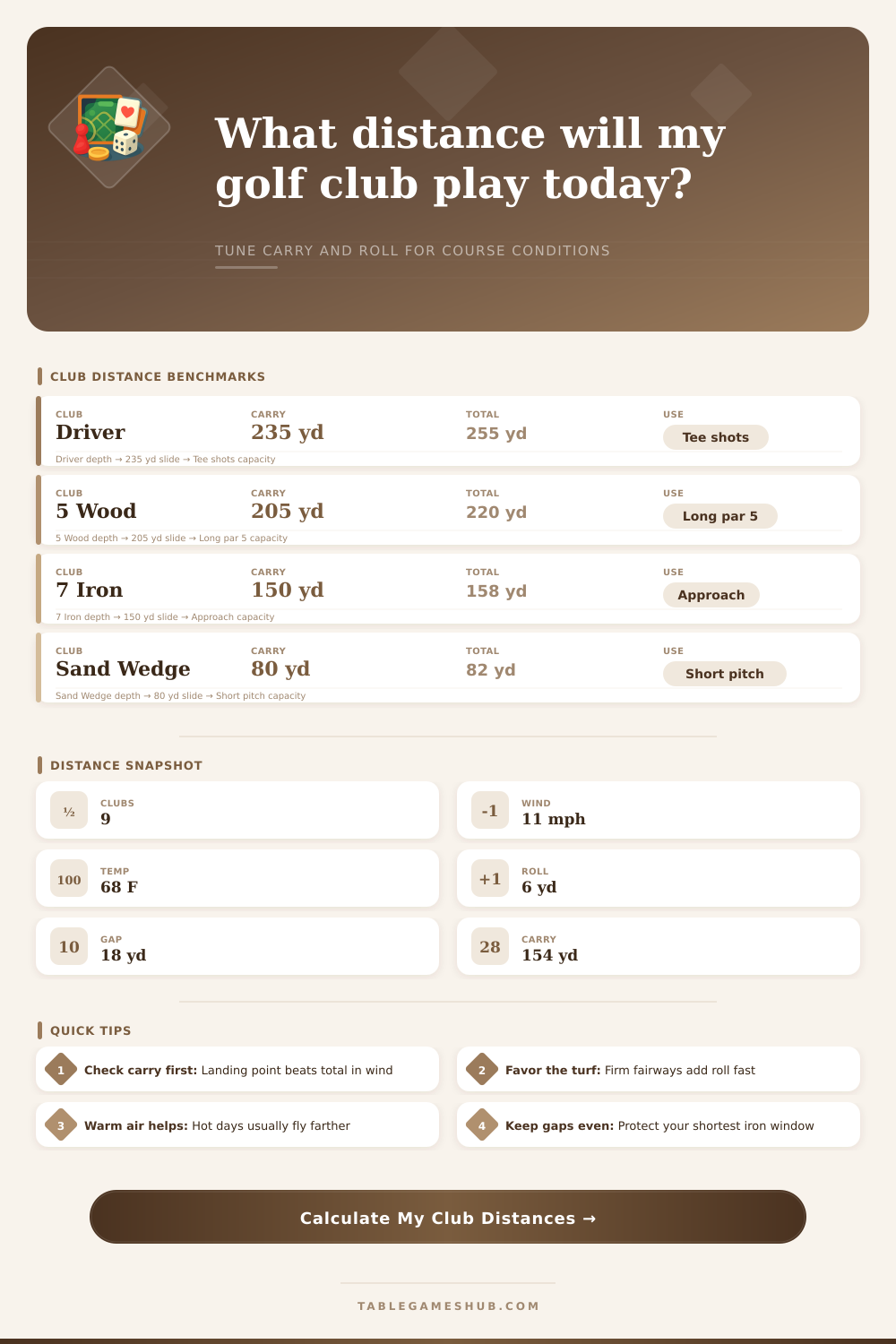
The distance that a golf ball will travel from the time the club hits the ball until the ball hit the ground is the carry distance of the ball. The total distance of the golf ball is the carry distance of the ball plus the distance the ball will travel after it hit the ground. Carry distance is essential for determining the club to use when playing because the firmness of the ground does not affect carry distance.
What Affects How Far a Golf Ball Goes
Total distance is not as fixed because the firmness of the ground will change how far the ball rolls. If a person select clubs only based on total distance, the ball may not be able to reach the hole when the ball will not roll on firm ground. Weather conditions will alter the distance that the golf ball will travel.
Wind will affect the ball; a headwind will reduce the carry distance of the ball, while a tailwind will increase the carry distance of the ball. If the temperature is cold, the air will be dense, and the carry distance of the ball will be reduced. If the temperature is warm and the air is thinner, the ball will travel more further.
The altitude will also change the distance of the ball; thinner air allow the ball to travel further. The condition of the turf will change the total distance that the ball will travel. If the ground is firm, the ball will roll further.
If the ground is soft or wet, the ball will lose energy when it hits the ground and roll a lesser distance. When a player is attempting to reach the pin on the green, carry distance is used. However, when a player is attempting to reach a specific area in the fairway, total distance are used.
The quality of the strike will impact the distance that the ball will travel. If the ball is hit on the toe of the club, the carry distance will be lessen but the ball may roll further. If the ball is hit on the heel of the club, the carry distance will be lessened and the ball may travel in another direction.
The intention in which a player swing the club will impact the distance; swinging clubs aggressively will increase the distance that the ball will travel but reduce the control of the club. Clubs have specific gap between them that should provide players with options when selecting clubs. The ideal distance clubs should have between them is between 10 and 15 yard in total distance.
If the gaps between clubs are too small, players will have too many options with club selection. If the gaps between clubs are too large, players may find themselves in dead zones in the course where no club may be appropriate for certain distances. The 7 iron can be used as a baseline club to determine the distances of the other clubs in a bag.
The elevation of the ball will change how players think about and play the game of golf. If players are forced to hit the ball uphill, the carry distance will feel longer for players because the ball must overcome gravity to continue forward. If the ball is hit downhill, the carry distance will feel shorter for players because gravity will assist the ball in traveling toward the target.
Because the elevation changes the total distance that the ball will travel, players must change the clubs that they use to hit the ball to accommodate these different elevation. A person can improve their club selection by establishing baseline distances for clubs using a launch monitor. Using a launch monitor, a person can determine the carry distance of the ball first and then the total distance of the ball second.
A person can also use the monitor to determine the distance that a ball will travel in specific weather conditions. For instance, if the wind speed is over 10 miles per hour, a person can select a club that will carry the ball further. If the temperature is low, a person can select a club that will carry the ball further.
By understanding the effect of these different variables on club selection, a person can make better decisions when selecting clubs to hit the ball with.