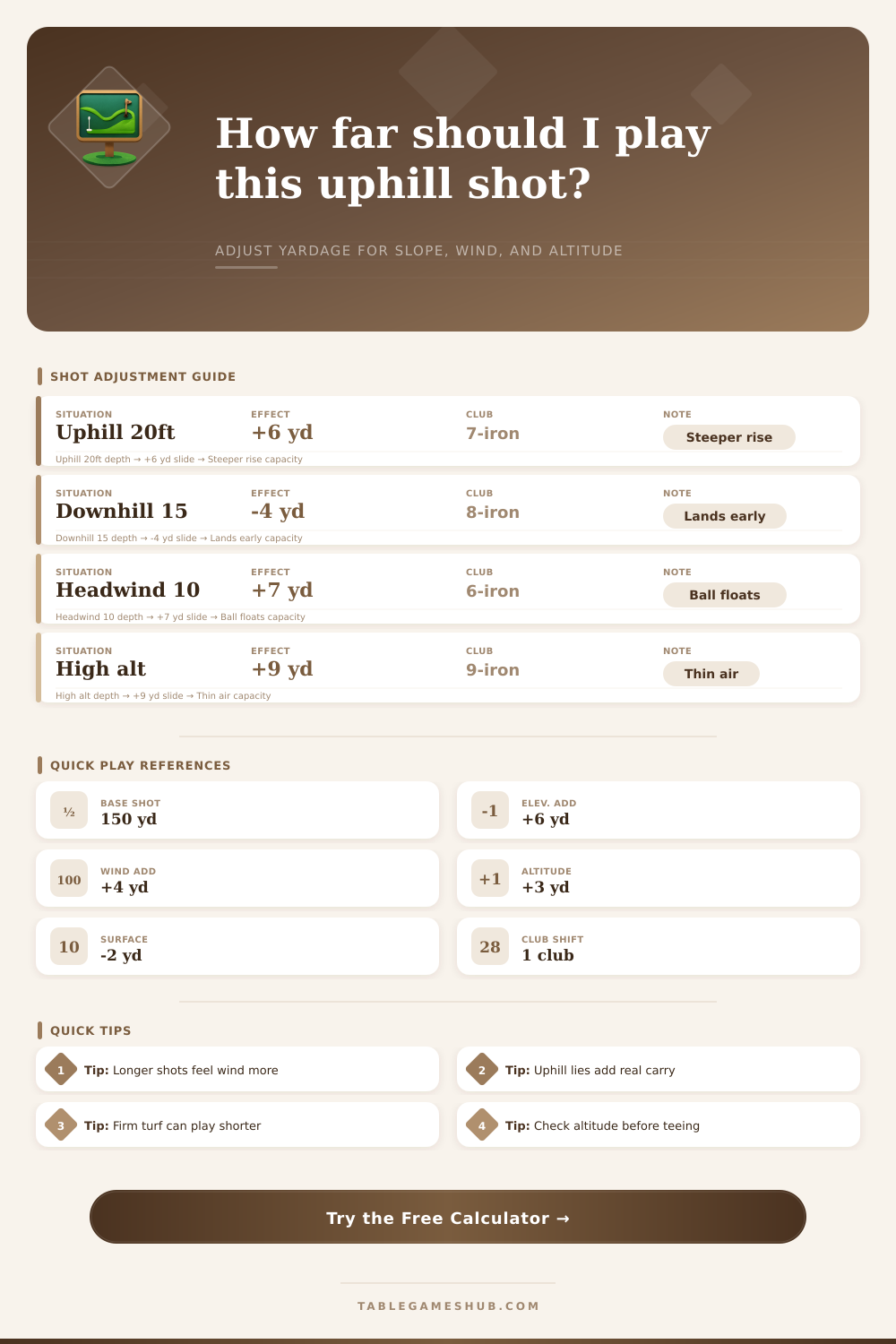
Golf Yardage Elevation Calculator
Adjust uphill, downhill, wind, altitude, temperature, and lie so you can pick the right club with more confidence.
| Shot Condition | 10 ft | 20 ft | 30 ft |
|---|---|---|---|
| Uphill | +3 yd | +6 yd | +9 yd |
| Downhill | -2 yd | -4 yd | -6 yd |
| Steep face | +4 yd | +8 yd | +12 yd |
| Soft landing | +1 yd | +2 yd | +3 yd |
| Wind | 120 yd | 160 yd | 200 yd |
|---|---|---|---|
| Headwind 10 | +5 yd | +6 yd | +8 yd |
| Quarter head | +3 yd | +4 yd | +5 yd |
| Crosswind | +1 yd | +1 yd | +2 yd |
| Tailwind 10 | -3 yd | -4 yd | -5 yd |
| Altitude | 100 yd | 150 yd | 200 yd |
|---|---|---|---|
| Sea level | 0 yd | 0 yd | 0 yd |
| 1,000 ft | +1 yd | +2 yd | +3 yd |
| 3,000 ft | +3 yd | +5 yd | +8 yd |
| 5,000 ft | +4 yd | +8 yd | +11 yd |
| Club | Carry | Loft | Use |
|---|---|---|---|
| Driver | 235 yd | 10.5° | Tee |
| 7-iron | 155 yd | 34° | Approach |
| 9-iron | 135 yd | 41° | Shorter |
| PW | 115 yd | 46° | Scoring |
In order to select the correct golf club, there are several environmental factors that must be accounted for. These factors include elevation, wind, altitude, temperature, and the lie and surface conditions of an golf course. If a golfer ignores these factors, the golfer will likely select the wrong club for the golf shot.
As a result, the ball will land in the incorrect location on the golf course. Elevation are one of the primary factors that can change the way that a golf ball travels. The elevation of the course can change due to the effect of gravity upon the ball while in flight.
How to Choose the Right Golf Club for Wind, Slope, Height, Temperature and Ground
If the golf ball is to travel to a target that is inclined upward from the golfer, the ball must fight against gravity to travel upward. Therefore, the ball will not travel as far to an upward target as it would on flat ground. Thus, a golfer should use a club that can travel the ball more further than normal for these types of shots (one or two clubs longer than normal).
However, if the ball is to travel downward toward the target, gravity will assist in the movement of the ball. Therefore, the ball will travel further on downward slope, which indicates that a club that travels the ball a shorter distance should be used. Wind can also impact the distance that the ball travels.
The effect of the wind on the ball depends upon the direction of the wind relative to the flight of the ball. If the wind is blowing against the direction of the ball (a headwind), the distance that the ball travels will be less than if there were no wind. If the wind is blowing in the same direction than the ball (a tailwind), the distance that the ball travels will be greater.
Finally, if the wind is blowing laterally (across from) the ball, the ball will travel off of it’s intended target. Additionally, the effect of the wind resistance is more stronger on balls that are to travel longer distances because there is more time for the wind to impact the ball while in flight. Another environmental factor is the altitude of the course.
Altitude changes the density of the air around the ball. Higher altitudes has less air molecules in the air relative to sea level. Therefore, the ball will travel further on higher altitudes due to the lessening of the air resistance upon the ball.
Thus, a golfer should use clubs that travel the ball a shorter distance at higher altitudes. Temperature also changes the density of the air around the ball. Cold weather air molecules is more dense than air molecules in warmer temperatures.
Thus, the density of the air creates drag upon the ball when the ball is traveling, which limits the distance that the ball can travel relative to warmer temperatures. Therefore, clubs that propel the ball a further distance should be used in colder weather. The last two factors to consider are the lie and the surface condition upon which the ball will land.
The lie of the ball changes how the ball rolls after it lands on the ground. If the ball lands in deep rough, for instance, the grass will slow the ball. However, if the ball lands on a firm surface, it will roll further once it make contact with the ground.
Thus, a golfer should use clubs that have a greater distance than normal on firm surfaces since there will be a rollout after the ball makes contact with the ground. In order to effectively play golf, each of these factors must be combined into one single yardage measurement. The golfer should not consider each of these factors separately.
However, the golfer should consider each of these factors together to determine the total effect that each of them have upon the ball. By calculating each of these factors together, the golfer will be able to determine which club should be used for each hole that the ball must be hit. Youll find that understanding these things is actualy more important than teh swing itself.
It should of been mentioned sooner, but it is alot to take in.