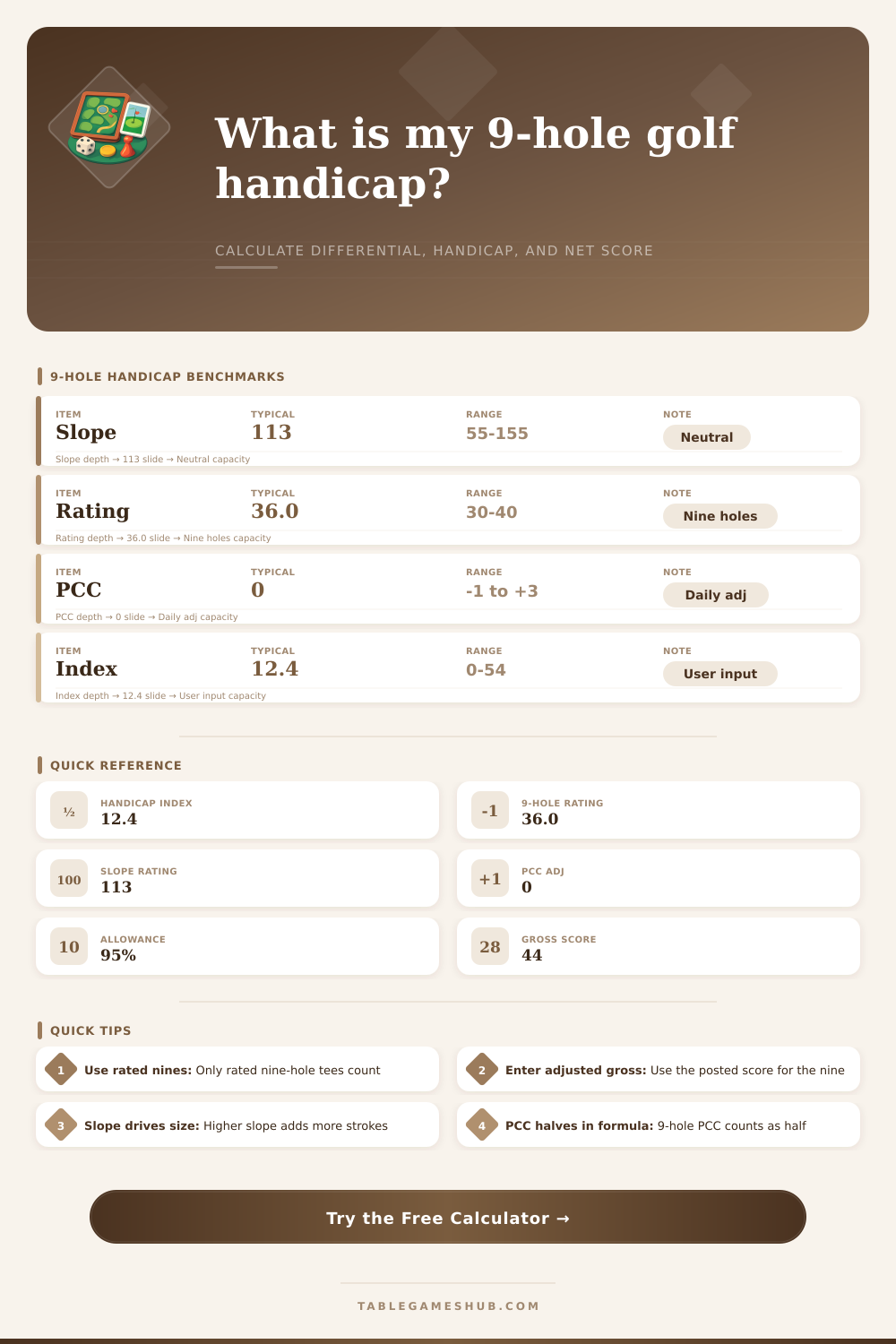
Golf Handicap 9 Hole Calculator
Calculate a WHS-style 9-hole differential, course handicap, playing handicap, and a simple 18-hole projection from one round.
| Step | Formula | Result | Notes |
|---|
| Common 9-Hole Setup | Course Rating | Slope Rating | Typical Course Hcp |
|---|---|---|---|
| Short par-3 nine | 31.2 | 92 | Lower |
| Balanced club nine | 34.8 | 113 | Middle |
| Championship nine | 37.6 | 128 | Higher |
| Tough back nine | 38.9 | 136 | Highest |
| PCC | Effect | 9-Hole Diff Shift | Example Use |
|---|---|---|---|
| -1 | Easier | -0.5 hole | Soft conditions |
| 0 | Neutral | None | Normal day |
| +1 | Tougher | +0.5 hole | Wind or rain |
| +3 | Very tough | +1.5 holes | Rare extreme |
| Allowance | Singles | Match Play | Notes |
|---|---|---|---|
| 85% | Rare | Used in some events | Low allowance |
| 90% | Occasional | Team formats | Moderate |
| 95% | Common | Friendly play | Default here |
| 100% | Net play | Full hcp | Most direct |
Use this 9-hole golf handicap calculator to compare your score against the tee rating, slope, and PCC. It quickly shows differential, course handicap, and a projected full-round view.
A golf handicap are a number that represents the skill of a particular golfer. A golfer’s handicap isnt based solely on the score that they receive when playing golf course, but also based on the difficulty of the courses that they play. To understand the concept of a handicap, it is first important to understand the concept of a differential.
A differential is a number that represents the skill of a golfer relative to the difficulty of the golf course that they played. To calculate a golfer’s differential for nine hole of golf, the course rating subtracts the player’s adjusted gross score, and the course slope rating multiplies the result. The slope rating of a golf course is a number that represent how difficult the course is relative to a scratch golfer.
How Golf Handicaps Work
The neutral number for slope ratings is 113, but a higher number indicate that a course is more difficultly to play. Golfers who play on a golf course with a higher slope rating receive more credit within their handicap system for meeting the challenges of the course. Other factors that can be included in calculating a golfer’s differential is the playing condition adjustment, or the PCC.
The playing conditions adjustment accounts for the condition of the golf course on the day that the golfer played, especially whether the weather or the green were challenging to the player. If the playing conditions are particularly difficult to the player, a value is added to the differential to account for bad weather. A golfer uses their handicap index to determine their course handicap.
Applying factor like the specific tee box that the golfer use, and the par value of the course that they played calculates a course handicap. While the par of the course is used as a factor in calculating a course handicap, the course rating is often more important. The course rating is used to calculate the handicap index to make sure that the golfer receives the apropriate number of stroke on the course.
Additionally, golfers can use a playing handicap when competing against other golfer. A playing handicap is often calculated as 95 percent of the course handicap to even out competition between golfers. Many golfer make mistakes when entering their golf scores into their handicap systems.
Many golfers often enter their raw score instead of adjusting their scores to account for the difficulty of individual hole on the course. Any score that is entered into a handicap system that does not cap the score for any given hole at double the par of that hole plus the golfer’s handicap strokes will result in an incorrect handicap. Additionally, the playing conditions adjustment, or PCC, should be applied to a golfer’s score when the playing conditions are difficult, especially due to bad weather.
If the PCC is +2, for instance, the golfer’s score will be adjusted to include one additional stroke, and the handicap will be softened by approximately 0.5 for that round of nine holes. Additionally, the tee box that is used can also impact a golfer’s handicap. The forward tee are typically the easiest to play, while the back tees are the most difficult.
A decision to play on a golf course with a high slope rating, such as 128, will result in a higher impact of a player’s score on their handicap index than if they play on a course with a lower slope rating. In match play, a different handicap allowance should be used then when competing in a league play competition. For match play, a golfer’s handicap should be dropped to 90 percent of their course handicap to allow for close competition between match play opponent.
For league play, a handicap of 95 percent of a course handicap can be used to ensure fairness in competition. A handicap index may be used to apply a handicap to a golfer for a round of golf, but the golfer must play on a nine-hole course that has an official handicap rating. Golf course that do not have official handicap numbers set for their nine-hole courses cannot have their score posted to the index.
The scorecard for each course will list the handicap for each nine-hole course and the slope rating for each nine-hole course. In order to see a real improvement in a golfer’s handicap, that golfer should track their differential. Taking the best eight differential for the golfer’s most recent rounds of golf calculates the handicap index for a golfer.
Scores for nine holes of golf can be posted to a handicap index. Additionally, two nine-hole score can be combined to create a score for eighteen holes of golf. By posting scores to a handicap index, a golfer can understand their skill in the game of golf.
By noting the PCC and the slope rating of each course that a golfer plays, the golfer can understand how challenging day (wind, rain) or courses impact their differential for the game of golf. Understanding a golfer’s handicap enables them to understand their net par for the game of golf, as well as to understand their progress in relation to their handicap for the game of golf.