Golf Course Handicap Calculator
Turn handicap index, slope, rating, and allowance into a playing handicap, net target, and stroke plan for any tee set.
Results
Breakdown
| Tee tier | Yardage | Slope | Typical index |
|---|
| Index band | Course hcp | Allowance | Round note |
|---|
| Format | Typical % | Use case | Strokes |
|---|
| Stroke count | 18-hole split | 9-hole split | Rule |
|---|
A golf handicap are a number that represents the potential skill level of a person who play golf. Many individuals uses the handicap system because it allows for individuals of all skill levels to compete against each other fair. To compete against others with a golf handicap, an individual must understand how to calculate their playing handicap.
A playing handicap is not the same than a golfer’s golf index. A golf index is a number that represents a person’s potential skill level on a golf course under standard conditions. A playing handicap, on the other hand, indicates how many stroke a person receives on a specific golf course.
How to Calculate Your Playing Handicap
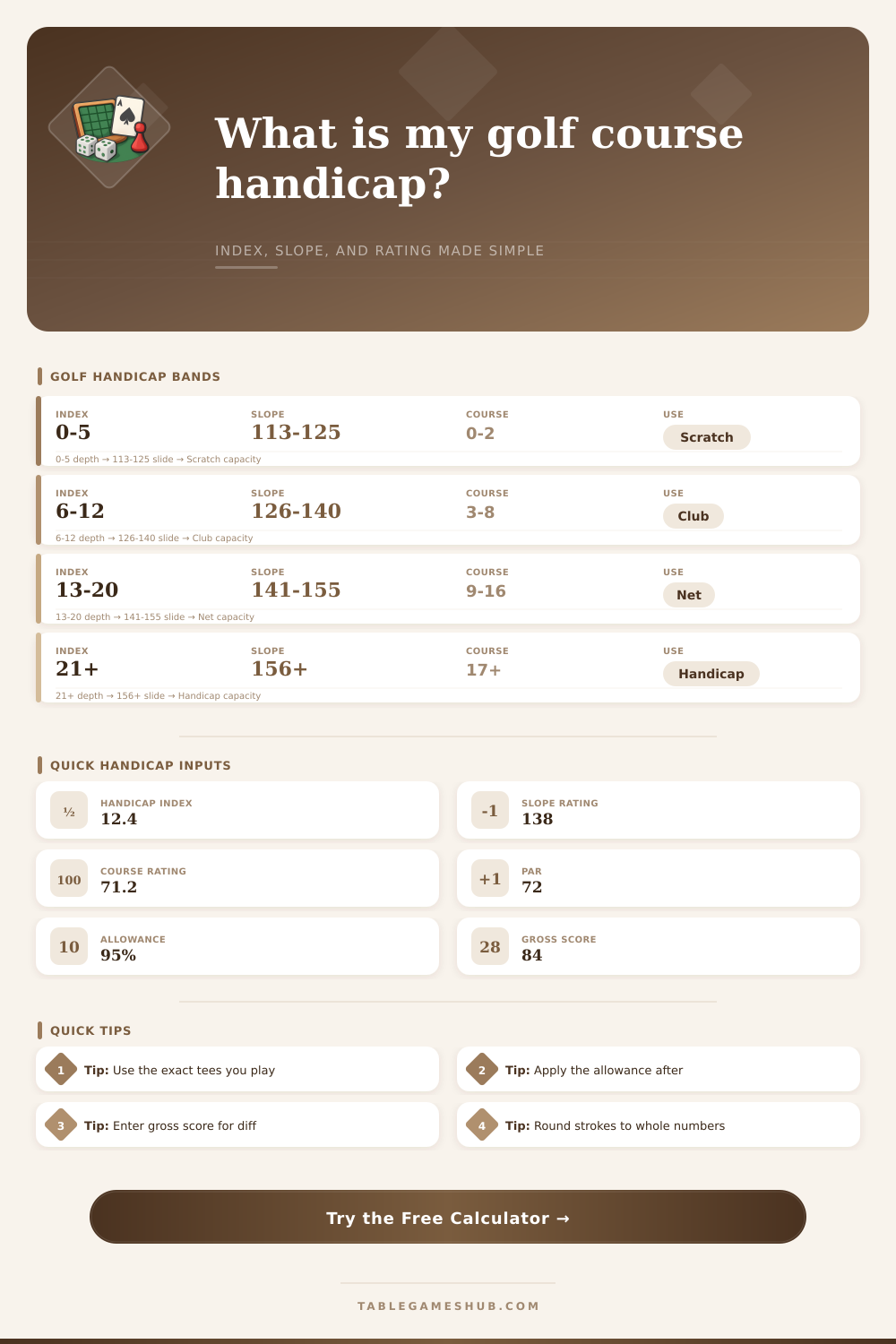
Golf courses offers many different tee boxes with different slope ratings and course ratings. The slope rating indicate the difficulty of a golf course for a person who is not a scratch golfer. The more higher the slope rating, the more difficult the golf course.
A slope rating of 113 is considered neutral for a golfer, and a slope rating higher than 113 means that the golf course are more difficult for a non-scratch golfer. The course rating indicates the difficulty of a golf course for a scratch golfer. A scratch golfer is a person who has a golf handicap of zero.
The course rating indicates the score that a scratch golfer should shoot on a specific golf course. To calculate a playing handicap, a golfer must use both the slope and course ratings for a golf course. These two ratings will change based on which tee box that a person select on a golf course.
The difficulty of a golf course changes when a person select a specific tee box. For instance, a person who selects the championship tees on a golf course will encounter a higher slope and course rating than a person who selects the forward tees on that same course. A playing handicap will be more higher for a person who selects the championship tees because the course is more difficult.
A playing handicap will be lower for a person who selects the forward tees because the course is easier to play. Many golfers selects the wrong tee box. A golfer’s net score will be inaccurate if they choose the wrong tee box.
A golfer’s net score is calculated by take their gross score and subtracting their playing handicap. A golfers net score is the measurement that is used to compare the performance of individuals within competitions with specific playing handicaps. Competitions such as stroke play, match play, scramble, and four-ball competitions has allowances that are applied to a playing handicap.
Stroke play competitions apply a 95 percent allowance to a player’s playing handicap. To calculate a playing handicap for stroke play competitions, the player must multiply their playing handicap by 0.95. Match play competitions use a 100 percent allowance for playing handicaps.
The playing handicap for match play competitions is the same as the player’s playing handicap. Stableford competitions uses a 95 percent allowance for playing handicaps. For scramble competitions, however, an 80 percent allowance is applied to the playing handicap.
Four-ball competitions use an 85 percent allowance for playing handicaps. These percentages are applied to playing handicaps because each type of competition requires a certain level of difficulty in order to remain fair for all golfers competing in the same competition. In addition to understanding how to calculate playing handicaps and how they may change based on type of competition, a player must also understand how to allocate playing strokes to specific holes on a golf course.
A playing handicap is divided by 18 to calculate how many strokes a player receive on a golf course. A player will receive one stroke on each of the hardest holes on a golf course based on a hole index. Depending on the handicap level of the player, a player may also receive two strokes on certain hole on a golf course.
For example, a player with a playing handicap of nine or less will receive one stroke on each of the nine hardest holes on a golf course. A player with a playing handicap that is higher than 18 will receive two strokes on some hole on a golf course. These strokes must be distributed evenly on all 18 holes on a golf course.
For a nine-hole golf course, a player must divide their playing handicap by two because a nine-hole golf course is half the length of a full 18-hole golf course. There are some mistake that many players make when calculating their playing handicap. For example, one common mistake is to use a GPS app to measure the yardage of each hole on a golf course.
The yardage that should be used is the yardage that is marked on the golf course. Using a GPS app will lead to an inaccurate playing handicap because the slope and course rating will not be correct. Another mistake is to fail to align a person’s par number with the number of holes on a golf course.
This mistake will lead to an inaccurate net target score for the round of golf. A net target is a player’s par score for each round of golf plus their playing handicap. The net target score is the score that a player must achieve to be considered to play well relative to their playing handicap.
Finally, a person should track their differential over many rounds of golf. A differential is calculated by taking a player’s score for a round of golf, subtracting the course rating, and dividing the result by the slope rating. A player’s differential will tell a player if their score for the round match with their golf index.