Golf Score Differential Calculator
Convert an adjusted round into a handicap differential using course rating, slope rating, and PCC.
Calculation Breakdown
| Score Type | When to Use | Example | Notes |
|---|---|---|---|
| 18-hole score | Full round | 84 | Use 18-hole rating and slope |
| 9-hole score | Half round | 41 | Use 9-hole rating and slope |
| Adjusted gross | Handicap posting | 82 | Includes caps and penalties |
| PCC included | Competition day | +1 | Small daily course-condition adjustment |
| Slope Band | Difficulty | Typical Range | What It Means |
|---|---|---|---|
| 55-79 | Very easy | Forward tees | Differentials run lower for same score |
| 80-113 | Easy to average | Shorter setups | Close to neutral or slightly forgiving |
| 114-134 | Average to tough | Club tees | Common range for many courses |
| 135-155 | Very tough | Championship | Each extra stroke matters less in the formula |
| Adjustment | Typical Value | Effect | Example |
|---|---|---|---|
| Penalty strokes | 0-5 | Raises adjusted gross | Lateral hazard penalty |
| Cap correction | 0-4 | Manual score fix | Net double bogey limit |
| PCC | -1 to +3 | Moves differential | Weather or setup impact |
| Hole count | 9 or 18 | Chooses rating scale | Use matched course values |
| Step | Formula Piece | Result | Meaning |
|---|---|---|---|
| 1 | Gross + penalties + cap | Adjusted gross score | Your posting score for the round |
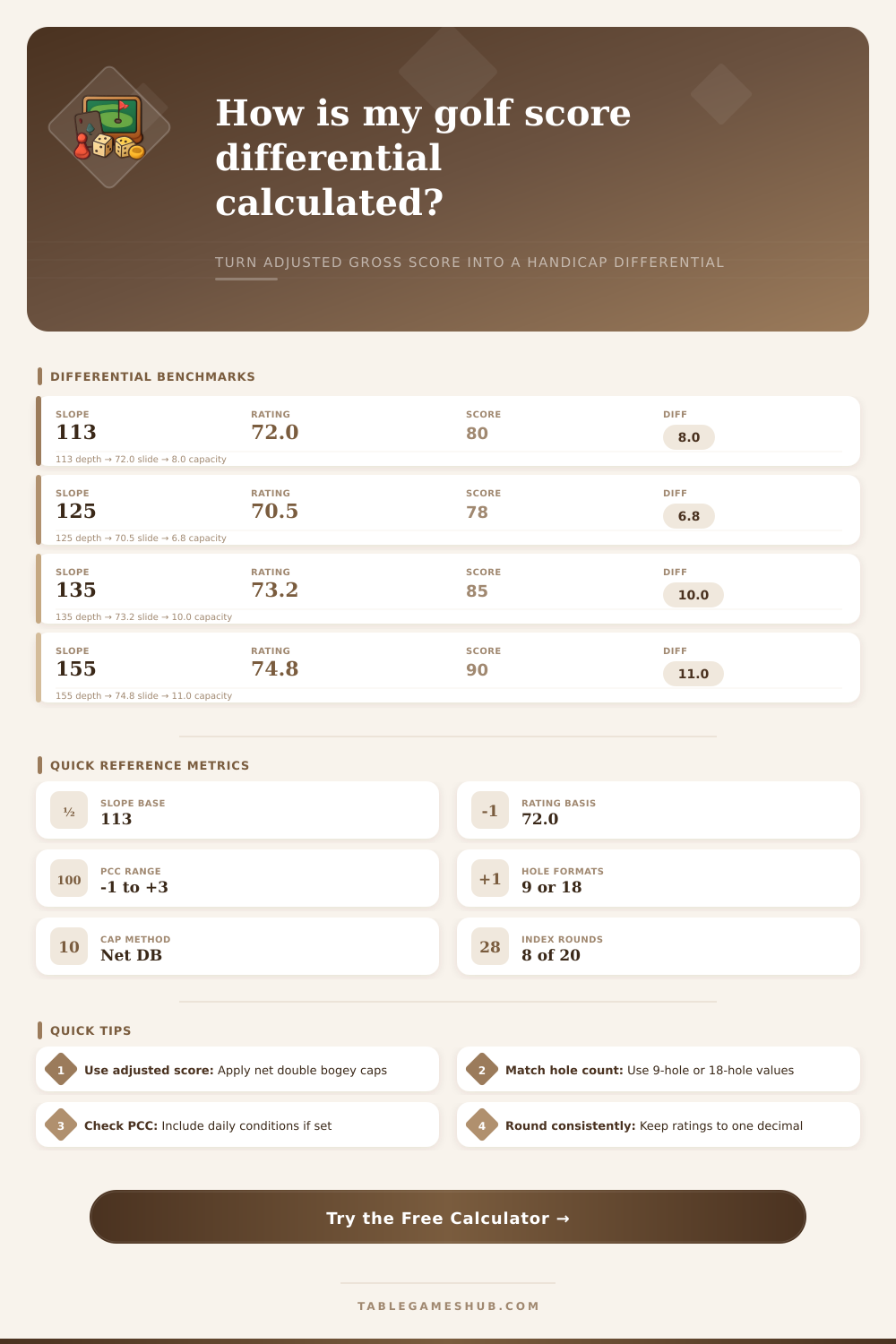
| 2 | Adjusted gross - rating - PCC | Score above rating | Measures performance before slope scaling |
| 3 | Result x 113 / slope | Differential | Normalizes the round to neutral difficulty |
| 4 | Compare to par | Par delta | Shows how the round stacked up to course par |
A score differential is a mathematical calculation uses in golf to measure a person’s performance. Whereas the raw score for a round of golf measures the total number of strokes that a person take to complete one round, the score differential take into account the difficulty of a course that was played. Thus, the score differential is the measurement of a persons skill with golf courses of vary difficulties.
In order to calculate a score differential, there is several pieces of information that is required about the course that is to be scored. First, the golfer use the course rating. The course rating is the score that is expected for a scratch golfer on that specific course.
What Is a Score Differential
Second, the slope rating are used. The slope rating is a number between 113 and 155 that indicates the difficulty of a course for golfers that is not scratch golfers. Finally, some course may use the playing conditions calculation, or PCC.
The PCC is a number that accounts for the conditions of the course at the time of play; weather, greens speed, etc.
In order to calculate the score differential, a person’s adjusted gross score are used. The golfer calculates the adjusted gross score by cap the number of strokes that is recorded on any given hole. A common system uses a cap of net double bogey for each hole to ensure that a bad hole does not adversely affects the score differential for that round of golf.
Additionally, any penalty stroke that are taken during the round must also be accounted for in calculating the score differential. The score differential is a number that allows for the comparison of a person’s performance on different golf courses. For instance, if an individual scores a 90 on a difficult course with a high slope rating, their score differential will be lower than if they scored a 90 on an easy course with a low slope rating.
This is due to the fact that the slope rating of the course adjusts their score; the more higher the slope rating, the lower the value of each stroke in the calculation of the score differential. Thus, score differentials is a measurement of a player’s skills relative to the difficulty of the course that they played. A handicap index is derived from the score differentials that a golfer scores.
A player’s handicap index is calculated by taking the twenty most recent score differential for that player, using only the eight lowest score differentials, and calculating the average score of those eight score differentials. Consequently, a bad round of golf will not impact a player’s handicap index. However, a series of good rounds will lower that player’s handicap index.
When calculating a score differential, it is essential that the correct course rating and slope rating is used. For instance, if the rating for the tees that are used is used, but the player did not play from those tees, the score differential will be incorrect. Additionally, the correct number of holes for the course must also be used; nine holes are not the same than eighteen holes when calculating score differentials.
Overall, the score differential uses the course rating, slope rating, and adjusted gross score to measure a player’s performance with golf. Thus, the score differential allow for many golfers of all skill level to compare their skills with other golfers. Through the use of this score differential, each golfer is able to track there progress in the game of golf over time.