🎯 Bolt Action Points Calculator
Total your army list, check limit pressure, and compare how much room is left for upgrades.
| Measure | Value | Note | Status |
|---|
| List size | Typical feel | Model count | Comment |
|---|---|---|---|
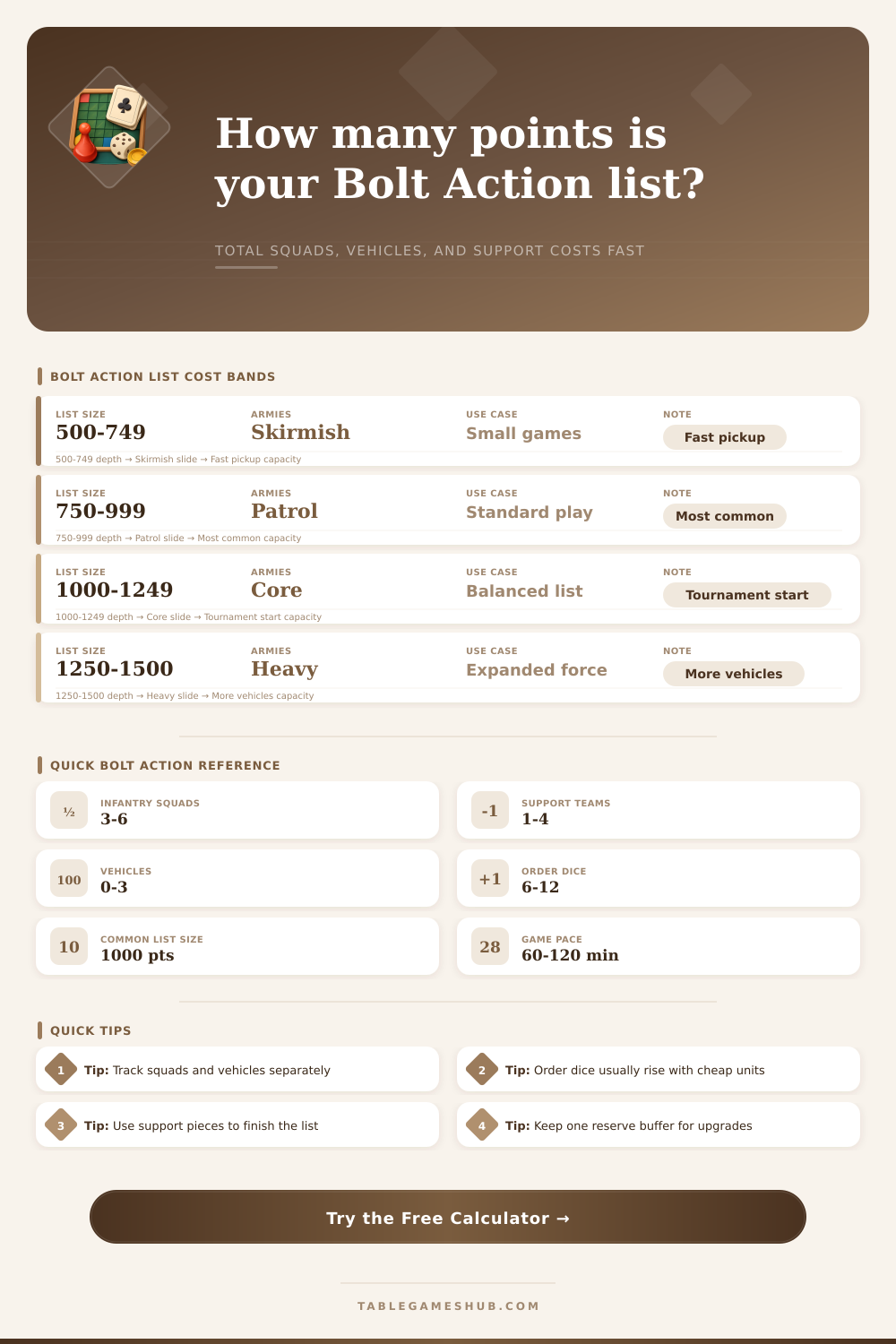
| 500 | Skirmish | Low | Fast learning game |
| 750 | Light force | Medium | Lean and mobile |
| 1000 | Standard | Medium-high | Best all-round size |
| 1250 | Expanded | High | More room for armor |
| 1500 | Heavy | Very high | Longer, denser games |
| Unit type | Point role | Order dice impact | Use case |
|---|---|---|---|
| Infantry | Efficient bodies | High | Objectives and volume |
| Elites | Premium damage | Medium | Shock assaults |
| Support teams | Utility fire | Low | Mortars and MGs |
| Vehicles | Big-ticket spend | Medium | Armor and transport |
| Buffer | Meaning | Risk | Comment |
|---|---|---|---|
| 0-24 | Tight | High | Little room for edits |
| 25-74 | Comfortable | Medium | Good upgrade space |
| 75-149 | Flexible | Low | Easy list tuning |
| 150+ | Open | Very low | Room for extra toys |
| Order dice | Tempo | Table pressure | Comment |
|---|---|---|---|
| 6-7 | Slow | Low | Elite-heavy or armored |
| 8-9 | Balanced | Medium | Common all-round force |
| 10-11 | Fast | High | Strong board control |
| 12+ | Very fast | Very high | Cheap-unit spam |
Keep the limit visible
Watch the remaining points before adding the final support pick. A clean buffer makes list changes much easier when you swap a squad role or transport choice.
Balance dice and punch
More units usually mean more order dice, while heavier vehicles and elite squads raise raw cost. Use the calculator to see which side of that tradeoff you are leaning toward.
Use the breakdown to compare infantry, elite units, support weapons, and vehicles against your list limit. The calculator is designed for quick Bolt Action roster checks and a clear read on how close the army sits to the agreed points cap.
Points management is one of the necessary parts of playing Bolt Action. Points management is the process of finding a balance between the cost of the units that you will play and the number of order dice that you can use in your game. Order dice help to determining the tempo for the game, and the number of order dice that you have is related to the number of points that you will spend on your platoon.
If you spend many points on vehicles or elite units, then you will receive fewer order dice. Alternatively, if you spend fewer points on cheap infantry units, you will get more order dice for your platoon. Players has to make a decision about whether they would like to use many cheap riflemen or a few expensive tanks or commandos.
How to Manage Points and Order Dice
Riflemen is cheap and offer many order dice to the player. Order dice allow players to control more of the game. Alternatively, if a player chooses to use alot of expensive units, they will have less order dice.
Players must be more careful with the order dice that they have, as they will be unable to take as many actions during their turns as players with more order dice. Players have more order dice if they use cheap units instead of expensive units. A player can organize their platoon by keeping track of how many infantry and vehicles they will use in their platoon.
By keeping track of both categories of units, a player can understand whether they are creating an infantry-focused platoon or a vehicle-focused platoon. Many players like to use infantry in their platoon because they are cheaper and offer order dice to the player. Elite units provides more combat strength than regular infantry.
However, they cost more points than infantry, leaving less points for other units. Support weapons such as machine guns offers additional utility for the platoon but do not contribute many order dice. Vehicles such as tanks and half-tracks offer both armor and fire power to a platoon.
However, they are very expensive and reduces a players order dice. Another essential part of forming a platoon is maintaining a points buffer. The points buffer is the amount of leftover points that a player has that is not used for the platoon.
If a player forms a list that uses up all of the available points, they will not have any flexibility to add additional upgrades to their platoon. A small points buffer of less than 25 points is considered risky. A buffer of 75 points or more gives a player a high degree of flexibility.
High flexibility allow a player to change one vehicle for another, such as swapping a truck for a scout car. Additionally, high flexibility allows a player to react quick to the rules of the game or the conditions of the game environment in which they will play. Another way to measure efficiency in the game is to calculate how many points are spent per order die.
In most games, if a player spends less than 100 points per order die, they have a compact list of units that can generate high pressure on the opponent. If a player spends approximately 130 points per order die, they have a balanced list that includes both a high degree of combat strength and presence on the battlefield. If a player spends more than 160 points per order die, they likely have an elite-heavy list of units that can knock down the opponent’s forces but move slow on the battlefield.
By calculating the points spent per order die, a player can recognize any bad habit that they have with their lists of units. The rules of the terrain and the country of the players can also affect the performance of a players units. For example, if the terrain the players will use favors movement, then the list of players will likely include many vehicles.
Alternatively, if the terrain feature many areas where infantry can move, then the list will include many infantry units. Open terrain features allow for the use of recce vehicles. Urban environments requires many infantry units to move through the terrain.
Additionally, there are also national rules for the cost of certain units. For example, German players often use more expensive panzers. The Soviets use more infantry because there forces is relatively more expensive.
A common mistake is to forget that transport vehicles count as vehicles. Including transport in the vehicle count will quickly deplete a players point budget. Other ways for a player to improve their list-building skills are to follow a few simple steps during the list construction process.
First, players needs to select the type of platoon that they would like to form. For instance, a player could select a lieutenant to lead their platoon. Second, form the squads within the platoon according to the players objectives.
For instance, use regular infantry to hold the line in certain areas and use elite infantry to clear enemy units from the battlefield. Third, add in support weapons to aid the platoon and vehicles to allow for breakthroughs in specific areas of the battlefield. Finally, calculate the total number of points that the platoon will spend, the number of leftover points, and the projected number of order dice that the platoon will have.
If the total points spend are over the point limit, remove a squad from the platoon. If the points are under the limit, then add more combat power to the platoon.