🃏 MTG Deck Synergy Calculator
Measure engine fit, package balance, and setup speed before you shuffle.
| Measure | Input | Derived | Note |
|---|
| Archetype | Best pieces | Ideal MV | Engine note |
|---|---|---|---|
| Tribal | Anthems | 3.4 | Creature mass matters |
| Tokens | Payoffs | 3.1 | Wide boards need glue |
| Artifacts | Rocks | 2.8 | Cheap pieces snowball |
| Graveyard | Fillers | 3.3 | Self-mill and recursion |
| Package share | Feel | Typical hit | Fix if low |
|---|---|---|---|
| 18-22% | Thin | Engine pieces are sparse | Add more copies |
| 23-27% | Fair | Playable but swingy | Add support |
| 28-32% | Tight | Strong game plan | Watch curve |
| 33%+ | Dense | Very reliable engine | Trim dead cards |
| Score band | Label | Assembly | Tuning note |
|---|---|---|---|
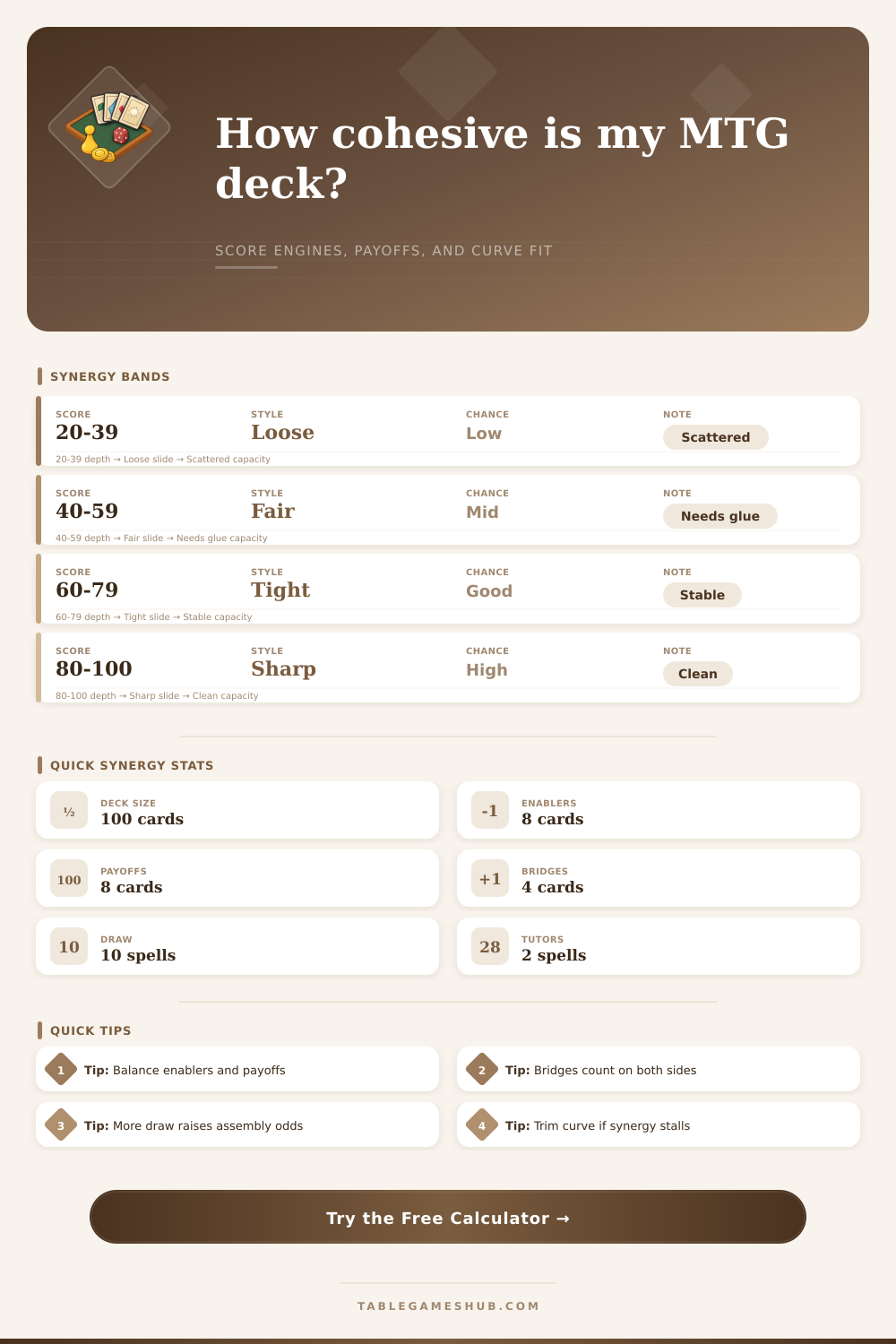
| 0-39 | Loose | Low | Engine is scattered |
| 40-59 | Fair | Mid | Needs more glue |
| 60-79 | Tight | Good | Plan shows up often |
| 80-100 | Sharp | High | Very clean shell |
| Deck size | Variance | Sample note | Best use |
|---|---|---|---|
| 60-card | Lower | Fewer blanks | Tighter lists |
| 75-card | Medium | Middle ground | Kitchen table |
| 100-card | Higher | Singleton style | Commander |
| 120-card | Very high | Big spread | Casual only |
Match the halves
When enablers outnumber payoffs too much, the engine feels busy but not decisive.
Draw is real synergy
Extra card flow often raises the chance of seeing both sides of the engine on time.
Use this MTG deck synergy calculator to compare enablers, payoffs, bridges, draw, tutors, and curve fit, then decide which part of the engine should get the next upgrade.
Building a Commander deck require a person to focus on the concept of synergy between the cards in the deck. Many people will create a series of lists of cards that they believes will work well with the other cards on the list. However, many deckbuilders will find that when they play these decks, the cards does not connect well with each other.
The engine created by these decks will fail to function when the individual cards does not have a connection to each other. In order to avoid this failure of the deck engine, a person must pay attention to the balance of the enablers, payoffs, and bridge cards within the deck. Enablers is cards that will help to create a strategy for the deck.
How to Build a Commander Deck That Works
Payoffs are the cards that a person includes in their deck that offer some benefit to the deck once the strategy has been created. If a person creates many payoffs but does not include enough enabler, the payoffs will remain in a players hand and will not become useful within the game. For example, a tribal deck will include payoff cards that provide some benefit to the creature controlled by the player.
However, if the tribal deck does not include enough creatures that the player can control, those payoff cards will be useless. Bridge cards are cards that provide two function within a deck; they can act as both an enabler and a payoff. Bridge cards improves the efficiency of a deck, as they can fulfill two roles within the deck engine.
The size of the deck also has an impact based off the number of cards that need to be included in a Commander deck. For instance, if a person is constructing a sixty-card deck, they will require fewer instance of some type of card than they will within a one-hundred-card Commander deck. If a person creates a deck that is too thin with the necessary enablers and payoffs, they will not draw enough of the necessary cards.
However, if there are too many instances of the necessary cards within the deck, the player may draw too many of those cards and struggle to draw enough land to play the necessary spells. Therefore, a person must adjust the density of the enablers and payoffs according to the size of the deck that they are constructing: sixty or one hundred cards. In addition to the enablers, payoffs, and bridge cards, a person must also include some support cards for the deck to function.
Support cards will improve the odds of drawing the necessary enablers for the deck. Draw spells and cantrips is types of support cards. They allow a player to draw more cards from their deck.
Additionally, tutors are support cards that will allow the player to find specific cards within their deck. If a player includes many enablers but no draw spells, they will run out of cards in their hand before they are able to activate the payoff spells. Thus, a person must include some support cards within their deck.
Another important aspect of a Commander deck is the mana curve. The mana curve will help to determine during which phase of the game a player can play their spells. If the mana curve of a deck is too high, a player will find themselves playing their cards too slow.
Playing too slowly with their cards will stall the players deck engine. For instance, artifact decks often use a lower mana value for their spells to allow the player to play their artifact rocks at the beginning of the game. If a player creates a mana curve that matches the archetype of the deck, the synergy between the spells within that deck will flow well.
However, if the mana curve does not match the type of deck, the synergy will stall. One of the most common mistake that people make when building their decks is ignoring the importance of enablers when including many payoff spells. If players include too many payoff spells but do not include enough enablers, those payoff spells will become useless within the game.
Players should focus on creating an even number of enabler and payoff spells. Another common mistake is ignoring the format of the game that they are playing. For Commander decks, there are many more engine piece in a one-hundred-card deck than in a sixty-card deck.
In order to evaluate a person’s deck, they can use a synergy score. The synergy score for a deck will combine multiple factors to determine a single score for the deck. A high synergy score will indicate that the players deck is more stable and able to execute its game plan.
A low synergy score will indicate that the deck is inconsistent in its performance within games. If the synergy score is low, the player can determine the weakness within the deck by evaluating the balance between the enablers and payoffs. If the player finds that there are too few enablers, they should add more enabler to the deck.
Additionally, if there are too few draw spells, the player should add more draw spells to the deck. Finally, a person can refine their deck by performing several steps. They can count the number of enablers, payoffs, and bridge cards in their deck.
Then, they can begin to adjust the components of their deck, according to the type of deck that they are constructing and the size of the deck. They should only adjust one variable at a time. Once they have adjusted the specified component of their deck, they can reevaluate the odds of successfully assembling the components of their deck engine.
By focusing on the mathematical connection between the enablers and payoffs for a Commander deck, the player will find that the deck functions well during games. You should of checked the math too. It can be alot of work.