🎯 MTG Commander Bracket Calculator
Score deck speed, engines, and finishers to estimate your likely bracket.
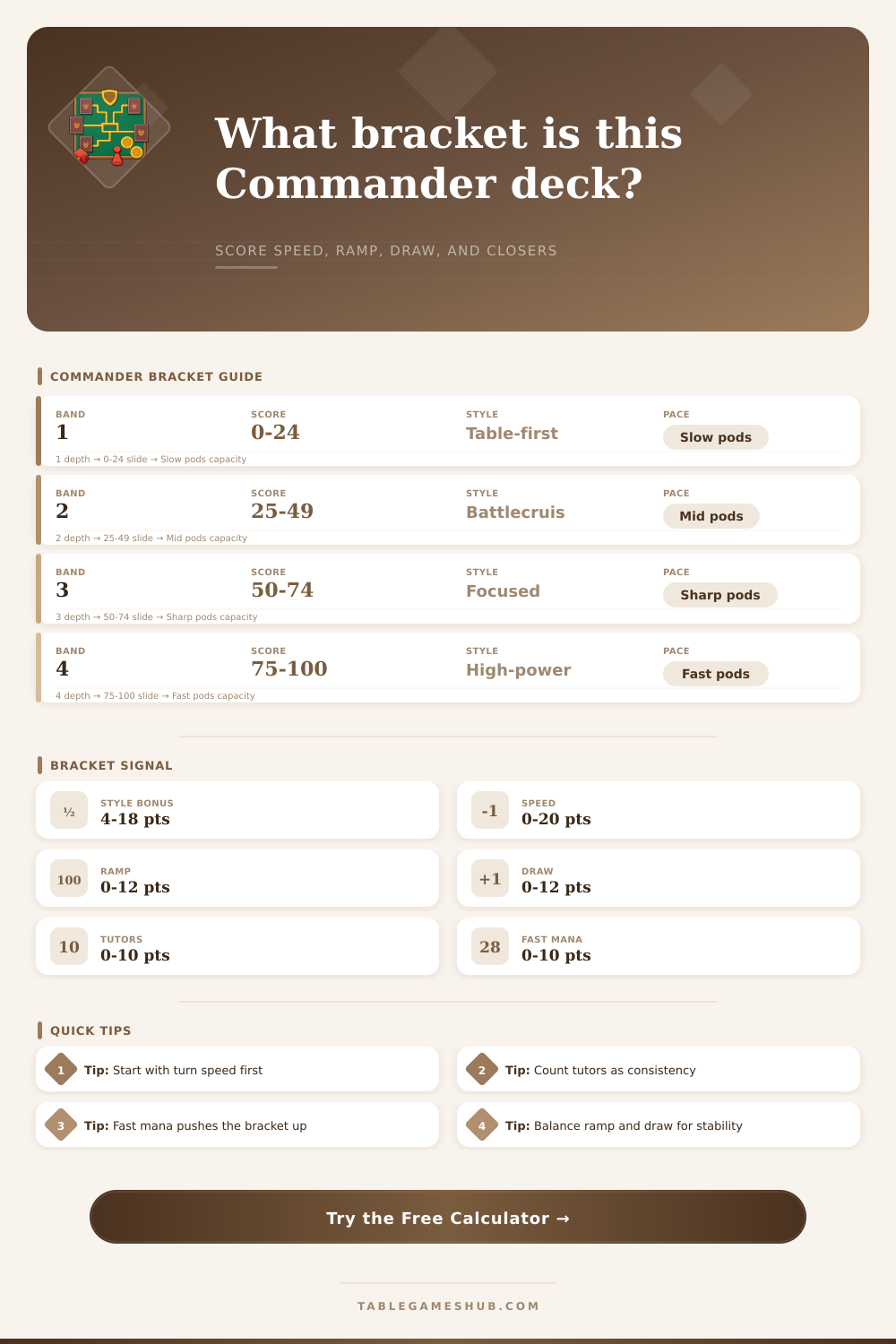
| Measure | Your deck | Calc | Meaning |
|---|
| Bracket | Score range | Deck feel | Typical pace |
|---|---|---|---|
| 1 | 0-24 | Story-first, low pressure, and light tutoring. | Slow pods and splashy plays. |
| 2 | 25-49 | Casual tuned with real ramp and a clear plan. | Mid-range tables and fair games. |
| 3 | 50-74 | Focused, consistent, and built to execute. | Sharp pods with tighter threat windows. |
| 4 | 75-100 | High-power lists with fast lines and tutors. | Explosive pods and compact turns. |
| Package | Low | Target | High |
|---|---|---|---|
| Ramp | 4-7 | 8-12 | 13+ |
| Draw | 3-6 | 7-10 | 11+ |
| Interaction | 2-5 | 6-9 | 10+ |
| Tutors | 0-1 | 2-4 | 5+ |
| Fast mana | 0-1 | 2-4 | 5+ |
| Combo finishers | 0-1 | 2-3 | 4+ |
| Turn band | Speed tier | Score push | Bracket signal |
|---|---|---|---|
| 10+ | Slow | Low | Battlecruiser |
| 8-9 | Steady | Mid | Casual tuned |
| 6-7 | Quick | High | Focused |
| 4-5 | Explosive | Very high | High-power |
| Profile | Common mix | Bracket pull | Short note |
|---|---|---|---|
| Precon | Low ramp and draw | 1-2 | Upgrade baseline first. |
| Casual tuned | Balanced value | 2-3 | Big spells are still fine. |
| Focused | Clean engines | 3 | Plan A should work often. |
| High-power | Tutors and fast mana | 4 | Compact lines matter most. |
Turn speed is the anchor
If your list wins much earlier than the table, the bracket will usually climb even before the rest of the package counts.
Balance matters too
Decks with strong draw but weak ramp, or the reverse, often feel less stable than the score suggests.
Use this Commander bracket calculator to translate speed, ramp, draw, tutors, interaction, and combo density into a clear bracket score, then compare your list to the table.
Commander power level brackets are tool that can be used to categorize Commander decks. Many people use vague term to describe the different types of Commander decks that exist, but using the power level brackets can provide a more concrete means of categorizing Commander decks. These brackets creates different tiers for Commander decks based on how they play during a game of Commander.
By using a calculator to score your Commander deck, you can find where your Commander deck fit within the power level brackets. There are several specific component that determine where a Commander deck falls within the power level brackets. One of the main component is speed.
How to Score and Balance Your Commander Deck
Speed determine how quickly a Commander deck can reach the winning state. You can use the average win turn for a Commander deck to calculate it speed. Ramp is another main component for Commander decks.
Ramp refers to mana rock and land tutors within a Commander deck. A Commander deck need to have at least some ramp to play its spells quickly. Draw engines are another essential component of a Commander deck.
Draw engines provides the player with the ability to have repeatable card advantage, which ensures that a Commander deck can continue to play its cards even when it encounters disruption during the game. Interaction is another main component for Commander decks. Interaction refers to counterspell and removal spells that a player can use against their opponents.
Too little interaction will make it difficult for opponents to be countered, but too much will make the Commander player a control player over the game. Tutors allow players to find their specific card within their Commander deck. This component increase the precision of a Commander deck.
Fast mana, such as Mana Crypt or Chrome Mox, allow a player to play their spells ahead of their scheduled turn. Finally, combo density is the last component for Commander decks. Combo density refers to the number of finishers within a Commander deck that allow the deck to win the game.
A Commander deck must contain a balance of these components for it to function properly. A Commander deck with alot of ramp but little draw will feel clunky and may struggle when playing against opponents with better draw ability. A Commander deck without balance in its components will struggle when playing against others.
The current scoring system aim to reward players with Commander decks that are balanced. Casual tuned decks, which aim to even play out a game of Commander fairly and provide enough resource for players to have success with their decks, exist within the middle power level bracket for Commander decks. Focused Commander decks are built to have each of their cards have several in-game function, and these decks exist in the upper brackets.
High-power list are the most powerful decks in each bracket and can execute their winning play every few turns. There are also several preset within this format. A precon baseline is one of the low-power level presets.
Precon decks provide for limited ramp and a focus on the theme of the deck. By adding some ramp and draw component to a precon, players can build a battlecruiser deck. Other popular deck type are token swarm decks and graveyard loop decks.
Each of these type of decks have varying requirement for interaction with opponents’ spells. Spell-slinger decks require many draw and counterspell component. Toolbox decks require many tutor to find the right spells.
Adding fast mana to a Commander deck can create what is essentially a bracket four deck; fast mana allow decks to make powerful play on turn one. It is important to be honest in determining the bracket of your Commander deck. If you claim your deck has a high power level but it does not, you will struggle against other player that may have higher power levels.
An underestimated power level will result in you missing opportunities to play at a higher level. Other factor such as consistency can play a big role in your bracket. Tutors will increase the consistency of your deck.
Another factor to consider is the demand of your commander. There are several strategy to improving your Commander deck. One of the first is to run a solo test of your deck.
During this test, you will clock how many turn it takes to win the game with your Commander deck. During a stress test, you will test your deck against the games threat. If the ramp in your deck outpaces your draw by five or more card, you should of replaced one of your mana rock with a card that provides more draw value.
If your finishers are weak in your deck, focus on adding tutor to find your win condition. Use a component grid to visually map out your Commander deck. This diagram will allow you to group all of your finisher, tutors, fast mana card, and closers.
Finally, ensure that your Commander deck is balanced. A Commander deck with a balance bonus will find more success within its bracket.