🃏 MTG Deck Calculator
Estimate lands, curve pressure, draw density, and color readiness before you shuffle up.
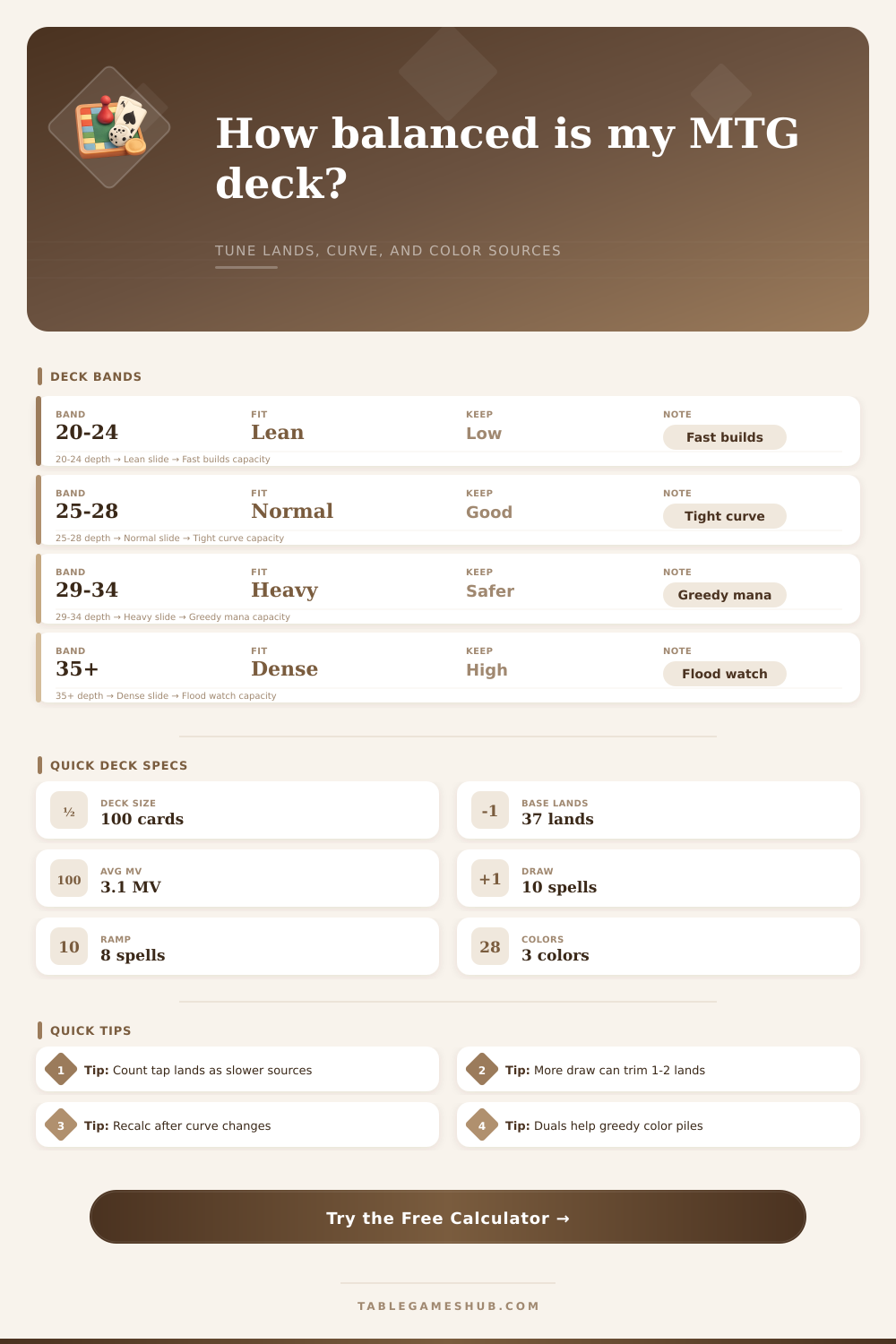
| Measure | Input | Derived | Note |
|---|
| Format | Base lands | Draw target | Deck note |
|---|---|---|---|
| Commander / EDH | 37 | 10 | Singleton mana needs cushion |
| 60-card Constructed | 24 | 8 | Lean shells reward cleaner curves |
| Limited | 17 | 6 | Curve and bomb density move it |
| Brawl | 26 | 8 | Commander-like pressure on a smaller shell |
| Curve band | Land range | Draw range | Typical feel |
|---|---|---|---|
| 1.8 to 2.4 | 22 to 24 | 7 to 9 | Fast aggro and low curve tempo |
| 2.5 to 2.9 | 24 to 26 | 8 to 10 | Tempo shells with steady pressure |
| 3.0 to 3.4 | 26 to 37 | 9 to 11 | Midrange lists that want balance |
| 3.5 and up | 28 to 40 | 10 to 14 | Control and ramp lists want slack |
| Color count | Source tilt | Double-pip watch | Mana note |
|---|---|---|---|
| 1 color | Low | 1 to 2 | Basic-heavy plans stay easy |
| 2 colors | Moderate | 2 to 4 | Duals and smooth fetches help |
| 3 colors | Medium | 3 to 5 | Greed rises fast with repeated pips |
| 4 to 5 colors | High | 5+ | Fixing quality matters a lot |
| Style | Ramp target | Draw target | Land note |
|---|---|---|---|
| Aggro | 0 to 4 | 7 to 9 | Cut slow lands when curve stays low |
| Tempo | 3 to 6 | 8 to 10 | Keep early turns untapped |
| Control | 2 to 6 | 10 to 14 | Higher land counts absorb the grind |
| Ramp | 8 to 14 | 8 to 10 | Land ceiling usually climbs fastest |
Count slow sources honestly
Tap lands and awkward fixing help color access, but they do not help your first turns as much as untapped sources.
Recalc after every curve change
A new one-drop, extra tutor, or pricier finisher can move the land target enough to matter in real games.
Use this MTG deck calculator to compare lands, draw, ramp, and color pressure, then decide whether the list needs more sources, a cleaner curve, or fewer slow cards.
A mana curve is an way to organize the costs of the cards in a deck, and a mana curve will determine in what way that deck function within the game. If a player constructs the mana curve in a poorly manner, it is possible that you have too many expensive spell in your deck and not enough lands, or that you have too many lands in your deck and not enough spells that can be played on the game. A mana curve is, therefore, vital to the construction of a deck, as it will dictate the tempo of the game in which that deck is played.
A well-constructed mana curve will allow a player to play their card during the appropriate turn within the game, but an unbalanced mana curve will make it difficult for a player to play their spells throughout the game. A mana base is the group of cards within a deck that provide mana to the player. These mana base must work in conjunction with the mana curve.
How to Build a Balanced Mana Curve and Mana Base
For instance, a mana base that includes too few land will prevent a player from having enough mana to play their spells. Additionally, if a player’s deck contains spells that require mana of color that are not provided by the mana base, the player will not be able to play those spells. Thus, a player must ensure that their mana base provide the correct amount and colors of mana needed for their deck.
Many deck builders can utilize another structure that is a three-part structure for a deck that includes lands, ramp spells, and bridge spells. Lands are the source of all mana within a game, and players use ramp spells to provide additional mana to a player. Additionally, bridge spells include spells that provide additional utility for the player, such as interaction spells that allow a player to respond to another player’s actions during there turn.
If a player ignores bridge spells during deck building, it is possible that the deck will lack the necessary ability to play between the early and mid-stages of the game. The archetype of a deck will determine the structure of the mana curve and base for that deck. For instance, aggro decks utilize low mana curve, as the archetype of those decks is for it to play many small creature during the early stages of the game.
Ramp decks has higher mana curves and include more lands in their decks to allow for the playing of very large spells later in the game. Control decks contain many draw and interaction spells to allow the deck to react to the actions of its opponent. Thus, decks of any archetype should have a mana curve that enables it to function in the same way that it is designed to.
The colors of mana that a deck requires will also impact how a mana base is constructed. If a deck utilizes many colors, the mana base will have to be constructed in a way that permits it to find mana of each of those color. For instance, you may incorporate dual lands into the mana base to allow for each color to be obtained, but each of those lands may enter the battlefield tapped.
Tapped lands will slow the construction of mana. In addition to incorporating dual lands into the mana base, you can also construct ramp spells to provide each of the colors of mana required by the deck. However, the ramp spells should be limited to only those that contain the same colors as those that are required by the spells in the deck.
If the deck contains many spells that require two colors of mana, for instance, then the mana base will have to include an increased number of source of those two colors. Within a deck, draw spells and ramp spells are considered support spells. Support spells help to contribute to the stability of the constructed deck.
Draw spells allow a player to see more cards within their deck. Seeing more cards allow a player to have a better chance of finding lands. Ramp spells will increase the total amount of mana that is available to a player.
Having more mana allows for more spells to be played during a player’s turn. However, if a player constructs too many ramp spells within a player’s deck, the player may have too much mana but not enough spells to utilize such mana. There are steps that can be followed to improve a deck.
For instance, a player can log the number of lands, ramp spells, and draw spells within the deck. Additionally, it is possible to calculate the average mana value for all of the cards within the deck. Each of these value will help a player to determine whether the mana curve for the deck is too high or too low.
In adjusting each of these categories, it is recommended to make only one adjustment at a time. After each adjustment to a category, the player should recalculate each of these logged values. By making adjustments to each of these variable individually, the player can properly balance the mana curve and mana base for a players deck.
Its important to realize that deck building can be dificult, but you should of practiced more. One should of studied more before making these moddern changes. You’ll find that most deck builders dont realize how much the mana base matters.
It’s alot of work to get it right. You should try to recieve more experience with different deck archetypes. A well designed deck is more comfortabley played than one that is poorly constructed.
Most players realize this after they play alot of games. The decks size is also a factor. You should check the deck’s size before you start.