🎲 Pathfinder 2e Difficulty Calculator
Find DCs by level, proficiency rank & difficulty adjustment
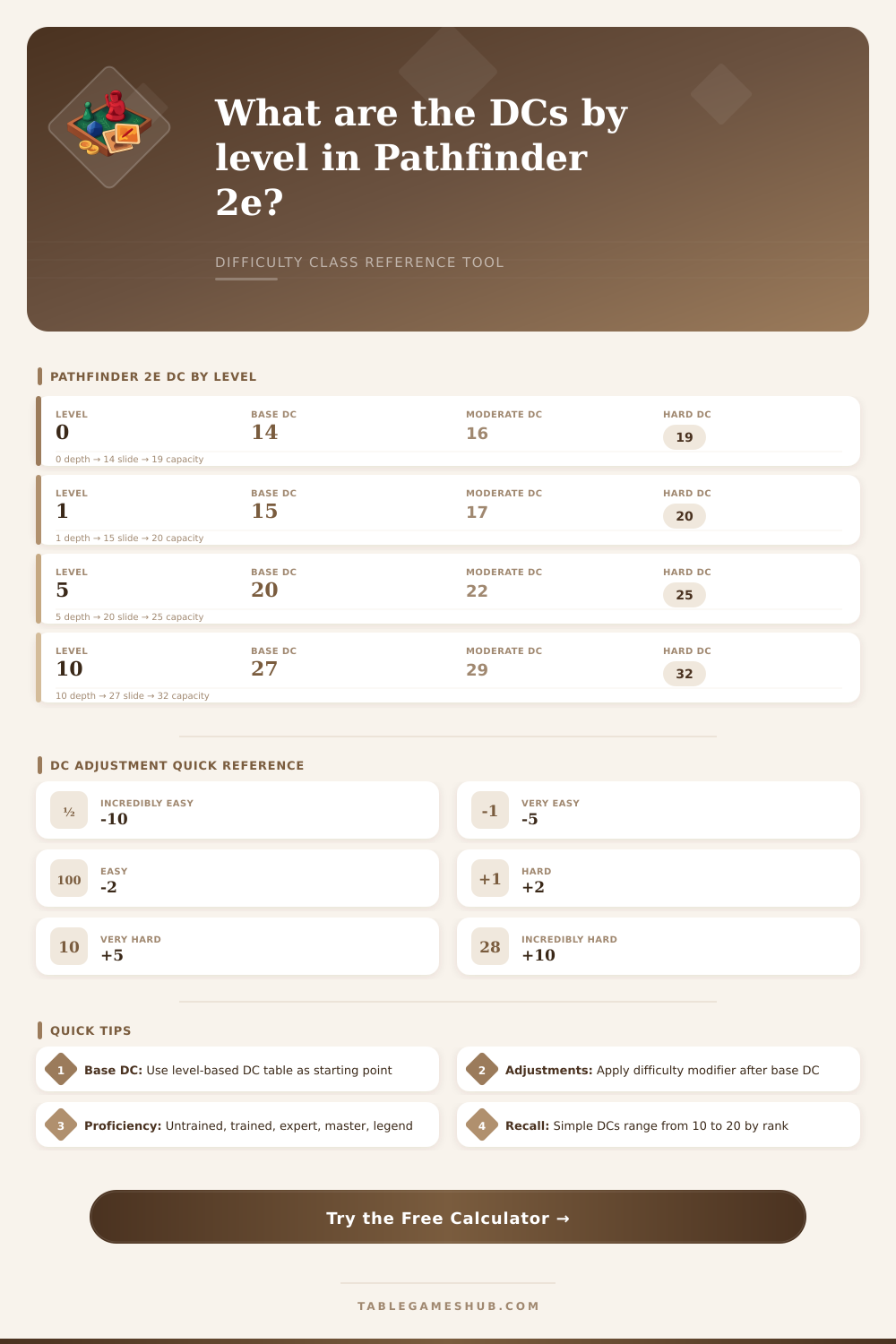
| Level | Base DC | Easy (-2) | Hard (+2) | Very Hard (+5) |
|---|---|---|---|---|
| -1 | 13 | 11 | 15 | 18 |
| 0 | 14 | 12 | 16 | 19 |
| 1 | 15 | 13 | 17 | 20 |
| 2 | 16 | 14 | 18 | 21 |
| 3 | 18 | 16 | 20 | 23 |
| 4 | 19 | 17 | 21 | 24 |
| 5 | 20 | 18 | 22 | 25 |
| 7 | 23 | 21 | 25 | 28 |
| 10 | 27 | 25 | 29 | 32 |
| 15 | 34 | 32 | 36 | 39 |
| 20 | 40 | 38 | 42 | 45 |
| 25 | 46 | 44 | 48 | 51 |
| Proficiency Rank | Simple DC | Typical Uses | Min Level |
|---|---|---|---|
| Untrained | 10 | Basic recall, simple tasks | Any |
| Trained | 15 | Standard tasks, common knowledge | 1 |
| Expert | 20 | Complex tasks, advanced knowledge | 3 |
| Master | 30 | Difficult tasks, rare knowledge | 7 |
| Legendary | 40 | Near-impossible tasks, secret lore | 15 |
| Degree | Condition | Typical Effect | Nat 20 / Nat 1 |
|---|---|---|---|
| Critical Success | DC + 10 or more | Enhanced effect | Nat 20 upgrades one step |
| Success | Meet or exceed DC | Normal effect | — |
| Failure | Below DC | No effect or minor penalty | — |
| Critical Failure | DC - 10 or worse | Severe penalty | Nat 1 downgrades one step |
Pathfinder 2e requires more from its players than 3.5, 5e D&D or even Pathfinder 1e did. You look at a system that rewards tactical thinking and class synergy on the battlefield. The best part?
When you follow the encounter guidelines, tough fights stay hard. They do not crash because of powergaming tricks (they require real skill to beat
Pathfinder 2e Is Harder and More Tactical
In 2e), actions matter more than anything else. The whole game changes the script: instead of worrying about enemy AC or if your attacks hit, you focus on strategy. How many actions do the enemies have compared with your group?
If you can burn the actions of the enemies and yet have some for attack, you almost won. It is a drastic change compared with 1e and 5e, but when it clicks, the variety of character builds and the tactical gameplay make everything much more funy.
PF2e characters are much more fragile than those of 5e. I saw groups that barely survived their first encounter, only to be entirely erased in the second. And they had a solid team with barbarian, monk, cleric and elemental sorcerer working together. That first adventure, Plaguestone, is famous for its violence, mostly because it was out before the rules about encounters were fully polished.
The system itself is known as balanced and fair, built on a specific level of expected trouble. Most of the actual challenges fall on the shoulders of the GM and you cannot simply pass them by means of optimizing the character. That is the heart of the matter, not only in 2e, but why trouble became a more important theme in gaming.
That idea of “magic healed between fights” creates a real problem. Every fight feels identical for folks playing martial characters, which kills any feeling of resource management. It also limits the GM when they design adventures.
If you just put three encounters with only 10 minutes between them, everything flows flat in 5e… But in 2e, that quickly becomes chaotic.
Learning the GM side is not too hard if you already played complex board games. I spent two weeks only reading, and later another two weeks before I could lead the game well. There is more math and modifiers than what 5e gives to you.
Even so, the basic rules of 2e are surprisingly intuitive. The real complexity comes from the many character choices that pile on top.
Each difficulty class (DC) ties to the level, ranging from level -1 at DC 13 until level 25 at DC 50. GMs use that when they set DCs for traps, dangers, skills and everything that is not a direct attack. The fastest way to set a DC “on the fly” is to think about what skill is needed for the task.
If almost anyone could do that reasonably, you use the untrained DC. Harder tasks usually require bumps for uncommon, rare or very rare stuff. Naturally, a challenge that is hard for a 2nd-level character will not feel hard for a 10th-level character.
When you mix special fighters instead of only a group of standard enemies; for example a bad cleric or warlock, the trouble grows and the fight becomes more interesting. Some classes however require more experience. Oracle and Alchemist are classes that new players probably should avoid initially.