🧙 Pathfinder 2e Stat Calculator
Ability scores, modifiers & character build optimizer
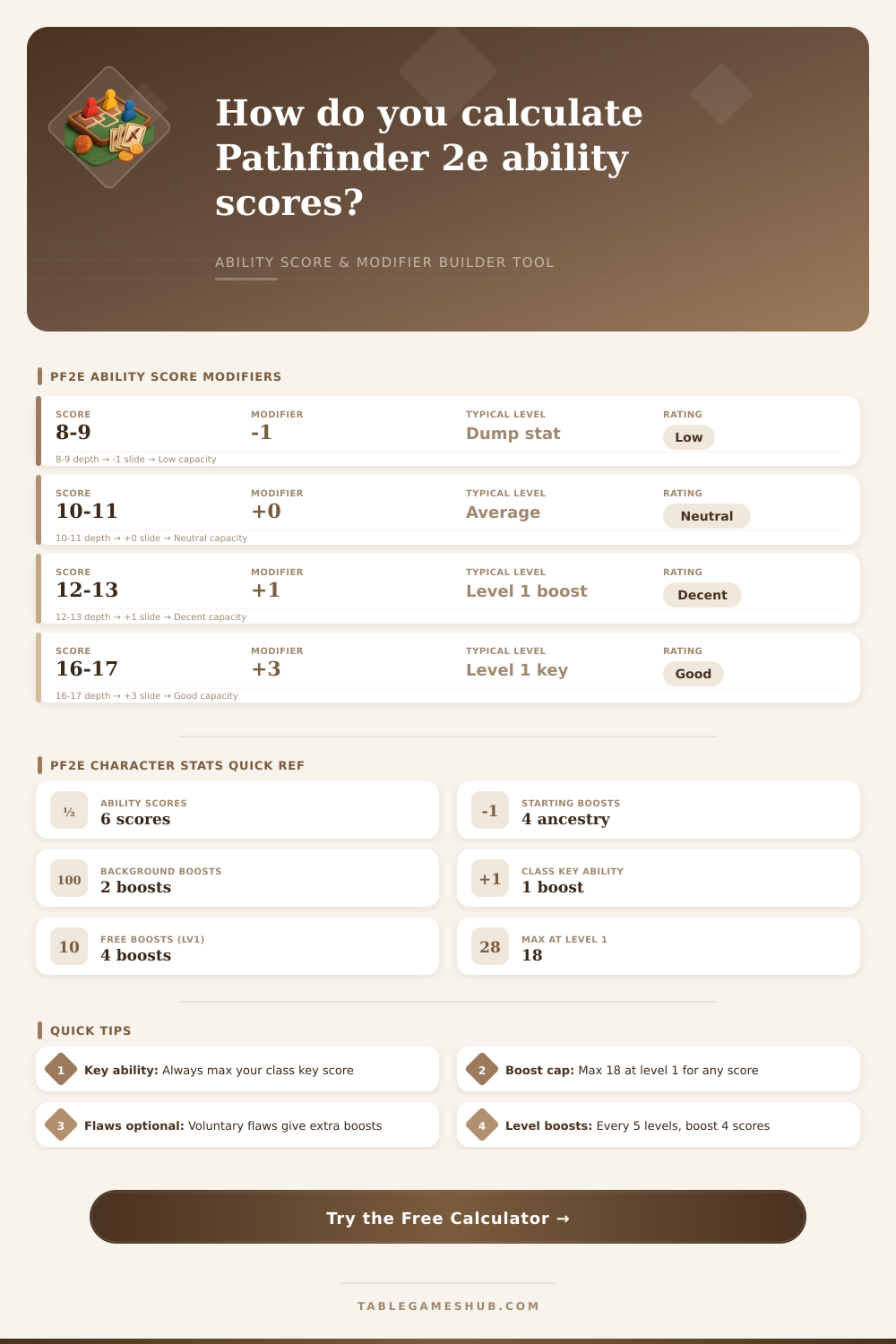
| Score | Modifier | Score | Modifier |
|---|---|---|---|
| 6-7 | -2 | 18-19 | +4 |
| 8-9 | -1 | 20-21 | +5 |
| 10-11 | +0 | 22-23 | +6 |
| 12-13 | +1 | 24-25 | +7 |
| 14-15 | +2 | 26-27 | +8 |
| 16-17 | +3 | 28-29 | +9 |
| Class | Key Ability | Secondary | Hit Points |
|---|---|---|---|
| Fighter | STR or DEX | CON | 10 + CON |
| Rogue | DEX | CHA or STR | 8 + CON |
| Wizard | INT | DEX or CON | 6 + CON |
| Cleric | WIS | STR or CHA | 8 + CON |
| Sorcerer | CHA | DEX or CON | 6 + CON |
| Monk | STR or DEX | WIS | 10 + CON |
| Ranger | DEX or STR | WIS | 10 + CON |
| Champion | STR | CHA | 10 + CON |
| Barbarian | STR | CON | 12 + CON |
| Bard | CHA | DEX or CON | 8 + CON |
| Druid | WIS | DEX or CON | 8 + CON |
| Alchemist | INT | DEX or CON | 8 + CON |
| Level | Boosts Available | Max Score After | Notes |
|---|---|---|---|
| 1 | Ancestry + Background + Class + 4 free | 18 | Initial creation |
| 5 | 4 ability boosts | 20 | +1 if score is 18+ |
| 10 | 4 ability boosts | 22 | +1 if score is 18+ |
| 15 | 4 ability boosts | 24 | +1 if score is 18+ |
| 20 | 4 ability boosts | 26 | +1 if score is 18+ |
Pathfinder 2e uses six ability scores to define every character: Strength, Dexterity, Constitution, Intelligence, Wisdom and Charisma. These scores show the basic skills of the character. The attribute modifiers are among the most important parts of any character because the numbers show the raw potential and affect almost every other statistic on the character sheet
Each ability score starts at 10, which represents the human average. While you make choices for the character, the scores adjust using ability boosts, which raise the score, and ability flaws, which lower it. In Pathfinder 2e the method uses boosts, which give +2 to an ability score and are quite common, and flaws, which mean -2 to an ability score and are very rare.
How Ability Scores Work in Pathfinder 2e
Character creation is about choices. You can put away the dice, because Pathfinder characters are made so that the choices of the player lead everything. There is no rolling for the statistics.
The system is very tight, and rolling could cripple a charatcer. Rolling was common in older books, because there the statistics did not matter much. The default method in the Core Rulebook helps players learn the story of their character step by step, while the alternative method for rolling scores is a nod to tradition.
Constitution measures the general health of a character and their stamina. It is an important statistic for all characters, especially for those that fight in close combat. When you think about distribution of statistics, you commonly ask if you keep everything balanced or strongly focus on one score.
For instance, should a barbarian have very balanced stats with Strength at 22 and the rest around 18, or push Constitution to 20 while lowering the other stats a bit?
Many builds suggest starting with 18 Strength for a martial character. Even so, for something like a monk, starting at level 1 with 16 Strength and 16 Dexterity can feel much better. A difference of +1 works more in Pathfinder 2e than in D&D 5e. Because of that the spell bless only gives +1 in Pathfinder 2e, while the 5e version gives a bonus of +1d4. Stats matter, but a character is not necessarily destroyed if the stats are not fully optimized.
Pathfinder 2e does not have strict maximums for abilities, although there is a soft limit of 24. By just leveling, a character can reach 22 in the primary ability of their class, like Wisdom for Clerics. What is gone, however, are all extra ways to increase statistics.
During character creation, odd numbers are basically impossible to get, and odd values usually appear only when you increase a score above 18 during level-ups. Compared with the first edition, the range of stats was lowered. It is important to choose things like ancestry and class before setting the ability scores, because each of those parts affects the base of the characterstatistics.