🧙 D&D 5e Jump Distance Calculator
Calculate long jump, high jump & movement cost using official PHB rules
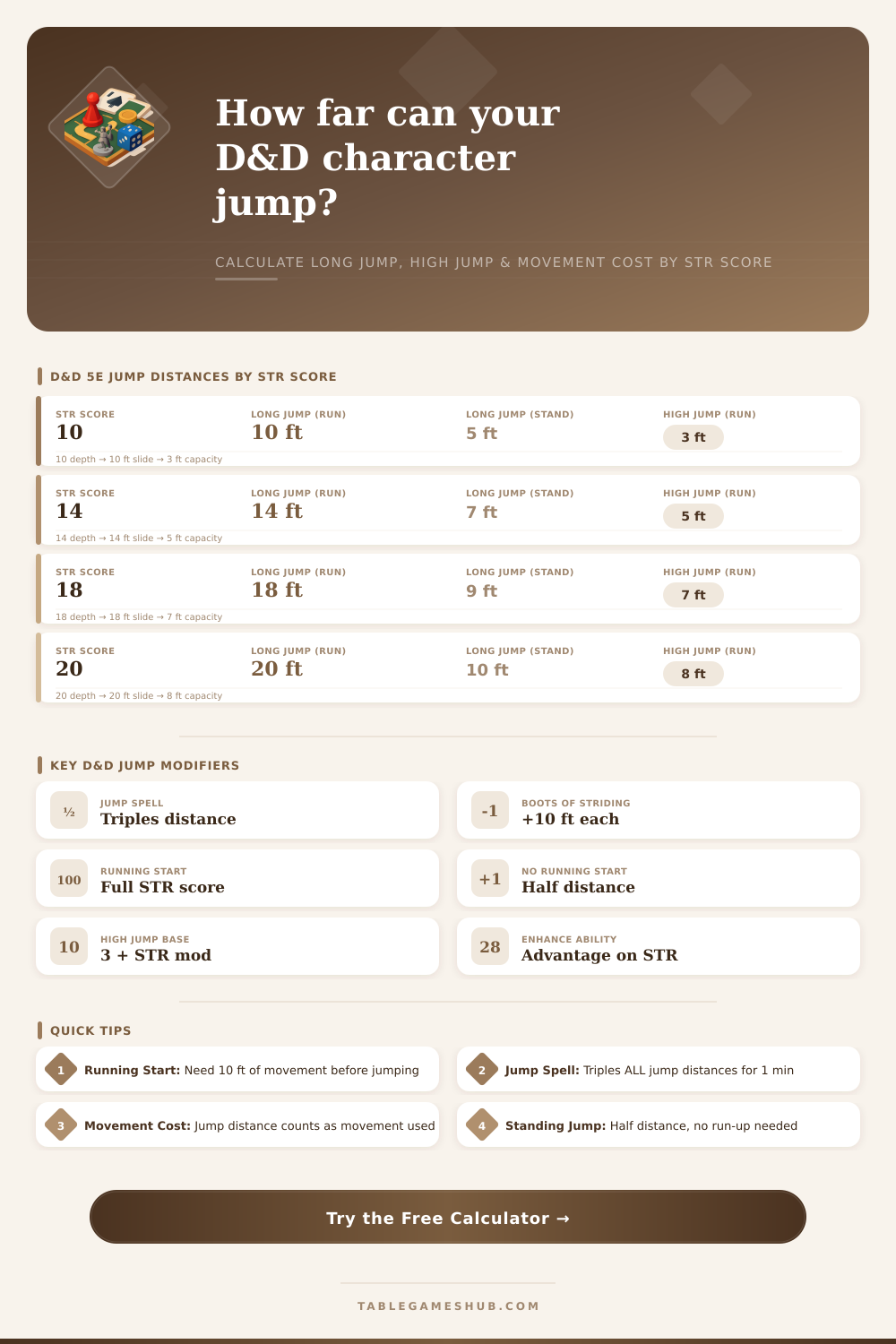
A running start requires at least 10 feet of movement immediately before the jump. Long jump = STR score in feet. High jump = 3 + STR modifier in feet. Both use movement equal to the distance jumped.
The Jump spell triples your jump distance for 1 minute (concentration not required). Boots of Striding and Springing add 10 ft to each jump type. These stack multiplicatively with the Jump spell for massive distances.
| STR Score | STR Mod | Long Jump (Run) | Long Jump (Stand) | High Jump (Run) | High Jump (Stand) |
|---|
Jumping in D&D has some interesting rules that can be a bit confusing When you do high jump, the character jumps in the air a number of feet equal to 3 plus his Strength modifier, but only if he moved at least 10 feet on foot before. If character tries long jump without motion, he can jump only half of the normal distance. In every case, every foot jumped uses one foot of movement.
If the jump fails, the character falls and lands prone.
How Jumping Works in D&D
Actually, it does not mention what kind of action jumping is or how much movement is needed to start it. In the combat chapter of the Player’s Handbook, no action is listed that allows a character to try acrobatics or athletics during fight. That makes things a bit complex when you fihgt.
Jumping is part of the normal movement, and the maximum distance depends on walking speed. If character uses the Dash action, that changes the situation a bit. Dash says that character can move 30 feet spending only 10 feet of movement.
Because it does not say what else it affects, the rules for high and long jump still apply as written in the rules.
The rules about jumping in D&D are very weird and seem to lack sense even in the own system of the game. With perfect combination, character with Strength 20 could reach 50 feet in long jump or 14 feet in high jump, everything without any magic items.
Talking about magic, there is a spell called Jump. You find it in the Free Basic Rules of both versions, 2014 and 2024. When you cast it, the magician touches a creature.
The jump distance of that creature is tripled until the end of the spell. That is very useful when you need to cross big holes.
If character jumps to seize something, successful check means that he reached the wanted height. If he wants to pull himself up after that, he can do that with a move action and DC 15 check of Climbing. If the jump check fails, the character does not reach the height and lands on his feet in the same spot.
There are also ways to build a character around jumping. Taking 2 levels of monk gives movement without armor, which raises the speed and the jump height to 40. At that level, spending 1 point to use Step of the Wind, you double the maximum jump to 90.
That is quite a wild number. DC 10 Strength Athletics check also can be used for jumping over obstacles. There are various calculators for D&D 5th edition that count the maximum distance based on attributes and all applicable modifiers or special abilities.