♟ Chess Advantage Calculator
Material balance • Exchange evaluator • Endgame classifier
♔ White Pieces
♚ Black Pieces
📊 Position Details
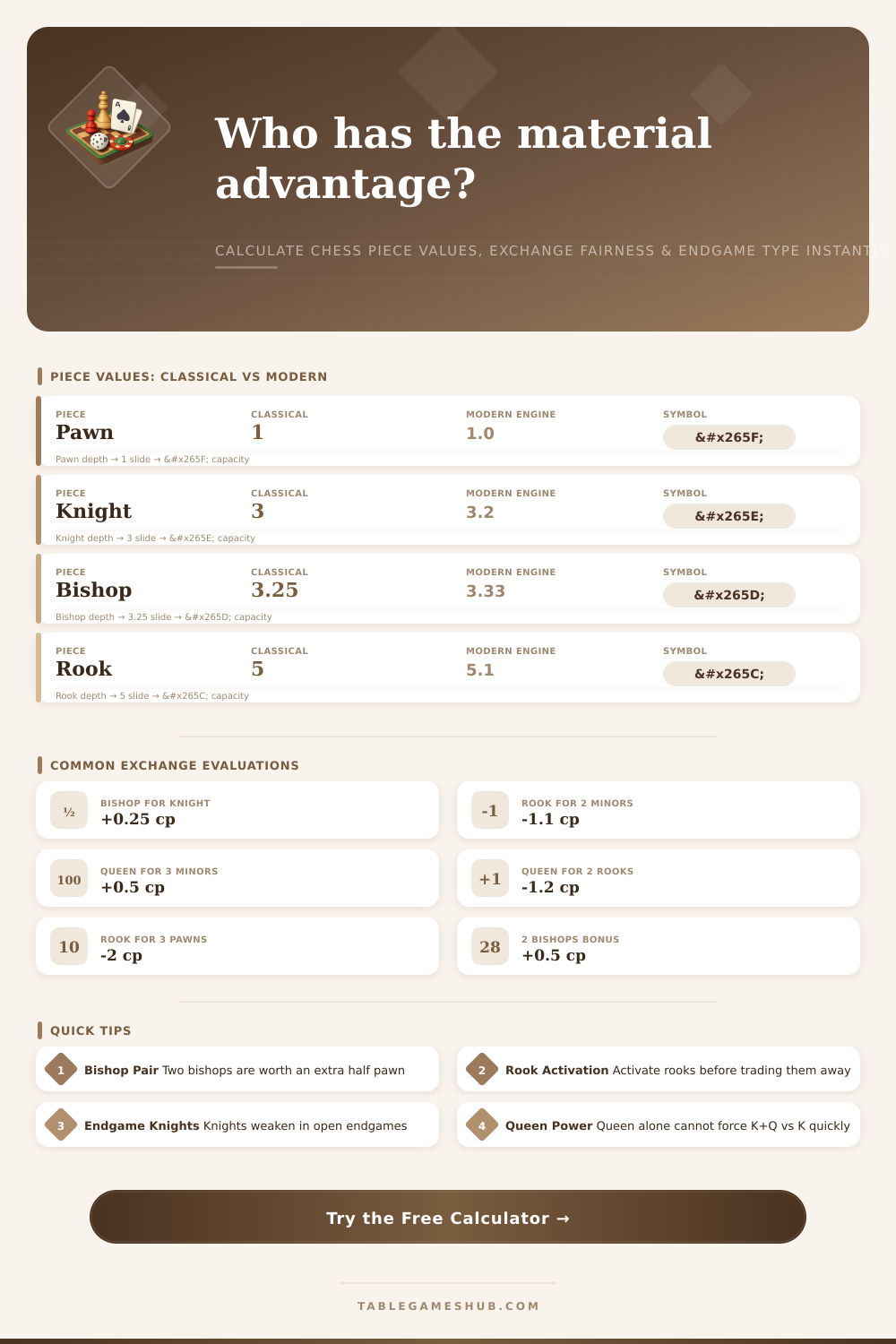
📋 Reference: Classical vs Modern Piece Values
| Piece | Symbol | Classical | Modern Engine | Centipawns |
|---|---|---|---|---|
| Pawn | ♟ | 1 | 1.0 | 100 |
| Knight | ♞ | 3 | 3.2 | 320 |
| Bishop | ♝ | 3.25 | 3.33 | 333 |
| Rook | ♜ | 5 | 5.1 | 510 |
| Queen | ♛ | 9 | 8.8 | 880 |
| Bishop Pair | ♝♝ | +0.5 | +0.5 | +50 |
⇄ Common Exchange Values
| Exchange | Classical Diff | Verdict |
|---|---|---|
| Bishop for Knight | +0.25 | Slight bishop favor |
| Rook for Bishop + Pawn | +0.75 | Slight rook favor |
| Rook for 2 Minors | −1.25 | Exchange sacrifice |
| Queen for 2 Rooks | +1.0 | Rooks typically better |
| Queen for 3 Minors | −0.75 | Roughly equal |
| Rook for 3 Pawns | +2.0 | Strong rook advantage |
🏁 Endgame Winnability Chart
| Endgame Type | Winnability | Notes |
|---|---|---|
| K+Q vs K | Forced Win | Mate in ~10 moves max |
| K+R vs K | Forced Win | Mate in ~16 moves max |
| K+2B vs K | Forced Win | Mate with both bishops |
| K+B+N vs K | Forced Win | Difficult, ~33 moves |
| K+B vs K | Theoretical Draw | Insufficient material |
| K+N vs K | Theoretical Draw | Insufficient material |
| K+Q vs K+R | Winning | Usually ~30 moves |
| K+R vs K+B | Complex | Fortress draws exist |
| K+P vs K | Key-square rule | Depends on pawn position |
In chess, the player that moves first (White) has a natural advantage. This is widely accepted since at least 1889, when Wilhelm Steinitz, the first world champion, noticed that Even so, that advantage is not big enough to win if both sides play perfectly.
At every level, from grandmaster to beginner, the first move gives White only around 5 percentage points more. If you play twenty matches as White against an opponent of the same strength, you will on average end one game above.500. That makes playing white a bit like being the home team in a Major League Baseball game.
Why White Has an Advantage in Chess
White wins about 2.5 to 5.0 percent more often than Black. Hence, pairing systems try to alternate the colors between the players. Some grandmasters are considered “underrated” because over time they accidentally received the black pieces more often than usual.
Because White moves first, you usually can start to press the opponnet. A well prepared player with white pieces can create important problems that are not easily settled on the board. White chooses from several critical options, while Black must respond.
But in recent years, computer engines showed that Black can reach equity with precise play in almost every main line. Even so, because chess is played by people, there is a clear practical advantage to have the white pieces.
Because chess is not yet solved, nobody knows 100 percent for sure, but the general opinion is that perfect play would lead to a draw. To know whether a game is perfect, the endgame tablebases should extend to the starting position. Right now, work is still underway to solve all eight-piece positions.
Some mistakes by White could be enough for Black to win. Even so, only one or two bad moves by Black could allow White, with perfect play, to win the full point.
That advantage itself is not something that you can define with precise math. If chess were solved, the only ratings of any position would be white win, black win or draw. Advantage is a flexible idea based on human insight.
When you look at a position, the way to decide who is better depends on factors like material, king safety, space and the quality of the pieces. There are many ways to have an advantage, including passed pawns, open files and better development. A passed pawn can bind a piece to defense, creating a material advantage because the opponent cannot use such a bound piece fully.
Having material advantage does not mean that the mechanics of the game changed. It stays a fight for the initiative. Winning positions are often converted to victory through simplification, which means to exchange pieces to reach a simpler position.
Chess is extremely dependent on the particular position.