♚ Chess Notation Calculator
Decode algebraic moves, convert squares, parse PGN & count plies
✓ Move Decoded
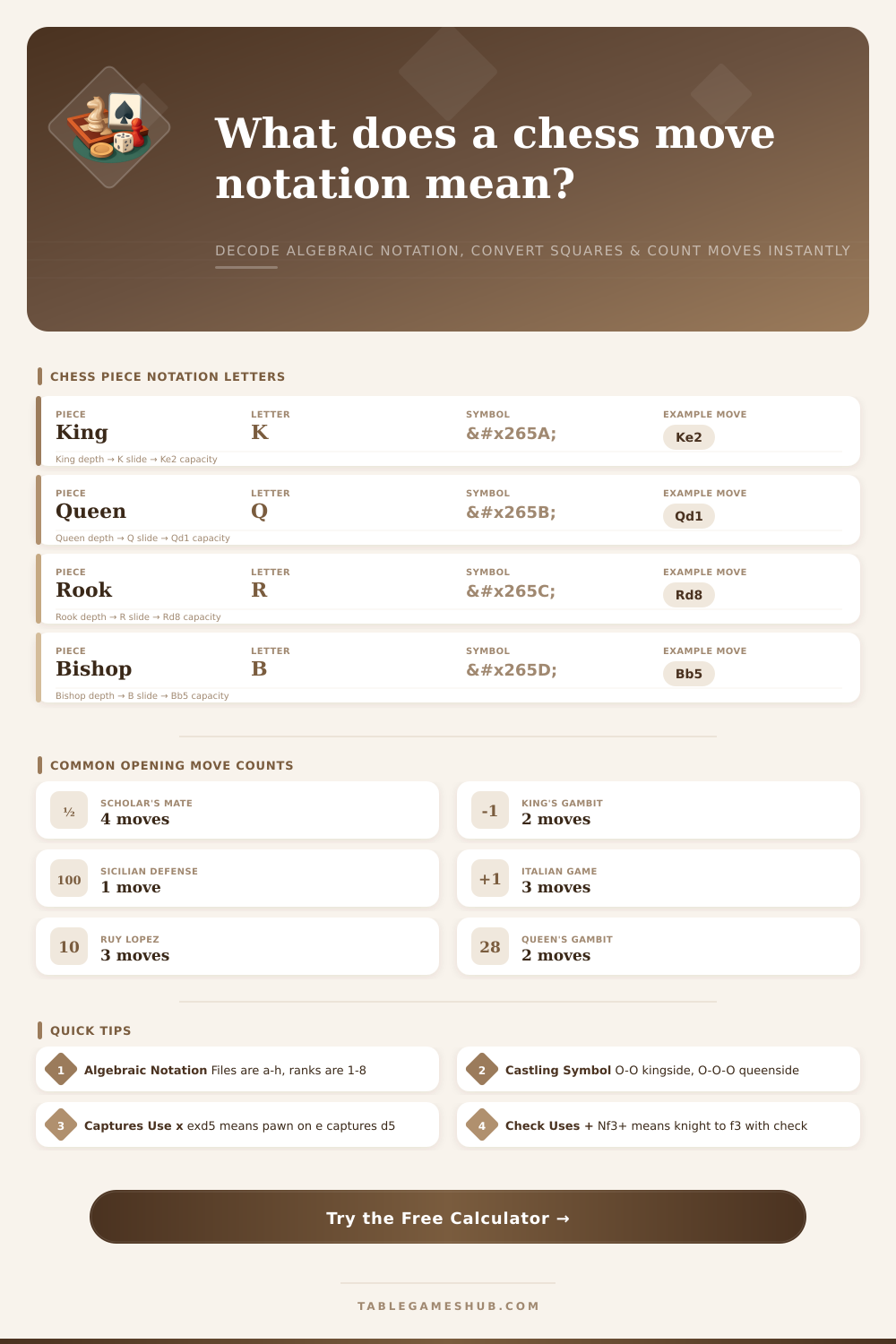
Files are labeled a-h (left to right) and ranks 1-8 (bottom to top). Piece letters: K=King, Q=Queen, R=Rook, B=Bishop, N=Knight. Pawns have no letter prefix. Captures use "x" and check uses "+".
O-O means kingside castling. O-O-O means queenside castling. En passant is written like a normal capture (exd6 e.p.). Pawn promotion uses "=" followed by piece (e8=Q). Checkmate is "#".
♟ Chess Piece Notation Reference
▦ Special Move Symbols Table
| Symbol | Meaning | Example | Notes |
|---|---|---|---|
| x | Capture | Nxe5 | Piece takes piece on target square |
| + | Check | Bb5+ | King is in check |
| # | Checkmate | Qxf7# | Game-ending check |
| O-O | Kingside Castle | O-O | King moves g1/g8, Rook h-file to f |
| O-O-O | Queenside Castle | O-O-O | King moves c1/c8, Rook a-file to d |
| = | Promotion | e8=Q | Pawn promotes to chosen piece |
| e.p. | En Passant | exd6 e.p. | Special pawn capture |
| ! | Good Move | Nf6! | Annotation: strong move |
| ? | Mistake | Qh5? | Annotation: weak move |
| !! | Brilliant Move | Rxf7!! | Annotation: exceptional move |
📊 Board Coordinate Grid (File x Rank)
| File Letter | File Number | Example Square | Board Index (rank 1) |
|---|---|---|---|
| a | 1 | a4 | 0 (a1=0) |
| b | 2 | b5 | 8 (b1=8) |
| c | 3 | c3 | 16 (c1=16) |
| d | 4 | d7 | 24 (d1=24) |
| e | 5 | e4 | 32 (e1=32) |
| f | 6 | f6 | 40 (f1=40) |
| g | 7 | g2 | 48 (g1=48) |
| h | 8 | h8 | 56 (h1=56) |
⏱ Common Opening Move Counts
| Opening | Moves (per side) | Total Plies | Game Phase |
|---|---|---|---|
| Scholar's Mate | 4 | 7 | Opening |
| King's Gambit | 2 | 4 | Opening |
| Sicilian Defense | 1 | 2 | Opening |
| Italian Game | 3 | 6 | Opening |
| Ruy Lopez | 3 | 6 | Opening |
| Queen's Gambit | 2 | 4 | Opening |
| Average Midgame Start | 15 | 30 | Middlegame |
| Average Game Length | 40 | 80 | Endgame |
Chess notation is basically the written language of chess, it allows players to record moves for study, share them with others and replay them whenever they want. By a combination of letters and numbers, the notation specifies which square a piece moves to. It is very practical, as soon as you get the hang of it
Algebraic notation is the standard that you meet almost everywhere now: in books, tournaments, online platforms and software. The board itself works as a coordinate grid. The horizontal lines are called ranks and numbered 1 to 8; the white pieces start on ranks 1 and 2, while the black pieces take ranks 7 and 8.

How Chess Notation Works
The vertical columns are called files, marked with the letters a to h from left to right. This fixed system is the base of algebraic notation, unlike older methods that changed depending on the view of the player.
Every piece has its own short letter. K for king, Q for queen, R for rook, B for bishop, and N for knight (because K was already used). Pawns?

They do not need a letter. You write e4 if a pawn moves there. But if you move a knight to c6, you would write Nc6.
Here is where it becomes a bit tricky: the bishop and the b-pawn look almost the same on paper. When a bishop takes a piece on a3, you write Bxa3 with a capitalized B. If a b-pawn takes on the same square, that is bxa3 with a lowercase b. The capital is the only diffrence between them.
There is also another version called figurine algebraic notation. Instead of letters, you use tiny symbols or images of the pieces. So Nc6 becomes a little knight symbol followed by c6. That looks cleaner and simpler than the standard notation.
Before algebraic notation won, descriptive notation ruled the chess world. Then, squares were called according to the view of every player, based on the start position of the pieces. The move e4 was then written as P-K4.
That often was confusing, various players saw the board differently, so following the game was more difficult. Various cultures even had their own names for the pieces, although most now use the English symbols.
Why bother to learn all that? Because you can not really engage with chess without it. You need the notation to read books, follow analysis of a computer or study games of grandmasters…
Everything that is needed. The learning curve exists, but it becomes easier more quickly than you would think. Noting the moves during your own games help a lot, just as working with chess books.
Online platforms and apps also offer exercises to practice the recognition of squares or game of notation. Give yourself time, and everything will become natural.