🐉 D&D 3.5 Encounter Calculator
Calculate Encounter Level (EL), XP awards, and encounter difficulty for any party and monster combination
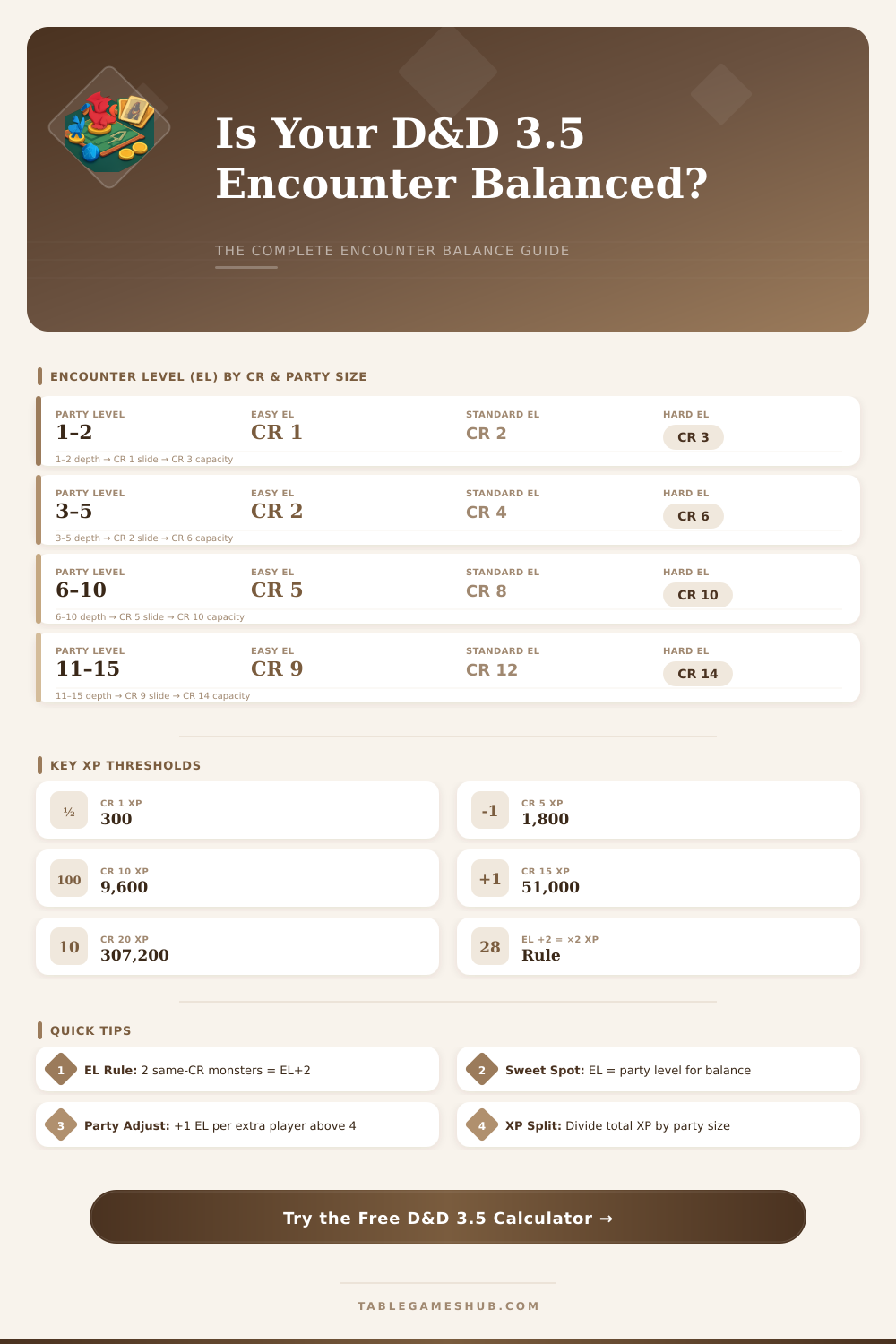
| Encounter Composition | EL Calculation | Example | XP Multiplier |
|---|---|---|---|
| 1 creature, CR X | EL = CR X | 1 Troll (CR 5) = EL 5 | ×1.0 |
| 2 same-CR creatures | EL = CR + 2 | 2 Trolls (CR 5) = EL 7 | ×1.5 |
| 3–4 same-CR creatures | EL = CR + 3 | 4 Goblins (CR 1) = EL 4 | ×2.0 |
| 6–10 same-CR creatures | EL = CR + 4 | 8 Kobolds (CR 1/4) = EL 4 | ×2.5 |
| 11–15 same-CR creatures | EL = CR + 5 | 12 Goblins (CR 1) = EL 6 | ×3.0 |
| 16+ same-CR creatures | EL = CR + 6 | 20 Skeletons (CR 1) = EL 7 | ×4.0 |
| Mixed CR group | Sum CR equivalents | See EL aggregation rules | Varies |
| CR | Base XP Award | Per-PC XP (4 players) | Typical Monster Example |
|---|---|---|---|
| CR 1/8 | 50 XP | 12 XP | Rat, Tiny Vermin |
| CR 1/4 | 75 XP | 19 XP | Kobold, Monstrous Centipede |
| CR 1/2 | 150 XP | 37 XP | Dire Rat, Gnome |
| CR 1 | 300 XP | 75 XP | Goblin, Skeleton |
| CR 2 | 600 XP | 150 XP | Orc, Zombie, Wolf |
| CR 3 | 900 XP | 225 XP | Hobgoblin, Gnoll, Ghoul |
| CR 4 | 1,200 XP | 300 XP | Ogre, Werewolf |
| CR 5 | 1,800 XP | 450 XP | Troll, Ettin |
| CR 6 | 2,400 XP | 600 XP | Wight, Medusa |
| CR 7 | 3,600 XP | 900 XP | Stone Giant, Manticore |
| CR 8 | 4,800 XP | 1,200 XP | Vampire, Wyvern |
| CR 9 | 6,600 XP | 1,650 XP | Cloud Giant, Roper |
| CR 10 | 9,600 XP | 2,400 XP | Young Adult Red Dragon |
| CR 12 | 19,200 XP | 4,800 XP | Beholder, Adult Red Dragon |
| CR 15 | 51,000 XP | 12,750 XP | Lich, Elder Red Dragon |
| CR 18 | 153,600 XP | 38,400 XP | Ancient Red Dragon |
| CR 20 | 307,200 XP | 76,800 XP | Balor, Pit Fiend |
| Party Size | EL Adjustment vs 4 PCs | XP Per PC Modifier | Notes |
|---|---|---|---|
| 1 PC (Solo) | –2 to EL | ×4.0 per PC | Dangerous; use CR = APL – 2 |
| 2 PCs | –1 to EL | ×2.0 per PC | Slightly harder encounters |
| 3 PCs | –0 to EL | ×1.33 per PC | Near standard |
| 4 PCs (Standard) | Baseline | ×1.0 per PC | Default D&D 3.5 assumption |
| 5 PCs | +1 to EL | ×0.8 per PC | Encounters feel easier |
| 6 PCs | +2 to EL | ×0.67 per PC | Increase monster count or CR |
| 7–8 PCs | +3 to EL | ×0.5 per PC | Large party; scale significantly |
D&D 3.5 Encounter form big part of the charm in Dungeons & Dragons. They are made up of situations that force the players to spend several of their resources to beat them. At the base, D&D is a game based on resources, however various classes face that in different ways.
Some classes work very explosive for example the wizard, while others, like the fighter, almost do not need any rest during the whole adventure.
How to Make Good D&D Encounters
To create good Encounter, challenges are not lacking. The game itself is so complex, that to simplify it to the most efficient calculations seems almost impossible. Many of those methods depend on the system to estimate challenges, which already has many gaps.
To design efficient Encounter truly needs getting rich experience about the game and well understanding how it is built.
Although, there are resources that help in that. D&D Beyond offers interactive tools to build Encounter, where one can set the group and add monsters. One can save and review the Encounter later.
There is also a set of tools prepared for players and Dungeon Masters of the 5th Edition. Redcap Press issued a new builder for the 2024 version of D&D 5e, that includes all monsters from the 2024 Monster Manual.
To estimate the trouble of an Encounter outside the basic calculation, first you must set the limits of experience points for every character in the party. The table shows four XP limits for every level of character, one for every type of Encounter challenge. The level of the characters helps to locate those values.
Players enter the amount of characters and their level, later they count to find the XP limits for the whole group. When characters have different levels, every set of same-level characters adds to its own whole.
The guidelines to build Encounter in the Guide of the Dungeon Master are quite descriptive, but not very exact. They work well to estimate how difficult a fight wood be, even though they do not promise a perfectly balanced fight.
Even so, not each Encounter must turn around fight. Time during travel in D&D commonly gets boring, so lists of roadside Encounter help to make ways between cities more fun. A traveling dealer maybe offers neutral magic objects, that later turn out to be damaged, cursed or otherwise unexpected.
Among the nicest Encounter are those that are entirely led by the players, for instance when the party sits at the main table on their ship and only discuss where to go next.
Some Dungeon Masters entirely skip balancing Encounter. Instead, they inform the players early and give XP for solving problems. Removing everything is not the only way to address situations.
Combat Encounter now can stage themselves directly oncharts, which makes things smoother and more strategic.