🐉 D&D 5e 2024 Encounter Calculator
Balance combat encounters using the 2024 Player’s Handbook XP budget system & adjusted multipliers
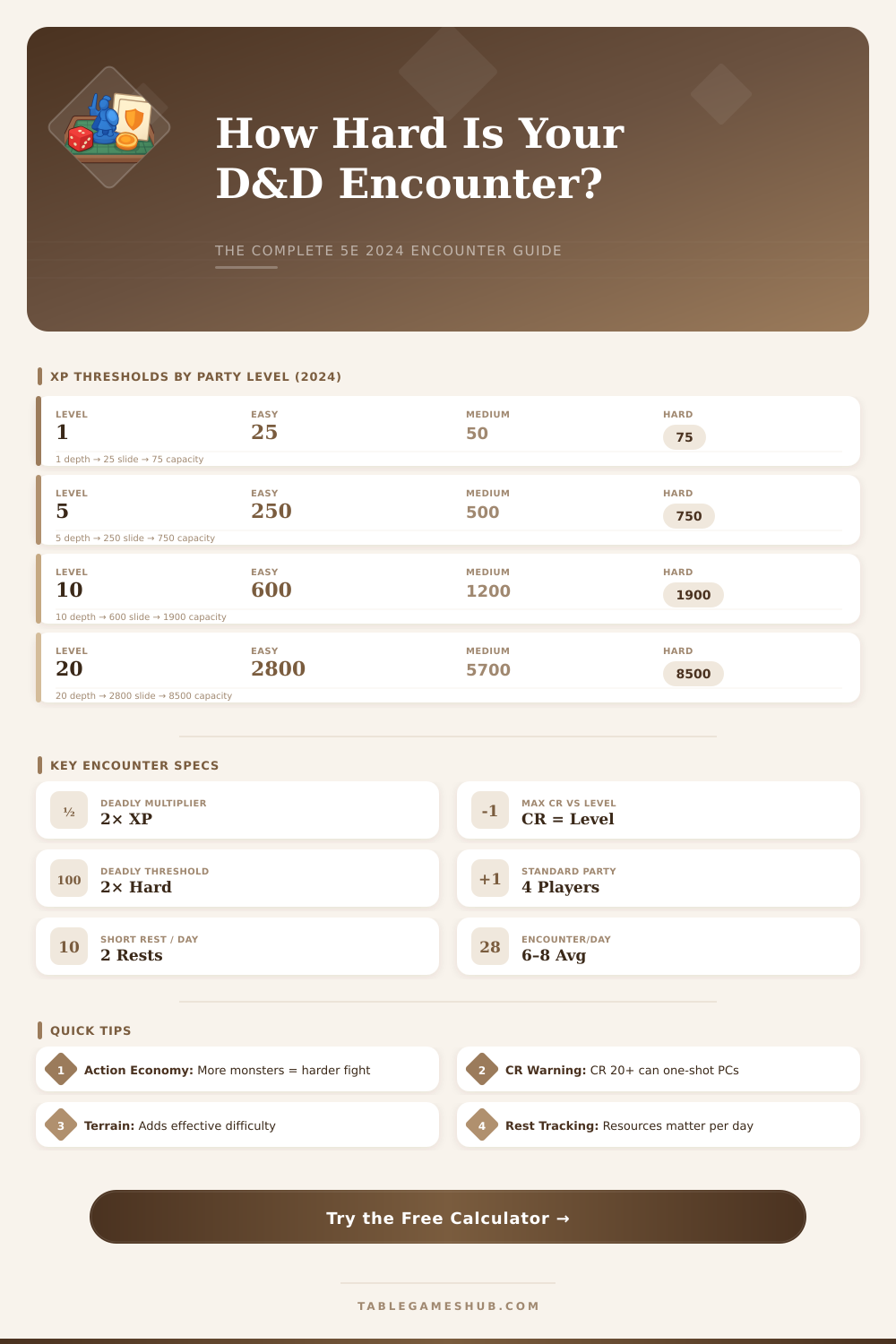
| Level | Easy XP (per player) | Medium XP | Hard XP | Deadly XP | Daily Budget |
|---|---|---|---|---|---|
| 1 | 25 | 50 | 75 | 100 | 300 |
| 2 | 50 | 100 | 150 | 200 | 600 |
| 3 | 75 | 150 | 225 | 400 | 1,200 |
| 4 | 125 | 250 | 375 | 500 | 1,700 |
| 5 | 250 | 500 | 750 | 1,100 | 3,500 |
| 6 | 300 | 600 | 900 | 1,400 | 4,000 |
| 7 | 350 | 750 | 1,100 | 1,700 | 5,000 |
| 8 | 450 | 900 | 1,400 | 2,100 | 6,000 |
| 9 | 550 | 1,100 | 1,600 | 2,400 | 7,500 |
| 10 | 600 | 1,200 | 1,900 | 2,800 | 9,000 |
| 11 | 800 | 1,600 | 2,400 | 3,600 | 10,500 |
| 12 | 1,000 | 2,000 | 3,000 | 4,500 | 11,500 |
| 13 | 1,100 | 2,200 | 3,400 | 5,100 | 13,500 |
| 14 | 1,250 | 2,500 | 3,800 | 5,700 | 15,000 |
| 15 | 1,400 | 2,800 | 4,300 | 6,400 | 18,000 |
| 16 | 1,600 | 3,200 | 4,800 | 7,200 | 20,000 |
| 17 | 2,000 | 3,900 | 5,900 | 8,800 | 25,000 |
| 18 | 2,100 | 4,200 | 6,300 | 9,500 | 27,000 |
| 19 | 2,400 | 4,900 | 7,300 | 11,000 | 30,000 |
| 20 | 2,800 | 5,700 | 8,500 | 12,700 | 40,000 |
| CR | XP Value | Proficiency Bonus | Typical AC | Typical HP | Example Monster |
|---|---|---|---|---|---|
| 0 | 10 | +2 | 10 | 1–6 | Commoner, Rat |
| 1/8 | 25 | +2 | 13 | 7–35 | Bandit, Kobold |
| 1/4 | 50 | +2 | 13 | 36–49 | Goblin, Wolf |
| 1/2 | 100 | +2 | 13 | 50–70 | Orc, Black Bear |
| 1 | 200 | +2 | 13 | 71–85 | Ghoul, Bugbear |
| 2 | 450 | +2 | 13 | 86–100 | Ogre, Gargoyle |
| 3 | 700 | +2 | 13 | 101–115 | Manticore, Wight |
| 4 | 1,100 | +2 | 14 | 116–130 | Banshee, Ettin |
| 5 | 1,800 | +3 | 15 | 131–145 | Troll, Unicorn |
| 6 | 2,300 | +3 | 15 | 146–160 | Chimera, Cyclops |
| 7 | 2,900 | +3 | 15 | 161–175 | Stone Giant |
| 8 | 3,900 | +3 | 16 | 176–190 | Frost Giant |
| 10 | 5,900 | +4 | 17 | 206–220 | Young Red Dragon |
| 13 | 10,000 | +5 | 18 | 241–255 | Storm Giant |
| 17 | 18,000 | +6 | 19 | 281–295 | Adult Red Dragon |
| 20 | 25,000 | +6 | 19 | 310–325 | Ancient White Dragon |
| 24 | 62,000 | +7 | 21 | 366–400 | Ancient Red Dragon |
| 30 | 155,000 | +9 | 22 | 450+ | Tarrasque |
| Monsters in Encounter | Party of 1–2 | Party of 3–5 | Party of 6+ | Effective XP Multiplier |
|---|---|---|---|---|
| 1 Monster | ×1.5 | ×1.0 | ×0.5 | Solo |
| 2 Monsters | ×2.0 | ×1.5 | ×1.0 | Pair |
| 3–6 Monsters | ×2.5 | ×2.0 | ×1.5 | Group |
| 7–10 Monsters | ×3.0 | ×2.5 | ×2.0 | Large Group |
| 11–14 Monsters | ×4.0 | ×3.0 | ×2.5 | Gang |
| 15+ Monsters | ×5.0 | ×4.0 | ×3.0 | Horde |
| Difficulty | DC | Successes Needed | Avg. +4 Bonus Hit% | Notes |
|---|---|---|---|---|
| Very Easy | 5 | 3 of 5 | 80% | Trivial tasks |
| Easy | 10 | 4 of 6 | 55% | Basic challenges |
| Medium | 15 | 6 of 8 | 30% | Standard skill check |
| Hard | 20 | 8 of 10 | 5% | Difficult tasks |
| Very Hard | 25 | 10 of 12 | 1% | Expert level |
| Nearly Impossible | 30 | 12 of 15 | <1% | Legendary feats |
Designing encounters for D&D? Yes, that is not as simple as many folks believe. The trouble lies in the system for estimating that many calculators use; it sounds good on paper, but really it commonly fails.
To create encounters that genuinely work, you need deep knowledge about the gameplay and about the ideas that the creators had in mind under the skin of the rules.
How to Make Good D&D Encounters
Good start is that some reliable resources help with that. D&D Beyond offers interactive tools for building encounters, you enter your group, mix monsters as you desire and save everything for later use. Very practical.
Moreover, there are whole bags of tools, made specially for leaders and players of the 5th Edition. Redcap Press launched their own builder for D&D 5e of 2024, and they filled it with every monster from the updated Monster Manual.
The base for building an Encounter depends on the insight about thresholds of expert spots. Every level of players has four XP-thresholds, that relate to levels of trouble. Enter the number of players that you have, their levels, what gives to every group its own challenge, if they differ, and you will find the threshold of XP for the whole team.
The Dungeon Master’s Guide gives quite a lot of good tips here. They are not precise as a rope, but they help you estimate, how far rough elements could be. Consider them as a good start not as perfect recipe for balance.
Journeys between cities do not need to last forever. Keeping a list of encounters on the way can give soul to those timetables. One collection offers 100 various encounters with enough detail, so that they easily adapt to your world.
Change the enemies, alter the names as needed, or whatever works for your story. They work also for casual incidents or for planned ones, according too your taste. There are also many lists of random encounters, because when your group chooses to go off the map and wander in the wild, you want to keep everything in motion.
Not every leader cares about balance of all encounters. Some find other ways to advance. Fight is not the only way for players to get XP, one can win them through clever solving of problems or through talking out of situations.
Players sometimes fall into logic of video games, thinking that they will receive any penalty, whatever happens. When an Encounter brings cruel rolls of dice, rage steals the fun. Worth noting here: you can now run tactical encounters directly in Maps, what simplifies everything andmakes the strategic part feel more natural.