♟ Chess Opening Calculator
Analyze opening statistics, piece activity, move probabilities, and position complexity for any chess opening
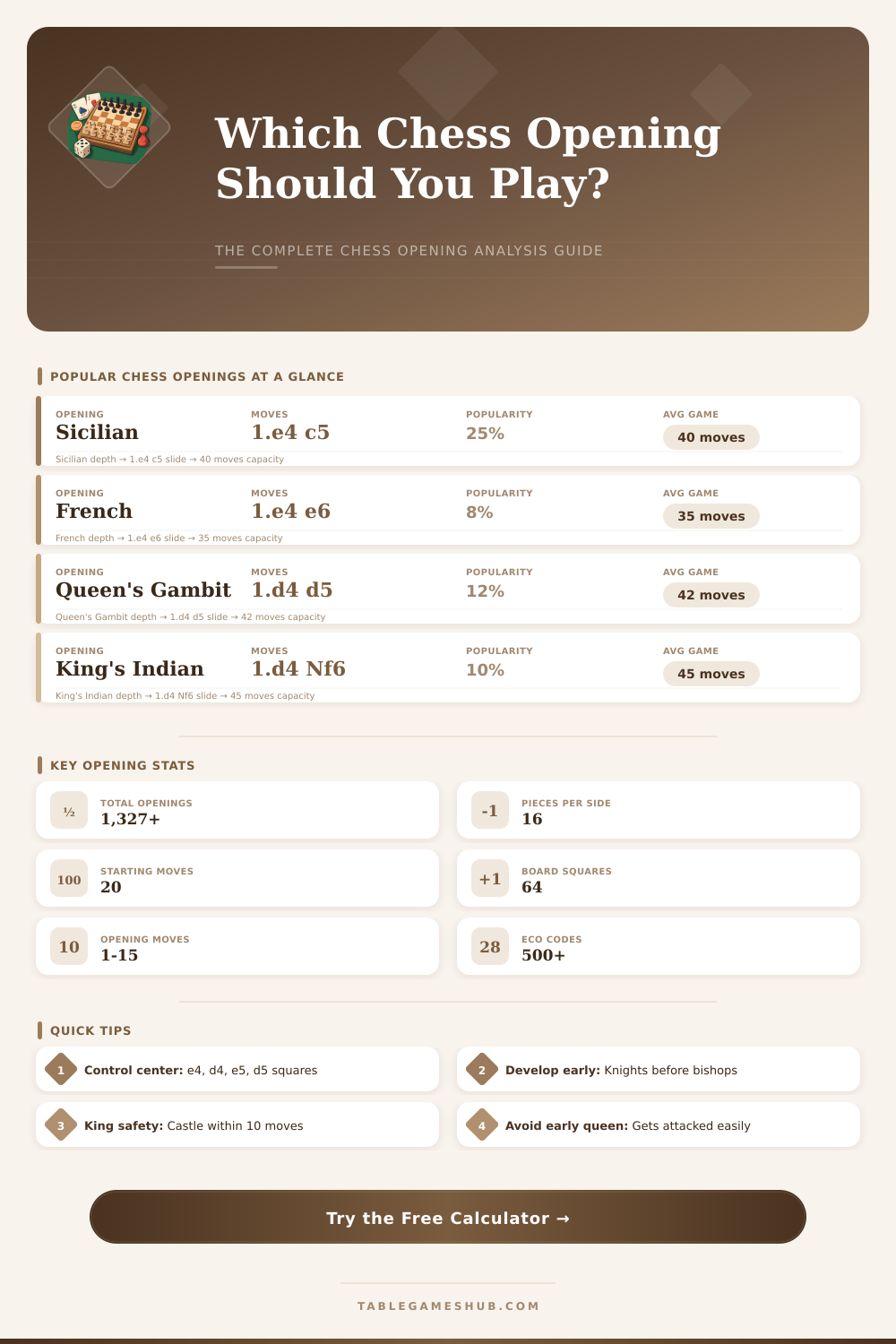
| Opening Name | ECO Code | First Moves | Type | Popularity (%) | Avg. Game Length | Win % (White) |
|---|---|---|---|---|---|---|
| Sicilian Defense | B20–B99 | 1.e4 c5 | Semi-Open | 25% | 40 moves | 52% |
| French Defense | C00–C19 | 1.e4 e6 | Semi-Open | 8% | 35 moves | 55% |
| Caro-Kann Defense | B10–B19 | 1.e4 c6 | Semi-Open | 7% | 38 moves | 53% |
| Queen's Gambit | D06–D69 | 1.d4 d5 2.c4 | Closed | 12% | 42 moves | 56% |
| King's Indian Defense | E60–E99 | 1.d4 Nf6 2.c4 g6 | Closed | 10% | 45 moves | 51% |
| Ruy Lopez | C60–C99 | 1.e4 e5 2.Nf3 3.Bb5 | Open | 9% | 44 moves | 57% |
| English Opening | A10–A39 | 1.c4 | Closed | 8% | 41 moves | 53% |
| Nimzo-Indian Defense | E20–E59 | 1.d4 Nf6 2.c4 e6 3.Nc3 Bb4 | Closed | 6% | 43 moves | 52% |
| Scotch Game | C44–C45 | 1.e4 e5 2.Nf3 Nc6 3.d4 | Open | 4% | 36 moves | 56% |
| Italian Game | C50–C59 | 1.e4 e5 2.Nf3 Nc6 3.Bc4 | Open | 7% | 37 moves | 54% |
| Set Type | King Height (in) | King Height (cm) | Board Size (in) | Board Size (cm) | Square Size (in) | Ideal For |
|---|---|---|---|---|---|---|
| Mini Travel | 1.5″ | 3.8 cm | 10″ x 10″ | 25 x 25 cm | 1.1″ | Travel / casual |
| Standard Staunton | 3.75″ | 9.5 cm | 20″ x 20″ | 51 x 51 cm | 2.25″ | Club / home |
| Tournament Set | 3.75″ | 9.5 cm | 21″ x 21″ | 53 x 53 cm | 2.25″ | Rated tournaments |
| Large Club Set | 4.5″ | 11.4 cm | 24″ x 24″ | 61 x 61 cm | 2.75″ | Demonstration |
| Magnetic Board | 1.75″ | 4.4 cm | 12″ x 12″ | 30 x 30 cm | 1.5″ | Portable play |
| Move Depth | Possible Positions | Branching Factor | Recommended Level | Theory Depth | Preparation Time (hrs) |
|---|---|---|---|---|---|
| 1 move (ply 2) | 20 | 20 | All levels | Basic | 0.5 |
| 3 moves | 8,902 | 30 | Beginner+ | Introductory | 2 |
| 5 moves | ~69,000 | 35 | Intermediate | Foundational | 5 |
| 8 moves | ~1.7M | 38 | Advanced | Standard theory | 15 |
| 10 moves | ~121M | 40 | Expert | Deep theory | 30 |
| 15 moves | ~1017 | 40+ | Master | GM-level prep | 100+ |
chess starts from the first part of every game in chess. In that moment the main task is to move pieces to good positions and protect the king in his fortress. After the opening phase come usually the middlegame, followed by the endgame, and everything builds on basic main principles.
There are a lot of named openings in the world. The Oxford Guide about Chess mentions 1 327 of them, while some databases let you research more than 3 000 opening lines.
Simple Rules for Chess Openings
Bad early strategy can lay you in troubles before the main struggle even begins. Good opening must control the central part of the board, which is the most important zone. It includes also fast and safe growth of the pieces, avoiding of typical beginner traps and mistakes, early castling to secure the king, together with learning of repeatable chess tactics.
There does not exist one unique best opening. To estimate which ones work most effectively for human players, one can check stats from games of masters. For instance, 1.d4 give around 56% of points for the whites, compared to almost 54% for 1.e4.
Even so that does not show that one is totally better then the other. Openings with e4 commonly result more lively and dynamic. Between other first moves are 1.c4, the English opening, 1.Sf3, the Zukertort opening, or even rare ones as the Bird opening by means of 1.f4 and Polish by means of 1.b4.
The Ruy Lopez opening gives solid growth and strong grip of the centre. One also calls it the Spanish opening, and it comes from Ruy López of Segura in the year 1561. The theory around it grew because of its scope and deep study, not because of complex basic ideas.
For newcomers, play it indeed correct more than jump directly to some hypermodern openings.
For easy access, the London system works well as white. Against 1.d4, respond with d5 and enter in the queen gambit accepted is solid choice. Before 1.e4, the Caro-Kann defence ranks between the most natural protections.
The queen gambit by means of 1.d4 d5 2.c4 suits players that favour closed and positional games.
Also the Sicilian defence enjoys big popularity. Many players like the Sicilian dragon or the boosted dragon as black. Less usual openings, as the Trompowsky or the Scandinavian, can give practical edge in local tours, where opponents probably did not prepare themselves for them.
The choice of a particular opening dependspartially on personal taste.
Both players start from the same position, hence openings have such weight. When skills in the middlegame improve, the opening game usually settles by itself through intuition.