🎲 Warhammer 40K Combat Calculator
Calculate hit, wound, save & damage probabilities for any unit profile with full modifier support
| Weapon | Range | A | BS/WS | S | AP | D | Special |
|---|---|---|---|---|---|---|---|
| Boltgun | 24" | 2 | 3+ | 4 | 0 | 1 | Rapid Fire 1 |
| Bolt Rifle | 30" | 2 | 3+ | 4 | -1 | 1 | Rapid Fire 1 |
| Plasma Gun (Std) | 24" | 1 | 3+ | 7 | -2 | 1 | Rapid Fire 1 |
| Plasma Gun (OC) | 24" | 1 | 3+ | 8 | -3 | 2 | Rapid Fire 1, Hazardous |
| Meltagun | 12" | 1 | 3+ | 9 | -4 | D6 | Melta 2 |
| Lascannon | 48" | 1 | 4+ | 9 | -3 | D6+1 | — |
| Heavy Bolter | 36" | 3 | 4+ | 5 | -1 | 2 | Sustained Hits 1 |
| Flamer | 12" | D6 | Auto | 4 | 0 | 1 | Torrent, Ignores Cover |
| Autocannon | 48" | 2 | 4+ | 7 | -1 | 2 | — |
| Sniper Rifle | 36" | 1 | 3+ | 4 | 0 | 1 | Heavy, Precision |
| Power Sword | Melee | 4 | 3+ | 4 | -3 | 1 | — |
| Thunder Hammer | Melee | 3 | 4+ | 8 | -2 | 2 | Devastating Wounds |
| Chainsword | Melee | 4 | 3+ | 4 | 0 | 1 | — |
| Power Fist | Melee | 3 | 3+ | 8 | -2 | 2 | — |
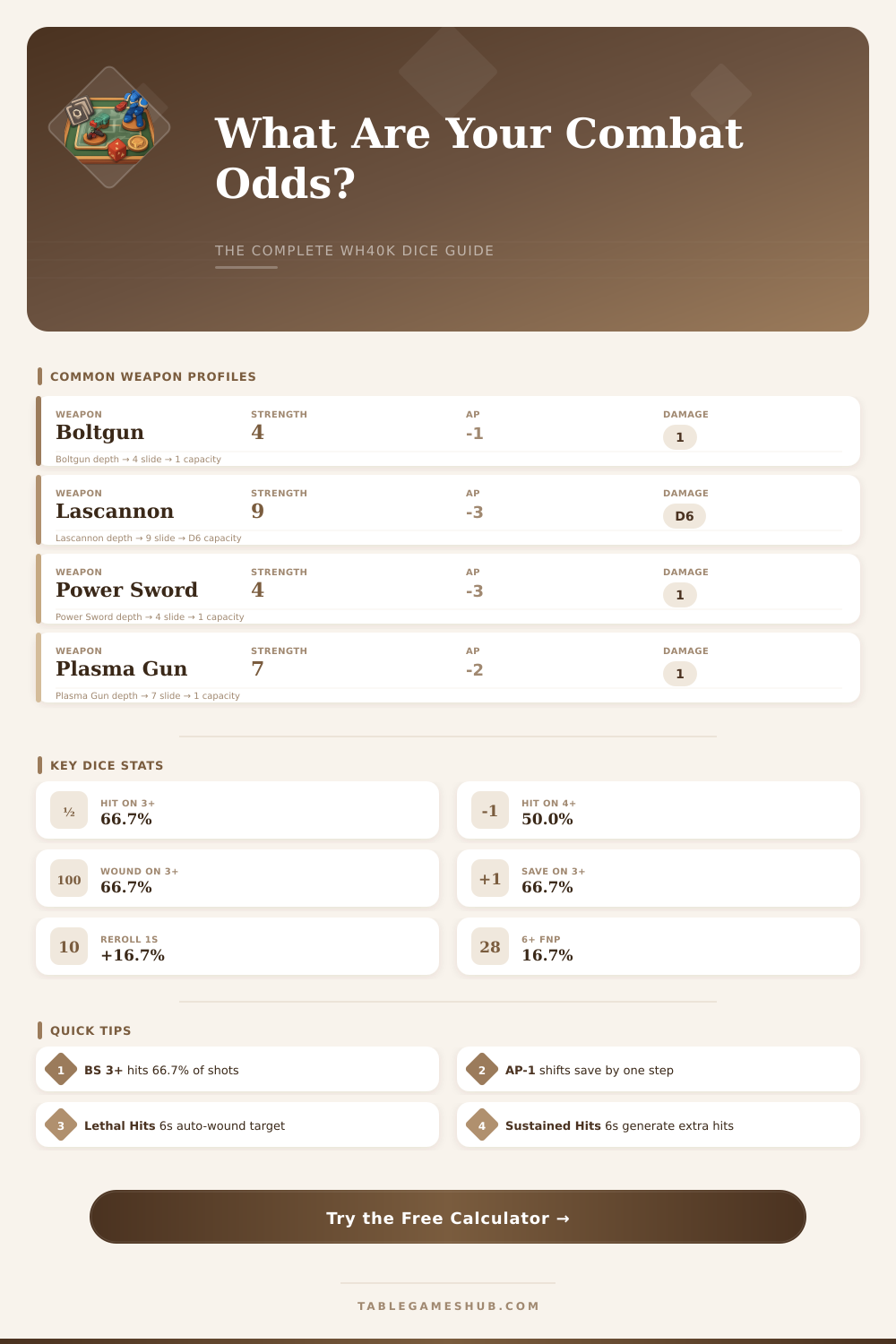
| S vs T | Wound Roll | Probability | Example |
|---|---|---|---|
| S ≥ 2×T | 2+ | 83.3% | S8 vs T4 |
| S > T | 3+ | 66.7% | S5 vs T4 |
| S = T | 4+ | 50.0% | S4 vs T4 |
| S < T | 5+ | 33.3% | S3 vs T4 |
| S ≤ T/2 | 6+ | 16.7% | S2 vs T4 |
| Unit Type | Toughness | Armour Save | Invuln | Wounds |
|---|---|---|---|---|
| Space Marine (MEQ) | 4 | 3+ | — | 2 |
| Guardsman (GEQ) | 3 | 5+ | — | 1 |
| Terminator (TEQ) | 5 | 2+ | 4++ | 3 |
| Daemon Prince | 7 | 3+ | 4++ | 10 |
| Ork Boy | 5 | 6+ | — | 1 |
| Necron Warrior | 4 | 4+ | — | 1 |
| Rhino (APC) | 9 | 3+ | — | 10 |
| Land Raider | 12 | 2+ | — | 16 |
Warhammer 40,000 is a fight-game with miniatures on a table, happening in a distant future. The famous slogan describes it well: in the black darkness of the far future only war rules between folks, demons and alien storms. The main draw of 40k comes from the miniatures, although there are also video games, board games and novels, everything bound in one same world.
The duels on the table are decided by rolling big sets of dice.
Combat Patrol in Warhammer 40,000
Combat Patrol is the version for small games inside Warhammer 40k 10th Edition. Every player leads a heavy group of miniatures in fast, active fighting. It is meant to be easier and faster than a whole game.
Like this it works for learning or for a session during lunch pause. Every box of Combat Patrol should be just as strong as the others. An army in that size helps to try a fresh faction.
There are series for hobbyists, where one can gather, build and paint game-ready Combat Patrol troops during many releases. Factions like Space Marines and Tyranids are included. The first edition blasted around Europe and included a Space Marine Captain in Terminator armor together with a Winged Tyranid Prime at a really tiny cost.
New Combat Patrol boxes always receive announcements. Blood Angels received a new box, described as really cruel, and Games Workshop also showed one for Ork and Militants Combat Patrol. The Ork and Militants use a safe style for struggle.
They rest on there natural power and discipline, tearing enemies by means of ruthless lead-with-lead attacks instead of too complex tactics.
Armies meant for Combat Patrol receive some new bonuses, that back attacking play style. For instance, a player chooses the target for a round after the charge roll. So a unit less risks to stay idle and does something.
Firm moves can pull an attacking group in Combat with an entirely new enemy team. That new team then can defend itself, but the attacker can not strike again, because it already acted.
Even equal results seem made up in the story. Some soldiers have defense as a weapon or separate trips. Others surround their bodies, what allows them to last equal wounds.
The whole world of 40k works by new rules. Searching strict logic here is a bit absurd. Everything is meant to be hopeless, scary and brutally wild.
Here is themain charm.
Space Marines own special units called Tactical Veterans, that know the weaknesses of every Tyranid monster. They focus on near Combat and carry special bullets together with krak-grenades. Every duel on the table shows only one tiny group in many bigger conflicts.