🎳 Bowling Ball Weight Calculator
Find the ideal bowling ball weight based on your body weight, age, strength & skill level — with imperial & metric conversions
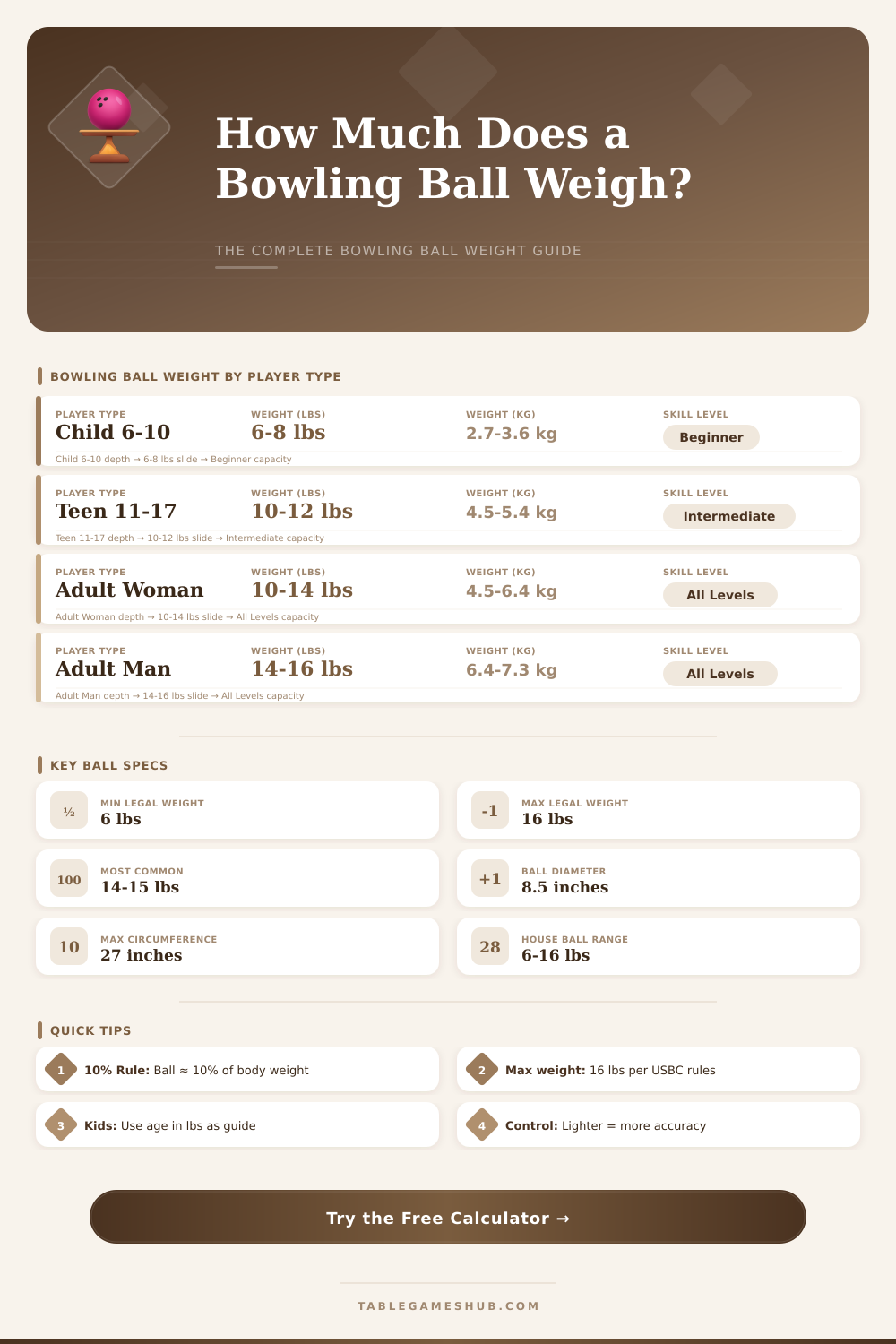
| Bowler Type | Body Weight | Recommended (lbs) | Recommended (kg) | Notes |
|---|---|---|---|---|
| Young Child (6-8 yrs) | 40-60 lbs / 18-27 kg | 6 lbs | 2.7 kg | Lightest available |
| Child (9-12 yrs) | 60-100 lbs / 27-45 kg | 6-10 lbs | 2.7-4.5 kg | Use age as guide |
| Teen (13-17 yrs) | 100-150 lbs / 45-68 kg | 10-12 lbs | 4.5-5.4 kg | Build up gradually |
| Adult Woman | 100-160 lbs / 45-73 kg | 10-14 lbs | 4.5-6.4 kg | Comfort is key |
| Adult Man | 150-200 lbs / 68-91 kg | 14-16 lbs | 6.4-7.3 kg | 14-15 most common |
| Senior (60+) | Any | 10-14 lbs | 4.5-6.4 kg | Go lighter for longevity |
| Heavyweight Adult | 200+ lbs / 91+ kg | 15-16 lbs | 6.8-7.3 kg | 16 lbs maximum |
| Competitive Bowler | Any | 15-16 lbs | 6.8-7.3 kg | Maximize pin action |
| Ball Type | Weight Range | Core Type | Best For | Hook Potential |
|---|---|---|---|---|
| House / Polyester | 6-16 lbs / 2.7-7.3 kg | Pancake (symmetric) | Beginners, spares | Low |
| Urethane | 10-16 lbs / 4.5-7.3 kg | Symmetric | Intermediate control | Medium |
| Reactive Resin | 12-16 lbs / 5.4-7.3 kg | Asymmetric | League & competitive | High |
| Performance Reactive | 14-16 lbs / 6.4-7.3 kg | Asymmetric | Pro & tournament | Very High |
| Spare / Plastic | 12-16 lbs / 5.4-7.3 kg | Pancake (symmetric) | Spare shooting | Very Low |
| Specification | Imperial | Metric | Governing Body |
|---|---|---|---|
| Lane Length (foul line to pin deck) | 60 ft | 18.29 m | USBC / WBF |
| Lane Width | 41.5 in | 105.4 cm | USBC |
| Pin Height | 15 in | 38.1 cm | USBC |
| Pin Weight (min) | 3 lbs 6 oz | 1.53 kg | USBC |
| Pin Weight (max) | 3 lbs 10 oz | 1.64 kg | USBC |
| Ball Max Diameter | 8.595 in | 21.83 cm | USBC |
| Ball Max Circumference | 27.002 in | 68.58 cm | USBC |
| Ball Max Weight | 16 lbs | 7.26 kg | USBC |
| Approach Length (min) | 15 ft | 4.57 m | USBC |
| Ball Weight | Metric | Pin Action | Control Level | Best Bowler Profile |
|---|---|---|---|---|
| 6-8 lbs | 2.7-3.6 kg | Minimal | High (light) | Young children |
| 8-10 lbs | 3.6-4.5 kg | Low | Good | Older children |
| 10-12 lbs | 4.5-5.4 kg | Moderate | Good | Teens, small adults |
| 12-14 lbs | 5.4-6.4 kg | Good | Very Good | Average adults |
| 14-15 lbs | 6.4-6.8 kg | Very Good | Good | Most adult bowlers |
| 15-16 lbs | 6.8-7.3 kg | Excellent | Requires strength | Strong adults, pros |
Rolling balls in local bowling stores range from six to sixteen pounds. That gives quite a big range, and choosing the right weight is really important. Lightweight balls of six, eight and ten pounds are for children.
For teenagers most pick something between eleven and fourteen pounds. A common rule says that a bowling ball should weigh around ten percent of your body mass, maximum sixteen pounds. Like this folk weighing 150 pounds probably should not use an eight-pound ball.
How to Choose the Right Bowling Ball Weight
The heaviest allowed weight for a bowling ball is sixteen pounds. Before that was the standard for bowlers in contests. Even so as time passed, many good players changed to fifteen or even fourteen pounds.
New materials for balls and key builds make lighter balls work more well. The difference in pin effort between sixteen and fifteen pounds is so tiny, that it likely will not affect the majority of folks.
Fourteen pounds is a good weight to start. Getting a ball, that a shop drills for your hand, makes a big change. A ball drilled to order does seem two pounds lighter than the same heavy house ball.
So a fourteen-pound house ball could feel like fifteen or sixteen pounds, when it is well drilled. It helps to add one or two pounds to the weight of a house ball that feels comfortable, and buy that heavier version.
Heavier balls can push pins out of the way more easily, which helps the effort. But throwing a too heavy ball causes problems with control and can reduce the results. A ten-pound ball also moves pins, which hampers blows.
Balls of twelve pounds and more give better hits than those of eight ore nine pounds. Lightweight balls of eight or nine pounds do not deliver good effort, unless one throws them very slowly.
Most bowling balls under twelve pounds do not have the same heavy core as heavier models. Balls of ten and eleven pounds commonly lack a core entirely. It is good to know that when buying lighter gear.
Comfort beats pride. No one should feel pressure in choosing a certain weight just for looks. Some bowlers choose a too heavy ball to impress others, which hurts their game.
If your swing starts to slow after a bit of time, the ball probably is too heavy. Many players reached perfect 300 games with different weights. The secret sits in finding what fits your style and helps to reach the best blows.
Choosing fifteen pounds stays popular, because many balls come inthat weight and pro stores offer more options and better prices here.