🎳 Bowling Score Calculator
Enter your pins knocked down each frame to calculate your official bowling score with strikes, spares & bonuses
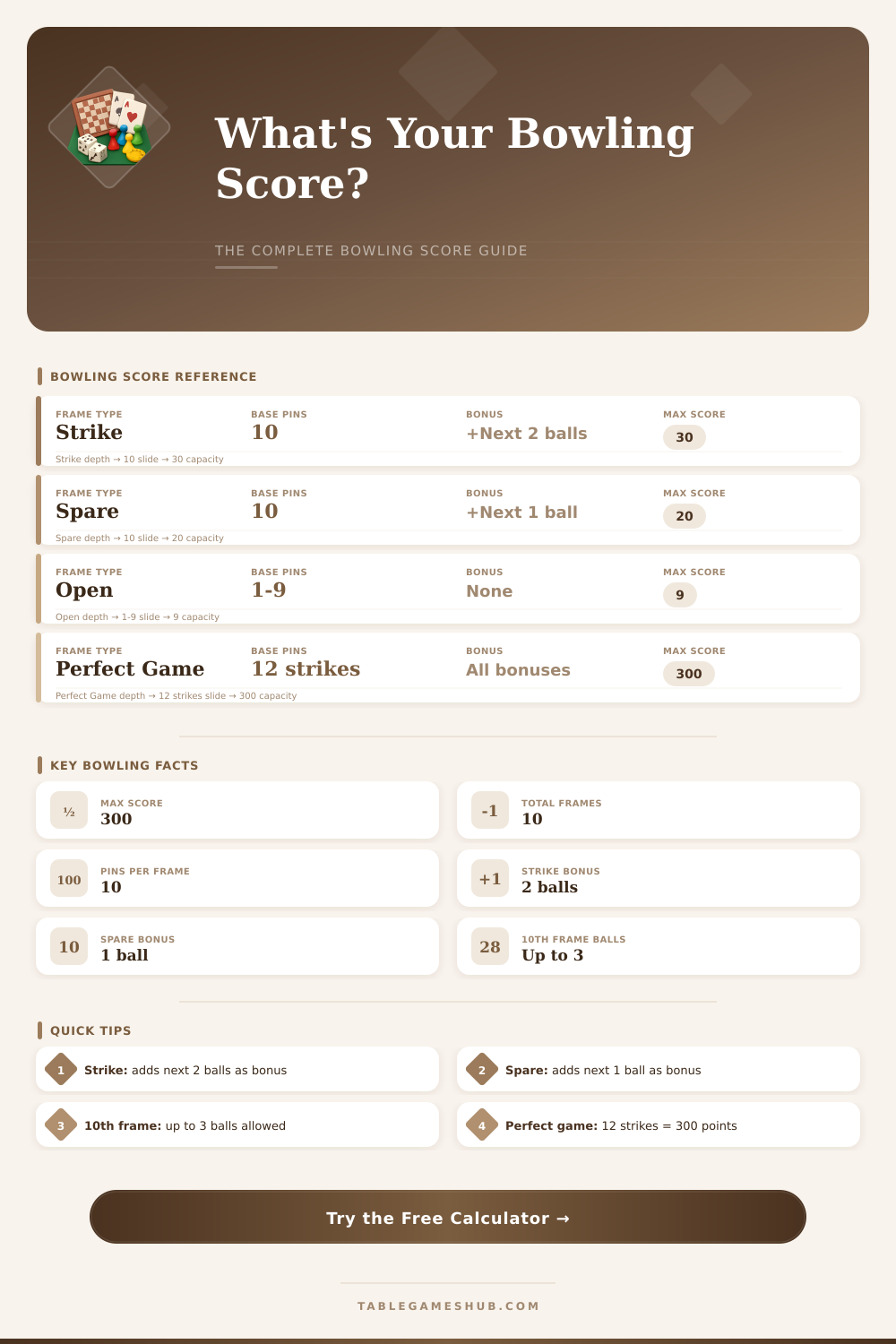
| Frame Result | Symbol | Base Pins | Bonus | Max Frame Score |
|---|---|---|---|---|
| Strike | X | 10 | Next 2 balls | 30 |
| Spare | / | 10 | Next 1 ball | 20 |
| Open Frame | – | 0–9 | None | 9 |
| Gutter Ball | G or – | 0 | None | 0 |
| Split | varies | 0–9 | None | 9 |
| Perfect Frame | X (10th) | 10+10+10 | Full bonus | 30 |
| Score Range | Level | Typical Profile | Strikes / Game |
|---|---|---|---|
| 0 – 70 | Beginner | New bowler, inconsistent | 0–1 |
| 71 – 120 | Recreational | Occasional bowler | 1–3 |
| 121 – 160 | Average | Regular league bowler | 3–5 |
| 161 – 200 | Above Average | Competitive club bowler | 5–8 |
| 201 – 250 | Advanced | Serious league / tournament | 8–11 |
| 251 – 300 | Elite / Pro | Professional / near-perfect | 11–12 |
| Game Type | Pins | Balls / Frame | Max Score |
|---|---|---|---|
| Ten-Pin | 10 | 2 (10th: up to 3) | 300 |
| Five-Pin | 5 | 3 per frame | 450 |
| Duckpin | 10 | 3 per frame | 300 |
| Candlepin | 10 | 3 per frame | 300 |
The scoring in Bowling can seem hard at first but it actually becomes clear when you grasp the basic rules. A game is made up of 10 frames. In the score sheet, you find 10 big boxes in a row beside your name.
Each of them shows one frame. Also, every big box has a little box in its right upper corner. The number of pins that you knock down with the first ball goes in the space to the left of that little box.
Bowling Scoring and Good Scores
The number from the second ball goes in the little box itself. One writes the total for the whole frame in the center of the big box.
Assume that a player knocks down 6 pins with the first throw and 3 with the second: then the total for the frame is 9. So really simple stuff.
When all 10 pins fall after the first ball, that is a strike. If two balls are needed to knock all of them down, one calls it a spare. When you do not manage that in two throws, it results in an open frame.
Here is your whole score: it adds the pins knocked down through the 10 frames, with added bonuses for strikes and spares. A strike means that one counts the pins of the next two balls. A spare brings 10 points plus the number from teh next ball.
For instance, after a spare, if the next ball knocks down 9, that frame is worth 19 points. A missed spare is marked in the score sheet with a crossing.
The top score in Bowling reaches 300. It requires 12 strikes one after the other in one game, which is called a perfect game. The next best result comes from nine strikes, which gives 270, so the tenth strike raises it too 280.
Two extra balls can bring it even to 290.
What counts as a good score? It depends on your experience. Around 100 points already counts for beginners that learn to hold the ball, stand right and aim.
A middle level player that trains often can reach between 100 and 170. A typical adult man that plays for fun usually falls between 130 and 170. Scores of 150 to 250 really impress.
Passing the 200 mark is a big achievement for many.
Professional players average between 190 and 250 points. 175 points could be great or only good, based on your usual level. A person that usually has 130 would be happy about 175.
A new player might start at around 84 on average and grow to 113 over time. A six-year-old child that plays for the first time could see 60 points as a good result. On the other hand, in leagues, players aim for 180 to 200.
In competitive leagues for experts, sometimes you need 240 or more to advance.
Bowling is a hard sport, and most folks reach lowscores. The main reason is how much time someone put into it.