Pool Table Size Calculator: Find the Perfect Fit
🎱 Pool Table Size Calculator
Calculate the perfect pool table dimensions, required room size, and cue clearance for your space
⚡ Quick Presets
⚙️ Configuration
🎱 Your Pool Table Setup Results
📊 Pool Table Quick Reference
57 in
Standard Cue Length
16
8-Ball Pool Balls
2.25 in
Ball Diameter
4.5 in
Standard Pocket Width
29–31 in
Table Height Range
5 ft
Min Cue Clearance
9 ft
Tournament Regulation
2:1
Table Length:Width Ratio
📐 Pool Table Dimensions Reference
| Table Size | Overall (L x W) | Playing Surface | Min Room Size | Ideal Room Size | Player Capacity |
|---|---|---|---|---|---|
| 6 ft (Kids) | 70" x 35" | 56" x 28" | 13.1’ x 9.9’ | 14’ x 11’ | 1–2 |
| 7 ft (Bar) | 88" x 44" | 76" x 38" | 14.2’ x 10.8’ | 16’ x 12’ | 1–4 |
| 8 ft (Home) | 103" x 58" | 88" x 44" | 15.6’ x 12.2’ | 17’ x 13.5’ | 2–4 |
| 8.5 ft (Mid) | 109" x 61" | 92" x 46" | 16.1’ x 12.6’ | 17.5’ x 14’ | 2–4 |
| 9 ft (Tournament) | 114" x 64" | 100" x 50" | 16.8’ x 13.2’ | 18.5’ x 14.5’ | 2–6 |
| 10 ft (Oversized) | 128" x 68" | 112" x 56" | 18.2’ x 14.2’ | 19.5’ x 15.5’ | 2–6 |
| Snooker (12 ft) | 160" x 80" | 141" x 70.5" | 21.3’ x 16.8’ | 22’ x 18’ | 2 |
🎱 Game Component Counts
| Game Type | Ball Count | Active Balls | Rack Type | Pockets Used | Players |
|---|---|---|---|---|---|
| 8-Ball Pool | 16 (15 + cue) | All 16 | Triangle | 6 | 2 or 4 |
| 9-Ball Pool | 10 (9 + cue) | All 10 | Diamond | 6 | 2 |
| 10-Ball Pool | 11 (10 + cue) | All 11 | Triangle | 6 | 2 |
| Straight Pool | 16 (15 + cue) | All 16 | Triangle | 6 | 2 |
| One Pocket | 16 (15 + cue) | All 16 | Triangle | 2 (corner) | 2 |
| Cutthroat | 16 (15 + cue) | All 16 | Triangle | 6 | 3 or 5 |
| Snooker | 22 (21 + cue) | All 22 | Triangle + spots | 6 | 2 |
| Carom Billiards | 3 | 3 | None | 0 (no pockets) | 2 |
📏 Room Size by Cue Length
| Cue Length | Clearance Each Side | Min Room (8 ft table) | Min Room (9 ft table) | Best For |
|---|---|---|---|---|
| 48 in (4 ft) | 48 in (4 ft) | 15.6’ x 11.5’ | 17.3’ x 12.5’ | Tight spaces, kids |
| 52 in | 52 in (4.3 ft) | 16’ x 11.9’ | 17.7’ x 12.8’ | Smaller rooms |
| 57 in (standard) | 57 in (4.75 ft) | 16.5’ x 12.3’ | 18.2’ x 13.2’ | Most home tables |
| 58 in (pro) | 58 in (4.8 ft) | 16.6’ x 12.5’ | 18.3’ x 13.3’ | League / club play |
| 60 in (5 ft) | 60 in (5 ft) | 16.8’ x 12.7’ | 18.5’ x 13.5’ | Tournament standard |
💡 Setup Tips
📐 Cue Clearance Rule: Add your full cue length to all four sides of the table’s overall footprint. A 57-inch cue needs at least 57 inches of clear wall space on every side—no furniture, doors, or obstructions. Minimum room length = table length + (2 × cue length). Minimum room width = table width + (2 × cue length).
🏆 Tournament vs. Home Tables: Regulation tournament play uses a 9 ft table with a 100" x 50" playing surface. The 2:1 length-to-width ratio is consistent across all sizes. For home use, an 8 ft table is most popular; for tight spaces, a 7 ft bar table works well with a 48–52 inch cue to reduce room requirements significantly.
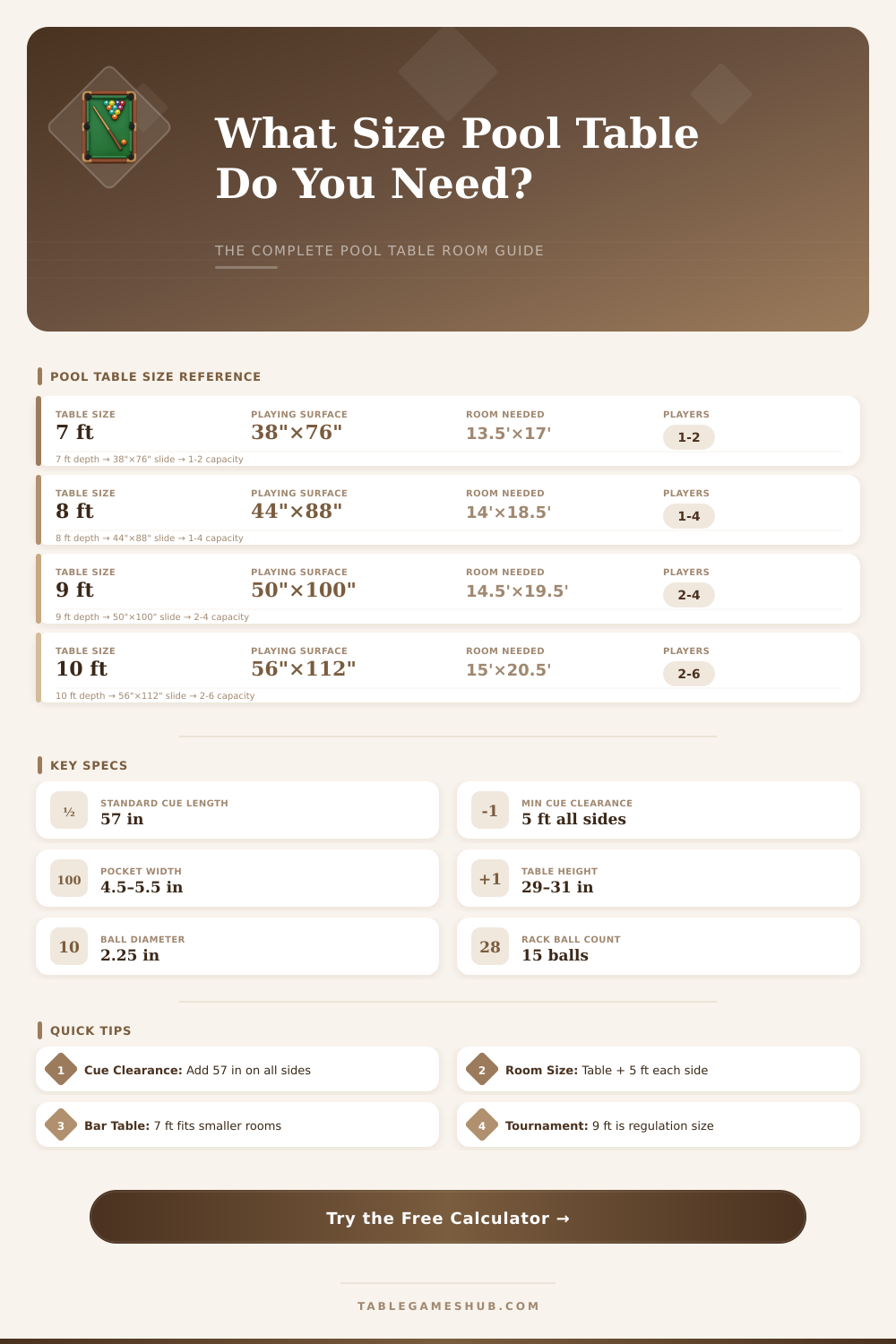
Election of the apt size for Pool Table really matters. Here four mainstream types, that one commonly meets, and all they follow the same rule: the playing area always is doubly long compared to its width. The most many folks ultimately choose between 7-foot, 8-foot or 9-foot model although it is possible to find samples of 6 to 10 feet, if one well searches.
The 7-foot table commonly calls “bar size” or “bar-table” and that is not without reason. One sees them everywhere in bars, pubs and even in clubs. It has a playing area of 3.5 feet by 7 feet.
How to Choose the Right Pool Table Size
What makes those little tables tricky, is that players need really precise and tight shot captures. They work well for little or medium rooms, for newcomers in the game or for casual players. Moreover, if you enter a tie or tournament with 7-foot tables, then practise home on same size makes sense.
Most many Americans ultimately buy an 8-foot Pool Table for their home. The playing area measures 44 inches by 88 inches. Usually one uses the standard 58-inch stick when one plays on a 4-by-8-foot table.
One finds those in many homes, but in Pool Table halls all use them commonly, one can fit more tables on the floor without losing visibility.
Tournament players favour the 9-foot Pool Table, that has a playing area of 50 inches by 100 inches. Indeed, this is the original size, for which the early billiards were designed. The bigger surface requires players to use real force…
One needs a more powerful shot to reach the balls across such distance. Many tournaments happen on those today, and they really shine in big rooms with expert players.
This is a cause that folks commonly overlook: the size of the room. The rough rule is add around 10 feet to the size of your table. So, for an 8-by-4-foot table, one needs a room about 18 feet by 14 feet.
No doubt, one must have at least 5 feet of free space on every side so that the stick can move well. That 14-by-18-foot area would bee perfect for an 8-foot Pool Table. Even for a 7-foot one needs minimal space; think about around 15 feet by 17 feet.
Before buying something, measure your available space. Consider both length and width of the room, together with what other stuff fills the area. Furniture, walls, tricky corners.
Honestly, a little table, where you can play freely without the stick touching the wall, beats a big table, where you always strike against something. On the other hand, a table where you sometimes touch the wall, is still better than having noPool Table at all.
Some folks get creative and use Pool Table tops for board games, although the height and size can create troubles. The most many Pool Table tops are 4 by 8 feet, which is quite a lot big for such uses.