Chinese Chess Calculator: Xiangqi Board & Piece Setup Tool
♟ Chinese Chess (Xiangqi) Calculator
Calculate board dimensions, piece distributions, move probabilities & game setups for Xiangqi
⚡ Quick Presets
⚙️ Configuration
✅ Calculation Results
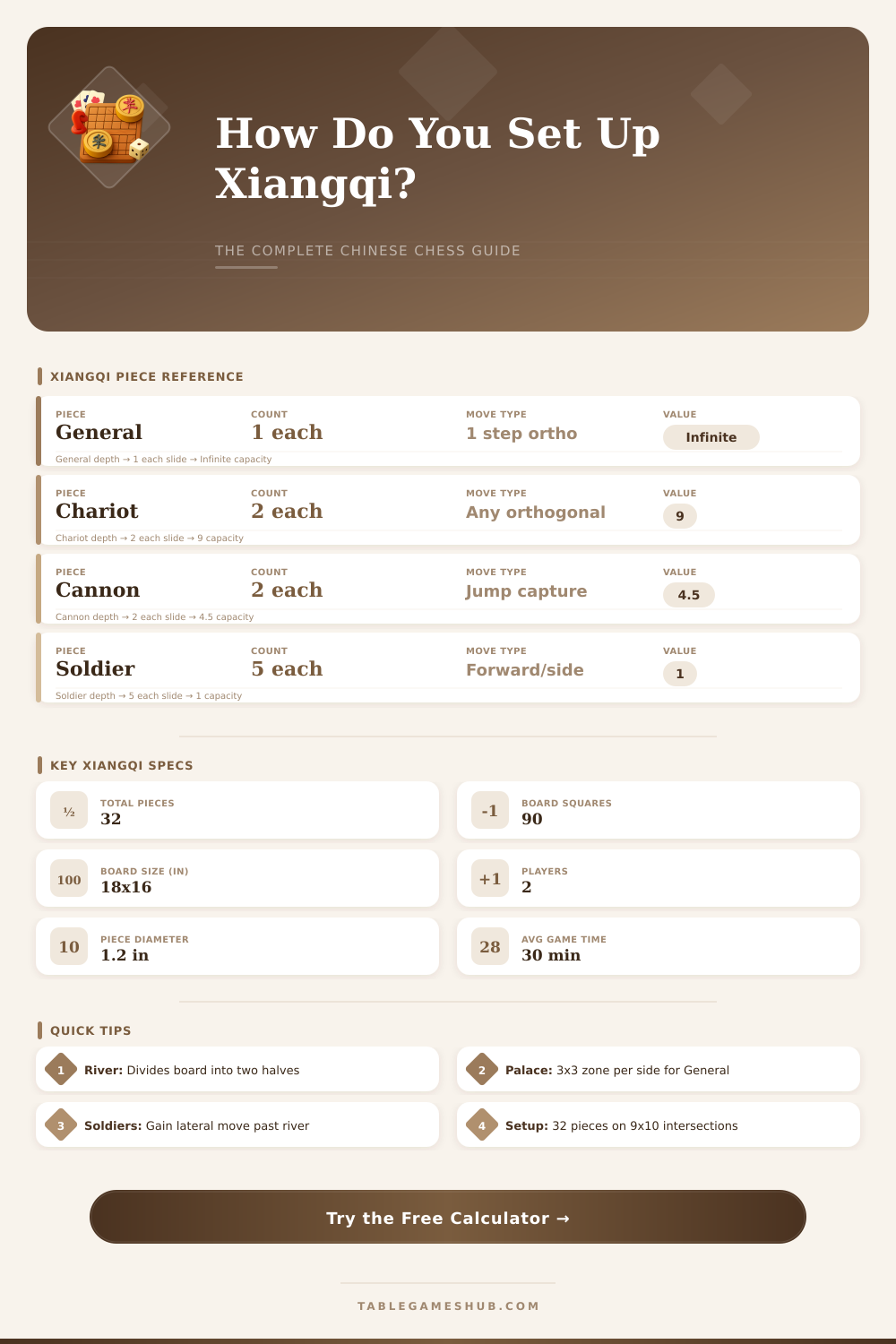
♟ Xiangqi Piece Reference
32
Total Pieces
90
Board Intersections
9x10
Grid Squares
2
Players
16
Pieces per Side
5
Soldiers per Side
3x3
Palace Grid
~30
Avg Game (min)
📋 Xiangqi Piece Details
| Piece (Chinese) | Count (each side) | Movement | Capture Rule | Point Value |
|---|---|---|---|---|
| 将 General (Jiang/Shuai) | 1 | 1 step orthogonal inside palace | Normal; cannot face opponent General | ∞ (Win condition) |
| 仕 Advisor (Shi) | 2 | 1 step diagonal inside palace | Normal | 2 |
| 象 Elephant (Xiang) | 2 | Exactly 2 diagonal; cannot cross river | Normal; blocked by intervening piece | 2 |
| 马 Horse (Ma) | 2 | 1 orthogonal + 1 diagonal | Normal; blocked by adjacent piece | 4 |
| 车 Chariot (Ju) | 2 | Any distance orthogonal | Normal; most powerful piece | 9 |
| 炮 Cannon (Pao) | 2 | Any distance orthogonal (move) | Must jump exactly one piece to capture | 4.5 |
| 兵 Soldier (Zu/Bing) | 5 | 1 step forward (lateral after river) | Normal; gains lateral after crossing river | 1 (2 after river) |
📏 Standard Board Dimensions
| Set Type | Board (in) | Board (cm) | Piece Dia (in) | Ideal Table (in) | Play Time |
|---|---|---|---|---|---|
| Mini Travel | 12 x 10 | 30 x 26 cm | 0.75 | 18 x 16 | 15–20 min |
| Magnetic Travel | 14 x 12 | 36 x 31 cm | 0.9 | 20 x 18 | 20–30 min |
| Standard Plastic | 18 x 16 | 46 x 41 cm | 1.2 | 26 x 22 | 30–45 min |
| Wooden Set | 20 x 18 | 51 x 46 cm | 1.3 | 28 x 24 | 30–60 min |
| Teaching Set | 16 x 14 | 41 x 36 cm | 1.1 | 24 x 20 | 20–40 min |
| Large Decorative | 24 x 21 | 61 x 53 cm | 1.6 | 32 x 28 | 30–60 min |
| Digital Display | 18 x 16 | 46 x 41 cm | 1.2 | 26 x 22 | Any |
| Jumbo Outdoor | 30 x 27 | 76 x 69 cm | 2.5 | 40 x 36 | 30–90 min |
🎲 Move Probability Reference
| Piece | Max Moves (open) | Typical Moves | Restricted Zone | Mobility Index |
|---|---|---|---|---|
| Chariot | 17 | 10–14 | None | High (9) |
| Cannon | 17 move / varies capture | 8–12 | None | High (8) |
| Horse | 8 | 3–6 | Near edges | Medium (6) |
| Elephant | 4 | 2–4 | Own half only | Low (3) |
| Advisor | 4 | 2–4 | Palace only | Low (2) |
| General | 4 | 1–3 | Palace only | Low (1) |
| Soldier (own half) | 1 | 1 | Forward only | Very Low (1) |
| Soldier (past river) | 3 | 1–3 | None in enemy half | Low–Med (2) |
📊 Common Setup Configurations
| Configuration | Board Size | Pieces Active | Avg Moves/Game | Duration |
|---|---|---|---|---|
| Beginner Casual | Standard (18x16 in) | 32 (full set) | 40–60 | 20–30 min |
| Club Standard | Standard (18x16 in) | 32 (full set) | 60–100 | 30–45 min |
| Tournament | Regulation (20x18 in) | 32 (full set) | 80–150 | 45–90 min |
| Blind Setup (Teaching) | Teaching (16x14 in) | 32 (full set) | 30–50 | 20–40 min |
| Endgame Study | Any | 4–10 pieces | 10–30 | 10–20 min |
| Correspondence Play | Any | 32 (full set) | 80–200 | Days–Weeks |
💡 Board Sizing Tip: For standard Xiangqi, allow at least 4–5 inches of table margin around the board on all sides. A 18x16-inch board ideally needs a 26x24-inch table surface for comfortable play without pieces falling off.
💡 Piece Spacing Tip: Each grid intersection on a standard board should be 1.8–2.0 inches apart. With 9 columns and 10 rows, that gives 8 column gaps x 2 inches = 16 in width and 9 row gaps x 2 inches = 18 in length — matching the standard 18x16 inch board exactly. Piece diameter should be 60–70% of grid spacing for comfortable play.
Chinese Chess, or simply Xiangqi, is made up of a strategic board game between two players. In China it beats all other board games in popularity. Some even think that it is the main type of chess globally, because the land has the biggest population on the planet.
It belongs to the same old line as European chess, Japanese shogi, Korean janggi and the ancient Indian chaturanga. Both Chinese and Western versions come from the old Indian game called chaturanga.
Basics of Chinese Chess
The main task in the game is to capture the king of the opponent that one also calls general in the Chinese version. That part is quite similar to regular chess. Even so some new features give it a fresh feeling.
The board includes separate zones, for example the river and the palace. Between the fifth and sixth rows lies the river, that splits the surface in two parts. One marks it usually with Chinese signs for “River Chu” and “Lima of Han”, hinting to the war between Chu and Han.
Western chess does not have clear pieces like the canon and the elephant. The canon moves like a rook, but it jumps over one piece of the same type during attack. Elephants together with advisers serve to defend the general, and their moves are limited too the palace.
In many cases the activity of pieces matters more than their amount, and the game is less positional than in European chess. Pawns do not form chains before the final phase.
In standard chess each piece can cross the whole board to attack, and pawns move freely. The Chinese version limits to six offensive pieces plus five soldiers. When forces exchange during the middle phase, changes become simple.
The share of such changes maybe is a bit lower than in Western chess, even so it stays quite high. The limit of elephants and advisers to their own half of the board causes many of those cases. The first player enjoys clear advantage, although it can be a bit softer than in the European version.
Chinese Chess enjoys big popularity in China as well as in Vietnam. Many pages online offer to play Xiangqi between folks and machines or against partners of various levels. Some platforms even allow you to use images instead of Chinese signs on the pieces, which reduces the fear for beginners.
Because of the setup of the board and the canon the game moves more quickly than Western chess. Outside of Asia one sometimes rates it too low as a type of chess. Unknown signs on pieces and unfamiliar rules can stop folks from trying, but thebasics are not that hard to learn.