Chess ELO Rating Calculator: Find Your True Rating
♟ Chess ELO Rating Calculator
Calculate exact ELO rating changes, expected scores, performance ratings & K-factor analysis
⚡ Quick Presets
⚙ Calculator Mode
🏋 Player Information
🏆 ELO Rating Calculation Results
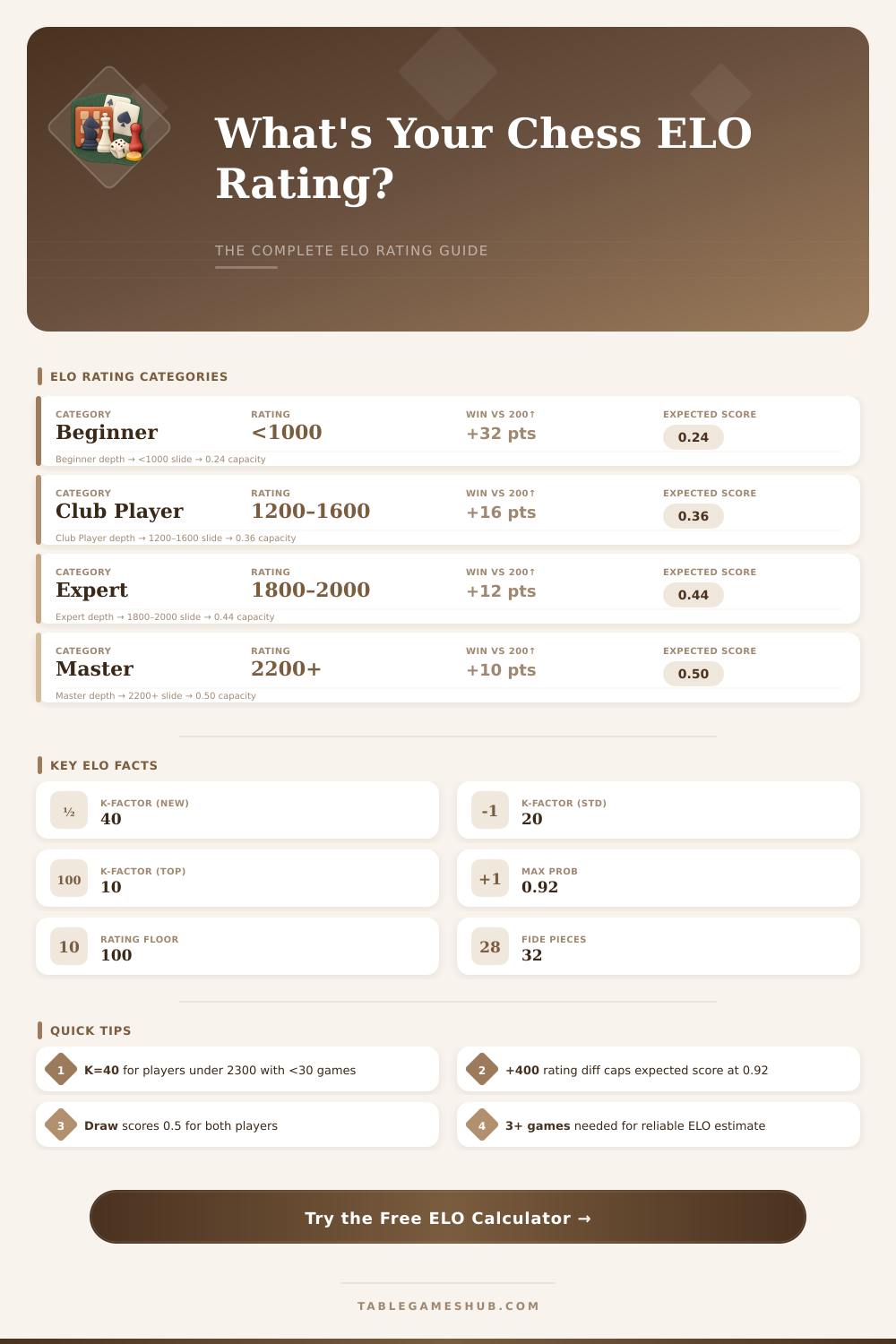
📊 ELO Rating Categories
K=40
New Player K-Factor
K=20
FIDE Standard K-Factor
K=10
Top Player (>2400)
±400
Max Rating Diff Used
2800+
Super-GM Level
2500+
Grandmaster Level
2200+
Master Level
1200
Casual Club Player
♟ ELO Rating Classification Table
| Title / Category | Rating Range | FIDE K-Factor | Win vs +200 Opp | Expected Score vs Equal |
|---|---|---|---|---|
| Beginner | <800 | 40 | +28 pts | 0.50 |
| Novice | 800–999 | 40 | +26 pts | 0.50 |
| Club Player | 1000–1199 | 40 | +24 pts | 0.50 |
| Intermediate | 1200–1399 | 20/40 | +22 pts | 0.50 |
| Advanced | 1400–1599 | 20 | +20 pts | 0.50 |
| Strong Club | 1600–1799 | 20 | +19 pts | 0.50 |
| Expert / Candidate | 1800–1999 | 20 | +18 pts | 0.50 |
| FIDE Master | 2000–2099 | 20 | +17 pts | 0.50 |
| International Master | 2100–2399 | 20 | +16 pts | 0.50 |
| Grandmaster | 2500–2699 | 10 | +15 pts | 0.50 |
| Super-Grandmaster | 2700+ | 10 | +14 pts | 0.50 |
🎯 Expected Score by Rating Difference
| Rating Difference | Expected Score (Higher) | Win % (Higher) | ELO Gain if Win (K=20) | ELO Loss if Loss (K=20) |
|---|---|---|---|---|
| 0 (Equal) | 0.500 | 50.0% | +10.0 | –10.0 |
| 25 | 0.536 | 53.6% | +9.3 | –10.7 |
| 50 | 0.571 | 57.1% | +8.6 | –11.4 |
| 100 | 0.640 | 64.0% | +7.2 | –12.8 |
| 150 | 0.702 | 70.2% | +5.9 | –14.1 |
| 200 | 0.760 | 76.0% | +4.8 | –15.2 |
| 300 | 0.849 | 84.9% | +3.0 | –17.0 |
| 400+ | 0.920 | 92.0% | +1.6 | –18.4 |
📋 K-Factor Reference & Systems
| Rating System | K-Factor | Applies To | Max Gain Per Game |
|---|---|---|---|
| FIDE (New) | 40 | First 30 rated games | +36.8 pts |
| FIDE (Standard) | 20 | Players below 2400 | +18.4 pts |
| FIDE (Top) | 10 | Players rated 2400+ | +9.2 pts |
| USCF (Under 2100) | 32 | US Players <2100 | +29.4 pts |
| USCF (2100–2400) | 24 | US Expert/Master | +22.1 pts |
| USCF (Over 2400) | 16 | US Senior Master+ | +14.7 pts |
| Chess.com (Rapid) | variable | Online games | Varies |
| Lichess | Glicko-2 | All online games | Varies |
♞ Chess Set Components & Standards
| Component | Count (Full Set) | Standard Size | Tournament Spec |
|---|---|---|---|
| Total Pieces | 32 (16 per side) | Various | FIDE Standard |
| Pawns | 16 (8 per side) | King height / 2 | 35–45mm base |
| Rooks | 4 (2 per side) | ~60% of king | Staunton pattern |
| Knights | 4 (2 per side) | ~70% of king | Staunton pattern |
| Bishops | 4 (2 per side) | ~80% of king | Staunton pattern |
| Queens | 2 (1 per side) | ~90% of king | Staunton pattern |
| Kings | 2 (1 per side) | ~95–100mm tall | 95–105mm FIDE |
| Board Squares | 64 (8x8) | 50–57mm square | 55mm tournament |
💡 ELO Calculator Tips
📌 Understanding K-Factor: The K-factor determines how volatile your rating is. New players use K=40 so their rating adjusts quickly to their true level. Top players use K=10 to protect hard-earned ratings from large swings.
📌 The 400-Point Cap: FIDE caps the rating difference used in calculations at 400 points. This means even if your opponent is rated 700 points higher, the expected score calculation treats it as 400 points. This prevents extreme point swings.
📌 Performance Rating Formula: Performance Rating = Average Opponent Rating + Rating Difference lookup. If you score 100%, add 800. If you score 0%, subtract 800. Each win or draw adjusts this proportionally using the standard ELO table.
📌 Tournament Strategy: Your expected score is the sum of individual expected scores vs each opponent. To gain rating, you need to outperform your expected score. Drawing against a lower-rated opponent still costs you points.
The ELO Rating system helps to estimate skill in Chess; it was born in the 1950s thanks to the physicist Arpad Elo, a Hungarian-American. The American Chess Federation accepted it around 1960 and since then it helps players estimate their ranking. In the Chess world people commonly mix “Elo” and “rating”, really it is one same idea.
Every player receives a number that shows his skill. Bigger numbers point to a stronger player, just like that simply. After every game the number adjusts up or down based on the result and the skill of the opponent.
How the Elo Rating Works in Chess
If you beat someone that ranks much higher than you, you win many spots. But if you beat a weak opponent, you receive only a few. Also a limit exists: most 32 spots can adjust in one single game.
The basic idea of the Elo-system turns around probability. A stronger player should win more often. Interesting is the math relation: if player A has twice more spots than B over a certain time, then A has usually 120 spots hgiher rating.
That difference grows when one climbs the ladder, the gap between different levels becomes more clear.
Currently Magnus Carlsen has the highest classical rating in the world. His rating nears 2900, but he did not pass that limit much, none did that. The 2800 spots show the most exclusive group.
If you reach 2700 or more, you enter the candidate grade, where Chess can become a full career.
For club level players the situation is different. The middle fast rating moves around 641, while blitz rating is almost 640. With a fast rating of 1350 you are in the 95th percent range, so you beat 95 percent of the fast players.
A rating of 700 is enough too defend yourself against average folk. The main difference between 1500 and 1800 lies in the amount and rate of mistakes, not in their type itself.
Online and official FIDE ratings are not the same thing. If you play on Chess.com, you receive their rating; Lichess gives its own. Here is the point: Lichess ratings usually are higher than FIDE ones.
No online rating matches official FIDE scores. They help well to follow your progress, but they stay only guesses. For real FIDE ELO Rating you must join your local Chess federation and play in actual tournaments.
Onlinegames simply do not affect that.
A study about game engines from tournaments of 1976 until 2009 showed something remarkable, there was no important inflation of ratings during that period. In the real Elo-system each game means equal change of spots between players. The method works especially well in Chess, because luck almost does not play a part.