Challenge Rating Calculator 5e – Balance Any Encounter
🐉 Challenge Rating Calculator 5e
Calculate D&D 5e encounter difficulty, adjusted XP, and CR balance for any party size and level
⚡ Quick Presets
👥 Party Configuration
💀 Monster Configuration
⚙️ Encounter Settings
⚔️ Encounter Analysis Results
📊 CR Quick Reference Stats
CR 1–4
Tier 1 Range
CR 5–10
Tier 2 Range
CR 11–16
Tier 3 Range
CR 17–30
Tier 4 Range
6–8
Encounters/Day
2
Short Rests/Day
x1.5
2 Monster Mult.
x4
15+ Monster Mult.
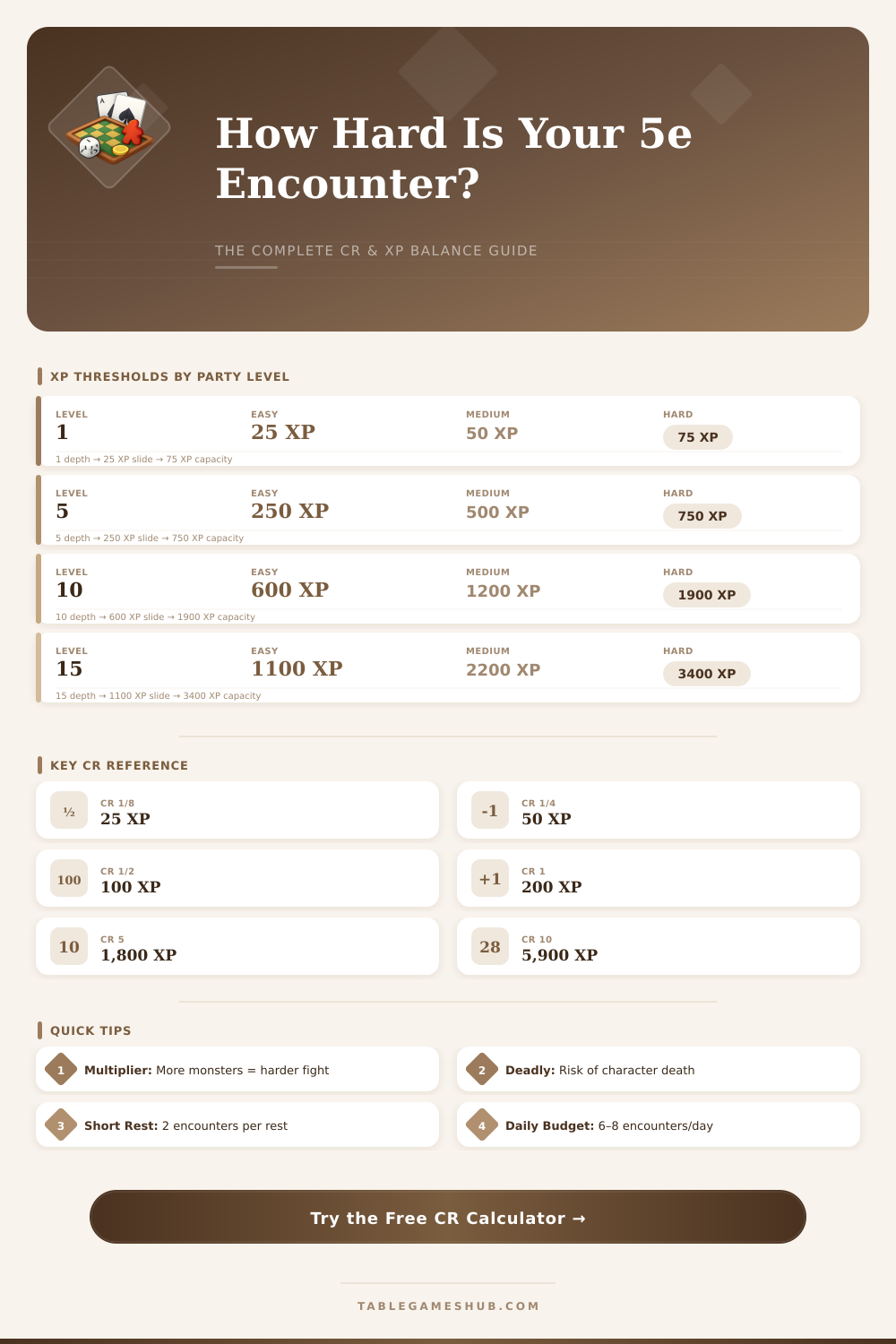
📋 XP Thresholds by Character Level
| Level | Easy XP | Medium XP | Hard XP | Deadly XP | Daily XP Budget |
|---|---|---|---|---|---|
| 1 | 25 | 50 | 75 | 100 | 300 |
| 2 | 50 | 100 | 150 | 200 | 600 |
| 3 | 75 | 150 | 225 | 400 | 1,200 |
| 4 | 125 | 250 | 375 | 500 | 1,700 |
| 5 | 250 | 500 | 750 | 1,100 | 3,500 |
| 6 | 300 | 600 | 900 | 1,400 | 4,000 |
| 7 | 350 | 750 | 1,100 | 1,700 | 5,000 |
| 8 | 450 | 900 | 1,400 | 2,100 | 6,000 |
| 9 | 550 | 1,100 | 1,600 | 2,400 | 7,500 |
| 10 | 600 | 1,200 | 1,900 | 2,800 | 9,000 |
| 11 | 800 | 1,600 | 2,400 | 3,600 | 10,500 |
| 12 | 1,000 | 2,000 | 3,000 | 4,500 | 11,500 |
| 13 | 1,100 | 2,200 | 3,400 | 5,100 | 13,500 |
| 14 | 1,250 | 2,500 | 3,800 | 5,700 | 15,000 |
| 15 | 1,400 | 2,800 | 4,300 | 6,400 | 18,000 |
| 16 | 1,600 | 3,200 | 4,800 | 7,200 | 20,000 |
| 17 | 2,000 | 3,900 | 5,900 | 8,800 | 25,000 |
| 18 | 2,100 | 4,200 | 6,300 | 9,500 | 27,000 |
| 19 | 2,400 | 4,900 | 7,300 | 10,900 | 30,000 |
| 20 | 2,800 | 5,700 | 8,500 | 12,700 | 40,000 |
🐉 CR to XP & Proficiency Reference
| Challenge Rating | XP Award | Prof. Bonus | Typical Monster | Approx. AC | Approx. HP |
|---|---|---|---|---|---|
| CR 0 | 10 | +2 | Awakened Shrub | 9 | 1–6 |
| CR 1/8 | 25 | +2 | Goblin | 13 | 7–35 |
| CR 1/4 | 50 | +2 | Wolf | 13 | 36–49 |
| CR 1/2 | 100 | +2 | Orc | 13 | 50–70 |
| CR 1 | 200 | +2 | Bugbear | 13 | 71–85 |
| CR 2 | 450 | +2 | Ogre | 13 | 86–100 |
| CR 3 | 700 | +2 | Manticore | 13 | 101–115 |
| CR 4 | 1,100 | +2 | Banshee | 14 | 116–130 |
| CR 5 | 1,800 | +3 | Troll | 15 | 131–145 |
| CR 6 | 2,300 | +3 | Wyvern | 15 | 146–160 |
| CR 7 | 2,900 | +3 | Stone Giant | 17 | 161–175 |
| CR 8 | 3,900 | +3 | Fomorian | 18 | 176–190 |
| CR 9 | 5,000 | +4 | Fire Giant | 18 | 191–205 |
| CR 10 | 5,900 | +4 | Young Red Dragon | 18 | 206–220 |
| CR 15 | 13,000 | +5 | Adult Red Dragon | 19 | 285–325 |
| CR 20 | 25,000 | +6 | Ancient Red Dragon | 22 | 546 |
| CR 24 | 62,000 | +7 | Tarrasque | 25 | 676 |
| CR 30 | 155,000 | +9 | Tiamat | 25 | 615 |
⚖️ Monster Count Multiplier Table
| Monster Count | Multiplier | Rationale | Small Party (<3) | Large Party (>5) |
|---|---|---|---|---|
| 1 Monster | x1 | Solo encounter | x1.5 | x0.5 |
| 2 Monsters | x1.5 | Pair tactics | x2 | x1 |
| 3–6 Monsters | x2 | Group pressure | x2.5 | x1.5 |
| 7–10 Monsters | x2.5 | Mob overwhelm | x3 | x2 |
| 11–14 Monsters | x3 | Large mob | x4 | x2.5 |
| 15+ Monsters | x4 | Horde tactics | x5 | x3 |
💡 Tip: Adjusted XP vs Award XP
The multiplied XP is only used to determine encounter difficulty — players still earn the base (un-multiplied) XP sum from defeated monsters. Never grant the adjusted XP as actual experience.
The multiplied XP is only used to determine encounter difficulty — players still earn the base (un-multiplied) XP sum from defeated monsters. Never grant the adjusted XP as actual experience.
💡 Tip: Daily Adventure Budgeting
The DMG recommends 6–8 medium-to-hard encounters per adventuring day with 2 short rests. If your party faces fewer encounters, even a "medium" fight may feel "deadly" because resources are not depleted.
The DMG recommends 6–8 medium-to-hard encounters per adventuring day with 2 short rests. If your party faces fewer encounters, even a "medium" fight may feel "deadly" because resources are not depleted.
Here the main idea: CR, either simply CR, is used in D&D so that masters of the game guess whether a monster truly forms a challenge. This tool helps you create encounters that truly will test your group, without risk that they will fall asleep or simply will vanish off the chart. The whole system builds on the idea that you have four playing players that well know what they do, but are not super tuned with every possible boost used up.
Here the main idea: the challenge rating of a monster means to give a good fight to four players of same level. So, if you send a CR 5 creature against four adventurers of level 5, that got rest and have good gear, they should win without struggle. That is the basic measure.
How Challenge Rating Works in D&D
If the CR beats the level of the group, the fight becomes truly dangerous. Lower it and it likely will not risk much. Really that simple.
Monsters rank somewhere on a range of 0 to 30. CR 0? It simply does not threaten anybody.
A monster of CR 1/4 is meant to threaten one single player. Go to CR 1/8, and it should take around two of them for one character. CR 10 should be fair trouble for four players of level 10…
Nothing huge, only a good strugle.
The rules are not set for always. You can change them by adding more enemies, higher CRs or changing the number of players at the table. Think of that: six players of level 3 against one monster of CR 7 should have same chances as three of same level against a CR 3 creature.
Especially at low levels, be careful with something that has CR above the average of your group. One good hit from a dangerous monster could badly hurt a character of lower level.
Here the main spot, even so. CR is only a guess, nothing exact. It builds on ideas, no more.
Every group plays different. If your party is full of clerics and paladins, they easily will beat undead monsters. Also, the action of the group, your four players act many times during a round, makes it so that won alone monster commonly barely resists, even if its CR seems scary on paper.
Four players of level 5 could easily beat a CR 5 encounter or even push past a monster of CR 9 or 10, but then fall in front of a horde of CR 1 creatures.
Some monsters end with oddly low CR, because their defenses are very weak. A creature can have strong attacks, but only 4 points of hit points total, which badly affects the rating. The system is not perfect.
Many think that it is wrong atbest. Even some built a whole new method called Challenging Ratings 2.0, after they checked the 5e edition and noticed that the original does not truly work well.