Billiard Angle Calculator: Find the Perfect Shot Every Time
🎱 Billiard Angle Calculator
Calculate shot angles, bank shots, cut angles & cue ball deflection for any pool table
⚡ Quick Presets
📐 Shot Parameters
📊 Calculation Results
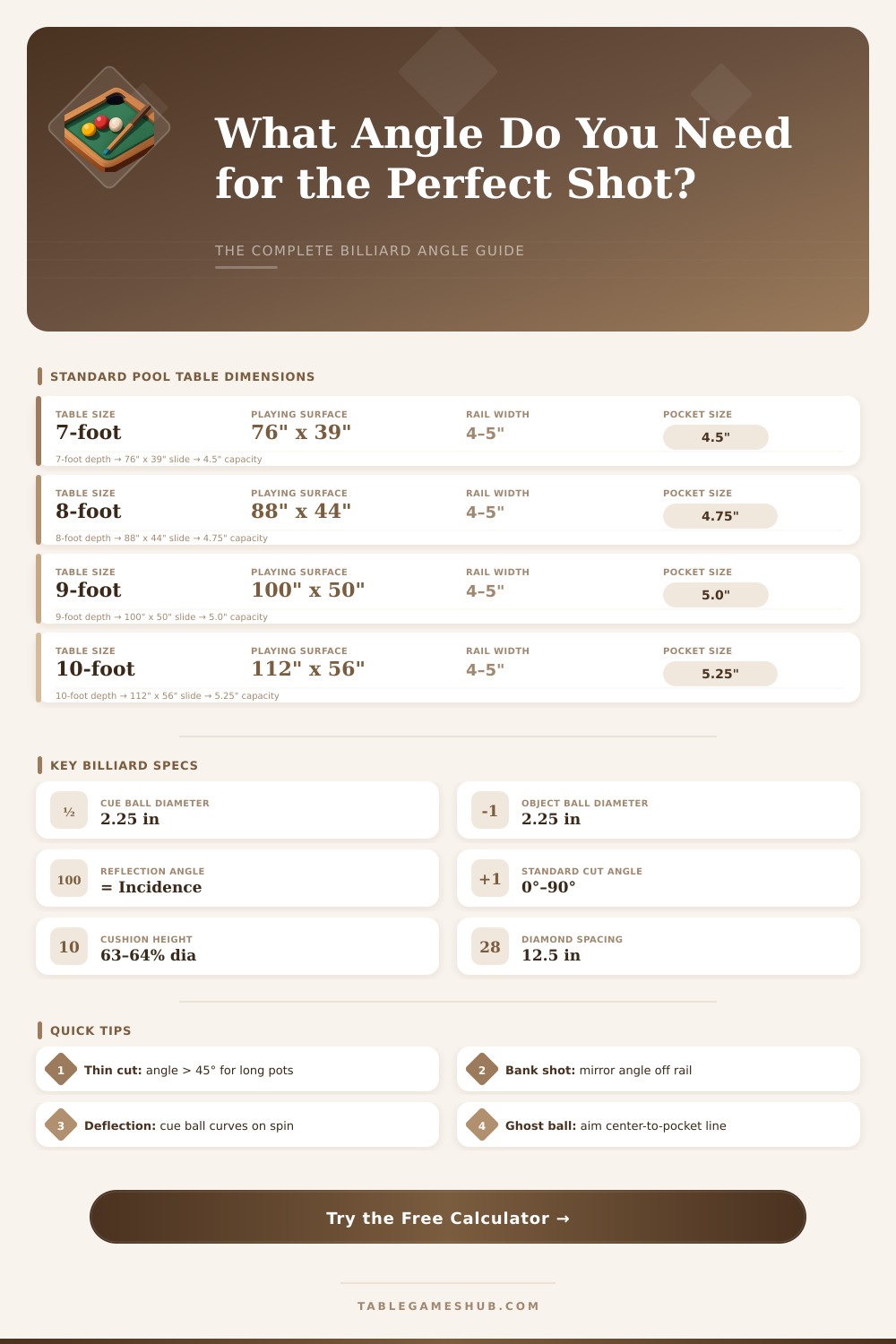
📊 Key Billiard Specs at a Glance
2.25"
Ball Diameter
57"
Std Cue Length
15
Object Balls (Pool)
90°
Max Cut Angle
45°
Equal Split Angle
63%
Cushion Height
5°
Deflect Per Tip
12.5"
Diamond Spacing (9ft)
📏 Standard Pool Table Dimensions
| Table Size | Playing Surface (in) | Playing Surface (cm) | Rail Width | Pocket Opening | Diamond Spacing |
|---|---|---|---|---|---|
| 7-foot (Bar) | 76" x 38" | 193 x 97 cm | 4–5" | 4.5" | 9.5" |
| 8-foot (Home) | 88" x 44" | 224 x 112 cm | 4–5" | 4.75" | 11" |
| 9-foot (Tournament) | 100" x 50" | 254 x 127 cm | 4–5" | 5.0" | 12.5" |
| 10-foot (Snooker) | 112" x 56" | 284 x 142 cm | 5–6" | 3.5" (snooker) | 14" |
🎯 Cut Angle vs Pocket Success Rate
| Cut Angle | Shot Type | Cue Ball Path (post-hit) | Ghost Ball Offset | Difficulty |
|---|---|---|---|---|
| 0° (Straight) | Full ball hit | Stops / follows straight | 0" offset | Easy |
| 15° | Thick cut | Slight deflect ~15° | ~0.3" offset | Easy |
| 30° | Standard cut | ~30° side path | ~0.6" offset | Moderate |
| 45° | Half-ball hit | 90° from object ball | ~1.1" offset | Moderate |
| 60° | Thin cut | ~60° deflect wide | ~1.6" offset | Hard |
| 70° | Very thin cut | ~70° deflect very wide | ~2.0" offset | Very Hard |
| 80°+ | Extreme thin | Grazes & wildly deflects | ~2.2" offset | Expert Only |
💡 Bank Shot Angle Reference (Mirror Principle)
| Incoming Angle | Rebound Angle | Rail Type | Speed Factor | Notes |
|---|---|---|---|---|
| 15° | 15° | Any rail | Medium | Easy bank, long travel |
| 30° | 30° | Any rail | Medium | Standard cross-side |
| 45° | 45° | Any rail | Medium | Corner to corner |
| 60° | 60° | Any rail | Firm | Short bank needed |
| 30° + Spin | ~25° (inside) | Side spin rail | Medium | Running English widens |
| 30° + Spin | ~35° (outside) | Side spin rail | Medium | Reverse English narrows |
📋 Cue Ball Deflection by English / Spin
| Spin Type | Cue Offset | Deflection Angle | Path After Contact | Best Use |
|---|---|---|---|---|
| No Spin (Center) | 0 tips | 0° | Perpendicular to object ball | Straight position |
| Top Spin (Follow) | Center high | Follows OB direction | Rolls forward | Extend run |
| Back Spin (Draw) | Center low | Reverses back | Rolls backward | Defense / safety |
| Left English | 0.5–1 tip left | ~5° left offset | Curves slightly left | Bank adjustment |
| Right English | 0.5–1 tip right | ~5° right offset | Curves slightly right | Bank adjustment |
| Max English | 2 tips | ~10° offset | Significant curve | Advanced shots |
💡 Ghost Ball Aiming: To aim a cut shot, visualize a "ghost ball" touching the object ball at the contact point. The line from the ghost ball center to the object ball center points directly to the pocket. Aim your cue ball at the ghost ball center for accurate cuts at any angle from 0°–85°.
🎯 90° Rule for Center Ball: When you hit the cue ball with center ball contact (no spin), after striking the object ball the cue ball travels at exactly 90° to the path of the object ball. This rule is reliable for cuts between 20°–70° and helps plan your next shot position accurately.
Understand corners in billiard are between the main causes for improving your game at the table. The basic idea is not difficult. When a ball touches the rail, the entering corner matches the exiting.
One sometimes calls it “corner in matches corner out” and it counts always for bounces of the cue ball against cushions.
Corners and Aiming in Billiards
A popular way to aim tough shots is the method of the ghost ball. It consists in imagine the position, where the cue ball should be when it contacts the target ball. For a 30-degree slice, the aim point rests right on the edge of the target ball.
Even exist plastic templates, that one can lay above the place of the ghost ball, and they help to estimate the corner of slice, the fraction of ball hit and the direction of the cue ball.
Some players favour that, what one calls the clock method. A corner of five hours is really easy to observe. That of three hours one can compare with a slice of pizza.
For seven and half, it looks like a bit of pizza. A half of pizza bit helps for half-ball shots. Basically, a 12-hour corner simply takes the slice of pizza from the proper viewpoint.
There is also good use of the cue stick. A one-degree corner spreads to one inch over 57 inches. Like this, laying the stick tip in the centre of the ghost ball and turning it, one can estimate corners during the game.
Three balls placed one to another show a 60-degree corner, and the half of that gives 30 degrees, what clearly shows, why the ghost ball method works when one looks from above.
The diamonds on the billiard table serve as basic marks for counting corners of balls. Between them the distances stay the same. The long side of the table splits in eight parts, while the short in four.
Front and back spin changes the bounce corner of the cue ball. This is key for bank shots. Even so, reaching the precise corner can be a real challenge.
Missing only by sum inches can cause too big or too little corner, what destroys the position for the next shot. Even seemingly cut ball more than 90 degrees are possible, but really it deals about bottom struck shots with first rail-contact, usually with spin.
Aiming by feeling is a skill that grows over time. After thousands of shots with same corner and position, the mind finally grasps what seems right. Some players find that they tend to undercut shots and make up for that by adding a bit more corner than the visible right.
Practice form, tension and stance are just as important asknowing corners. The more time one gives to corner shots, the less you need to think about the corner itself.