Battleship Probability Calculator: Find Your Best Shots
🚢 Battleship Probability Calculator
Calculate hit probabilities, optimal targeting odds, and ship coverage statistics for any Battleship grid configuration
⚡ Quick Presets
⚙️ Calculator Settings
📋 Probability Analysis Results
🚢 Ship Coverage Statistics — Classic 10x10
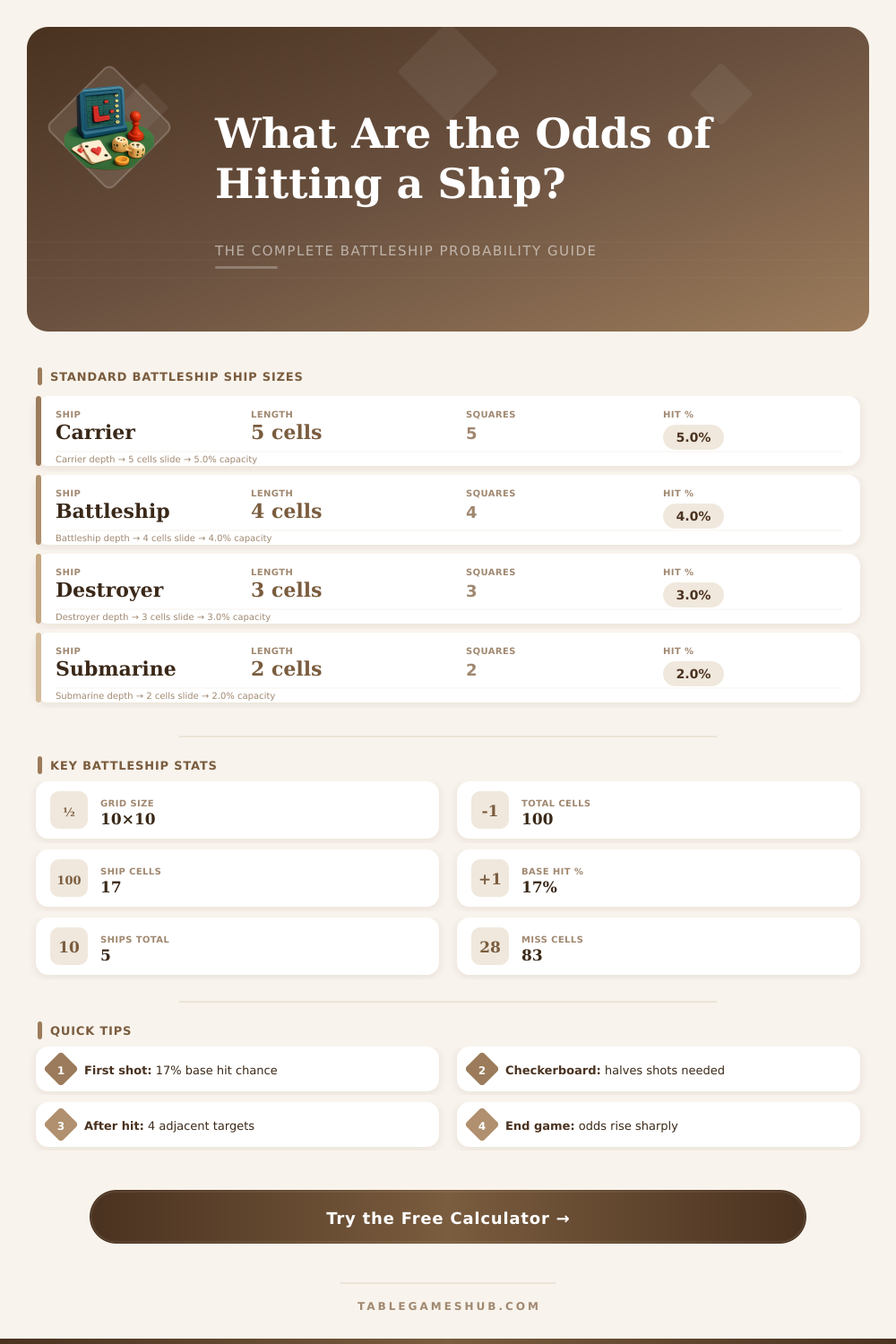
17
Total Ship Cells
17%
Base Hit Chance
96
Avg Shots to Win
42
Checkerboard Shots
100
Total Grid Cells
5
Ships in Classic
83%
Miss Probability
5.88
Expected Shots/Hit
📋 Standard Ship Configurations by Grid Size
| Grid Size | Total Cells | Ships (Classic) | Ship Cells | Coverage % | Avg Shots to Win |
|---|---|---|---|---|---|
| 6 x 6 | 36 | 3 | 9 | 25.0% | 27–30 |
| 8 x 8 | 64 | 4 | 14 | 21.9% | 50–55 |
| 10 x 10 | 100 | 5 | 17 | 17.0% | 90–96 |
| 12 x 12 | 144 | 5 | 17 | 11.8% | 128–135 |
| 15 x 15 | 225 | 7 | 26 | 11.6% | 195–210 |
🎯 Individual Ship Hit Probabilities (10x10 Grid)
| Ship Name | Cell Size | Hit % (100 cells) | Placement Combos | Horizontal Positions | Vertical Positions |
|---|---|---|---|---|---|
| Carrier | 5 | 5.0% | 120 | 60 | 60 |
| Battleship | 4 | 4.0% | 140 | 70 | 70 |
| Cruiser | 3 | 3.0% | 160 | 80 | 80 |
| Submarine | 3 | 3.0% | 160 | 80 | 80 |
| Destroyer | 2 | 2.0% | 180 | 90 | 90 |
📈 Strategy Comparison Table
| Strategy | Avg Shots to Win | Efficiency | Best For |
|---|---|---|---|
| Random | ~96 shots | Baseline | Beginners |
| Checkerboard | ~65 shots | 32% better | All skill levels |
| Hunt & Target | ~55 shots | 43% better | Intermediate |
| Optimized | ~40 shots | 58% better | Advanced |
| Salvo (5 shots) | ~20 turns | Fastest turns | Quick games |
💡 Checkerboard Strategy: By only shooting every other cell in a checkerboard pattern, you can guarantee finding any ship of size 2+ in at most 50 shots on a 10x10 grid. This cuts your expected miss rate significantly and is the most commonly recommended beginner strategy upgrade.
🎯 Hunt & Target Mode: After a confirmed hit, switch from random/checkerboard fire to targeting all 4 adjacent cells. Once you find the ship's orientation (horizontal or vertical), focus fire along that axis. This eliminates backtracking and reduces average game length by 40–45% vs. pure random shooting.
Battleship is made up of two players, that place different ships on a grid of squares, normally 10×10. Later they take turns to shoot at one square in the grid of the opponent, trying to hit the secret ships. It seems easy but really a lot of math happens under the surface.
In Battleship the main challenge is choosing between two basic tactics. One method is made up of using plans, that ensures finding of every ship but that costs a lot of time and commonly ends in defeats. The second way is simply guessing randomly and believing, that fate helps you.
How to Use Probability in Battleship
The key idea of the game is judging, which of those two ways to apply in any situation.
Here comes the probability. A calculator for probability in Battleship checks all possible arrangements of ships for a particular plan of the board and shows the chance, that a ship covers every square. It does not limit to advice about shots.
Instead it divides the whole board into colored percentages of likelihood, that adjust according to the progress of the game. That type of resource was created by C. Liam Bruna and one can use it freely online.
The math of it works by means of computing the most likely position for the next shot. It builds on layering of all possible places, where the enemy ships could be. And it takes into account all ships together, not only one of them.
So, if the board carries a carrier and Battleship, the program counts for both during its work.
An interesting part of that method is, that the distribution of probabilities on the board is not equal. It says, that the opponent chooses between possible positions equally, what results in focused distribution. Like this the center of the board tends to have bigger chances than the edges.
To reach evenly spread squares, one should choose an arrangement, that probably forms the strongest defense.
A good starting plan intends to cover the tiniest ship first. When that ship has too squares, one should place shots in a checkerboard style. If one finds it soon, the plan adapts to address the next, bigger ship.
Basically, tactics in Battleship combines probability distribution to find ships first with a system, that decides next shots according to the results as well.
You do not win in Battleship by finishing in the very next turn. Victory happens by means of use of less many shots than the opponent. Playing according to patterns gives a low middle number of moves compared to searching, around 2.5 instead of 2.66 against a casual opponent.
No one will ever win in only 17 shots, but usage ofprobability tools helps get closer to faster victory.