Architects of the West Kingdom Calculator
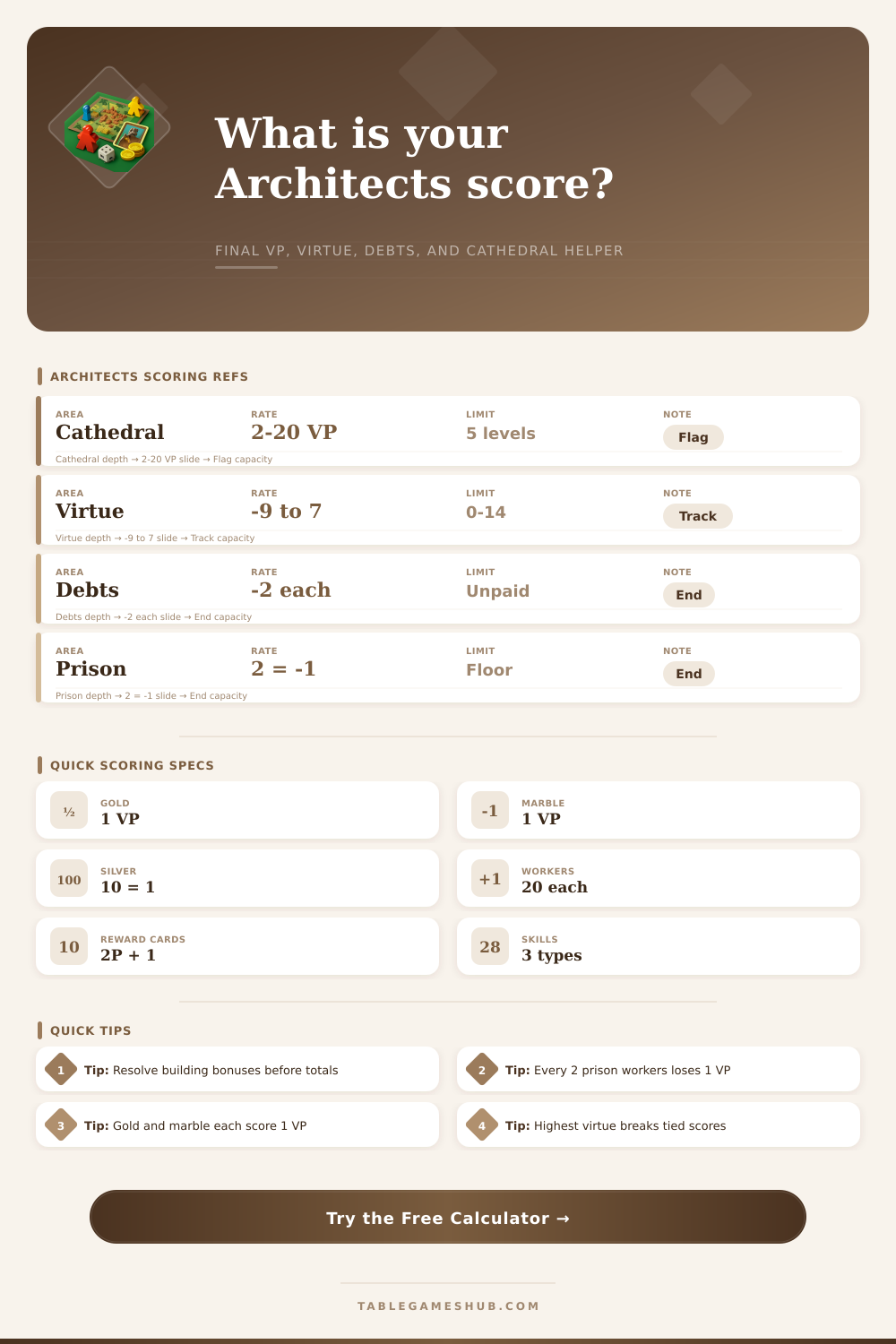
Total an Architects final score from buildings, cathedral progress, virtue, debts, apprentices, captured worker bonuses, gold, marble, silver, and workers left in prison.
Use a preset as a starting board state, then edit the values to match the player board after all end-game building effects are resolved.
| Category | Scoring rule | Calculator field | Common check |
|---|---|---|---|
| Constructed buildings | Printed yellow flags plus resolved end-game card text | Printed building VP, building bonus VP | Resolve card bonuses before final total |
| Cathedral | Score the yellow flag beside the current level | Cathedral level reached | Below lowest level is 0 VP |
| Virtue track | Score the flag at final virtue position | Final virtue position | High virtue breaks ties before silver |
| Unpaid debts | Lose 2 VP for each unpaid debt | Unpaid debt cards | Paid debts are not a VP penalty |
| Gold and marble | Gain 1 VP for each gold and each marble | Gold remaining, marble remaining | Clay, wood, and stone need card text to score |
| Silver and prison | Gain 1 VP per 10 silver; lose 1 VP per 2 prison workers | Silver remaining, your workers in prison | Both calculations round down |
| Track | Position | VP | Important restriction |
|---|---|---|---|
| Cathedral | Below, Level 1, Level 2 | 0, 2, 4 VP | Need virtue above 4 to work on the Cathedral |
| Cathedral | Level 3, Level 4, Level 5 | 7, 12, 20 VP | Each advance also discards 1 building card |
| Virtue low | 0, 1, 2, 3, 4, 5 | -9, -8, -7, -5, -3, -1 VP | At 3 or less, tax icons may be ignored |
| Virtue middle | 6, 7, 8, 9 | 0 VP | Starting virtue is 7 |
| Virtue high | 10, 11, 12, 13, 14 | 1, 2, 3, 5, 7 VP | At 10 or more, Black Market is closed |
| Item | Why it matters | Direct VP? | Calculator support |
|---|---|---|---|
| Carpentry, tiling, masonry | Some buildings require matching apprentice icons | No | Skill checkboxes show coverage |
| Hired apprentices | Abilities can alter end-game resources, debts, or bonuses | Usually no | Manual apprentice or multiplier VP field |
| Captured workers | Some building cards score captured workers | Only by card | Captured worker scoring card selector |
| Gold and marble | Rare resources retained on the player board | Yes | Automatic 1 VP each |
| Clay, wood, stone | May matter to specific building card text | No default VP | Tracked for audit in breakdown |
End-game order: resolve built building effects first, then score the main categories so virtue, debt, resources, and captured workers are final.
Rounding check: silver sets and prison penalties both round down, so 9 silver is 0 VP and 3 prison workers is -1 VP.
The final phase of Architects of the West Kingdom is when you find out if it is a great game or not. All this time you’ve been jockeying for position, moving workers around, trading with other player, and more. But then…you tally up the points. Suddenly everything make sense because it’s all numbers. And then it seems crazy. Until you realize that winning (or losing) is just going to come down to math. Now comes the calculator. Let someone else do the math while you play the game.
The flags waving from your buildings are visible during the game and most players concentrate on what they see. Those building scream “progress!” They clearly represent building efforts. It’s tempting to believe that’s all there is. Don’t rely solely on construction points. End-game effects hide within those buildings and it’s those that realy shift the point values. Certain cards award points based off workers held, specific resources, etc. Make sure to review these bonuses BEFORE totaling other points. One missed card effect may be the difference between finishing 1st and 4th.
Scoring Points in Architects of the West Kingdom
This makes the cathedral track strategic: it pays off players that commits long term. Getting to higher levels will net you a lot of points (especially with levels four and five where return is quite high). But you have to get rid of your building cards to advance. That’s an ability or income you’re giving up now for later turns. It creates a struggle between short term needs and long term payoffs. Those players who fail to pay attention to the cathedral initially can be left behind in the late rounds when they realize it costs too much to play catch-up.
A gatekeeper It also doubles as a scoring engine. There is no margin for error on the track that goes from negative points to positive scores. If your virtue slips below three, you avoid paying taxes. Sounds great until you can’t pull yourself above it again. You’re left in a net loss. Hit ten or higher, and the black market closes completely. Now you must decide whether you want long-term security at the cost of flexibility in short term. This dilemma dominates much of your mid-game strategy.
The most dangerous aspect of the game economy is your debt. Every debt incurs a cost of two points… And that’s a lot of points real fast, especially with several outstanding loan. To avoid getting yourself in trouble, many people attempt to maintain minimal debt. In some cases, though, you need to take out debt in order to afford a vital building or snag a reward card before someone else gets it. Learn where to accept the penalty and where to repay later.
Some cards directly score for resources such as marble or gold, which is actualy valuable late in the game. The silver isn’t so straightforward: it only scores in sets of ten, so there’s a sort of rounding mechanic here where partial sets don’t matter. Unless you play a certain kind of card. Unless you play a certain kind of card. The result is you aren’t just trying to hoard resource type by resource type but thinking more about how to group them together. Prison workers also carry a penalty that scales with quantity, adding another layer to worker management.
It gives you a sense of how things interact which alters your view of the game’s board state. Individual moves are not isolated; instead they are connected to resource stocks, debt loads, and virtue positions. Before making a move you can check out common scenarios in the tool’s reference tables that quickly double-check your mental math. It turns abstract planning into a concrete strategy.
Playing Architects is about finding the right balance between being cautious and aggressive. You must build up enough to score high, but keep enough flexibility to counter your opponent’s moves. Knowing your point total helps you see if those balances worked in your favor. This makes post-game analysis a means of learning what to do differently on your next game. Consider virtue tracks and cathedral levels prior to your first worker placement next time you play. Whoever plans ahead should of gets the points.