Newton Score Calculator
Total a finished Newton game from current VP, bookshelf progress, travel, study and work tracks, income, Master cards, objective tiles, and special scoring tiles.
📌Newton scoring presets
⚙Score sheet inputs
Enter points already on the VP track plus the end-game items you actually qualified for. The objective checkboxes apply Newton objective-tile formulas; the manual fields catch printed VP from variable tiles and cards.
✅Objective tiles to include
🧮Newton component scoring grid
📖Objective tile reference
| Objective source | Calculator field | Scoring formula | Important cap |
|---|---|---|---|
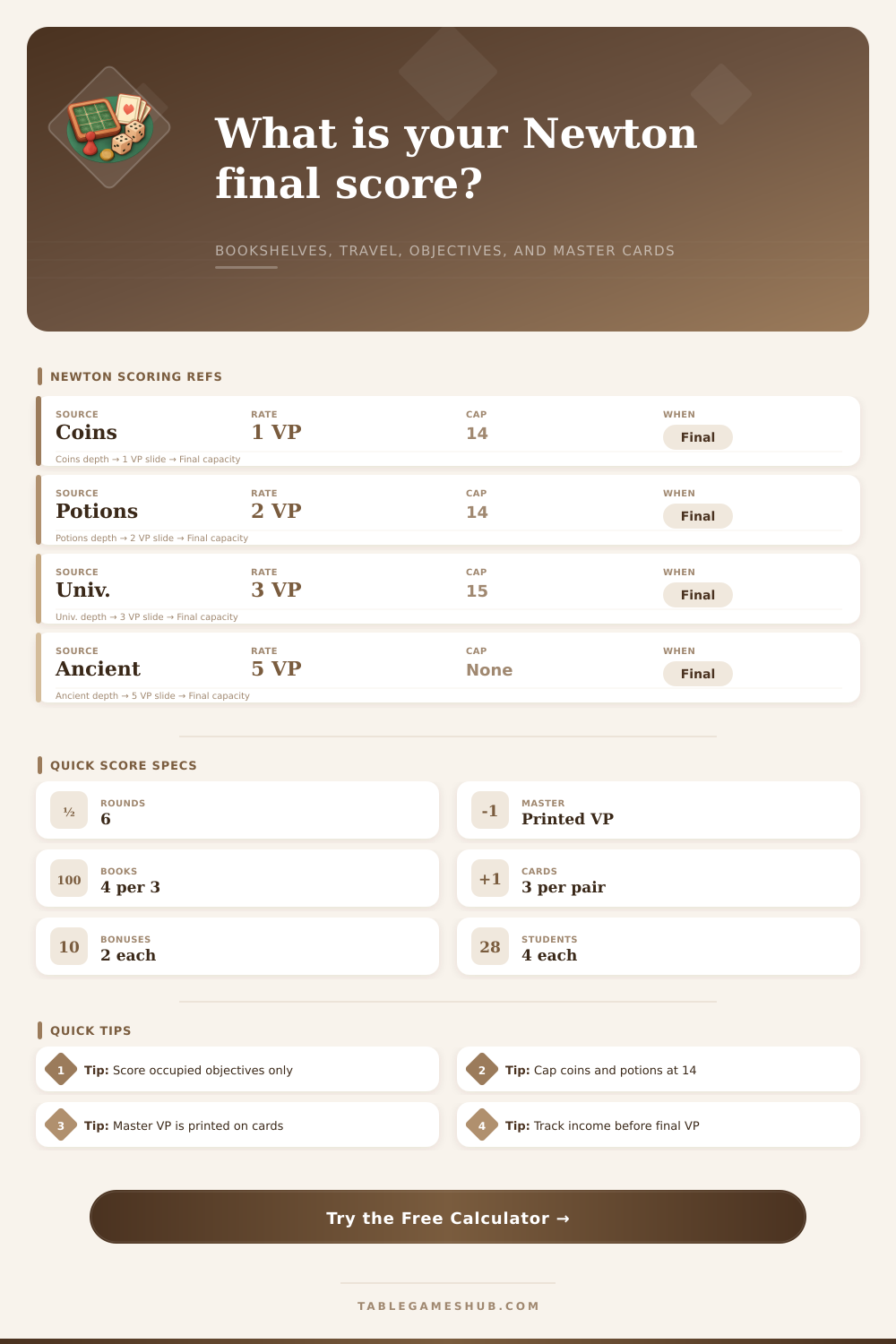
| Coins left | Coins objective | 1 VP per coin | Maximum 14 VP |
| Potions left | Potions objective | 2 VP per potion | Maximum 14 VP |
| Universities visited | University objective | 3 VP per university | Maximum 15 VP |
| Ancient Lands visited | Ancient Land objective | 5 VP per land | No fixed cap on tile text |
| Bookshelf tiles placed | Bookshelf objective | 4 VP per full set of 3 | Uses placed tiles only |
| Master cards played | Master card objective | 4 VP per played Master | Separate from printed Master VP |
| Different Volume sets | Volume sets objective | 5 VP per set of 3 colors | Maximum 15 VP |
| Non-starting action pairs | Action card pairs objective | 3 VP per pair | Maximum 15 VP |
| Bonus tokens left | Bonus token objective | 2 VP per token | Maximum 14 VP |
| Students at path ends | Student end objective | 4 VP per student | Maximum four students |
🗺Track and board scoring reference
| Board area | What to count | Where to enter it | Calculator note |
|---|---|---|---|
| Study board | Completed shelf rows, columns, and printed VP rewards | Bookshelf row/column VP | Keep separate from the bookshelf objective formula. |
| Travel map | VP printed beside cubes, cities, Ancient Lands, and map rewards | Travel cube and map VP | University and Ancient Land objectives can be toggled separately. |
| Technology tracks | Student path bonuses and manual objective values | Study and technology VP | The student-end objective uses its own field. |
| Work track | Printed objective tile reached by the work marker | Work track objective VP | Use the manual value if the tile is not one of the formulas. |
| Income spaces | Medicine tile VP and other active income rewards | Income tile VP | Use this for points already earned or final-counted from income. |
| Master cards | Printed VP on played Master cards | Printed Master card VP | Do not double-count the separate Master-card objective. |
| Special tiles | Special effects, bonus VP, and unusual tile scoring | Special tiles and card-effect VP | Manual catch-all for table-specific edge cases. |
🏅Solo scoring bands
| Final VP | Solo level | Score feel | Calculator use |
|---|---|---|---|
| 0-40 | Illiterate | Learning game | Check missed objective toggles |
| 41-60 | Scribe or Student | Early progress | Look for income and Master VP |
| 61-80 | Scholar or Professor | Solid finish | Compare bookshelf and map totals |
| 81-100 | Dean or Luminary | Strong finish | Objectives likely matter most |
| 101-120 | Master or Genius | Excellent finish | Review all caps and printed VP |
| 121+ | Science Legend | Top solo band | Confirm no objective was double-counted |
💡Scoring tips
And then, click, the last action card is played. And it’s over. At that point, the game changes into something else. The tile laying strategy come to an end. The busy resource management stop. You’re faced with a board littered with achievements, strewn across table. There are tokens and half-finished tracks. They appear less like money, and more like debris.
This is where Newton penalizes sloppy bookkeeping. Here, clarity is most important. Victory isn’t measured by the player who laid down the most tiles. It’s measured by the player who understood how they worked and turned them into points as engine shut off.
How to Count Your Points in Newton
Newton’s end game is famously heavy in scoring. It’s both a result of how tracks align at first sight and an elaborate set of goals tied to the end. On top of that, you need to account for points accumulated on your personal scoring track so far. And then there are all those pesky variable rewards on the board. Some folks get stuck here because there is just too many categories to consider. They’ll lose count of how many coins they’ve got or fail to remember that potions can only be worth up to X amount.
That’s where the above calculator comes in. It runs through all the math for you. It takes that messy visual mess and converts it into a solid number. But you’ve got to know what all of these inputs represent as missed opportunities and strategy in order to use it properly.
First, let’s discuss the bookshelf. Since it is physical and you are actually laying out tiles into rows and columns on your own copy of study board, I think that makes it feel like most concrete element of the game. And, you might think, well, yeah, the more tiles I put down, the more I’ll get. But here’s where things gets slightly subtle: For every three tiles placed, there’s often a set of bonus points available from the objective tile. In other words, four may not be any better then three because the fourth tile isn’t part of a set that hits a bonus threshold.
There’s another subtlety: When you place tiles, you also earn objective points based off only placement, completely apart from the points earned for completing a column or row. There are two scoring lines. These is two different ways to score that players often mix up. They are also separate from victory points printed on the tiles themselves. One common mistake is to add these all up as one grand total, and then over-estimate your lead, or under-estimate how far behind you are.
The same is true of travel and exploring. There’s a very quick hit of gratification from visiting cities and placing cubes on the map. In the end-game, how many points each city give you depends pretty strongly on what objective tiles you happened to occupy. Did you get the university objective? Great! Those university visits are now worth three points apiece with a maximum score of 15. But maybe you got the ancient lands objective instead? Depending on your board layout, those same visits could net you much higher points (or much lower).
How do you know which is important? Because while yes, you did go there… you have to check the list again to see if that really counts. It makes you audit your decisions throughout the game based off the unchanging end conditions.
The engine-building portion of this equation are Income and Master cards. These are the quiet point earners that chug away in the background as you work on other things. Master cards gives you printed points equal to what they cost. You also get another objective to play them. Both of these can be forgotten about or double counted without much thought. It is the same with income tiles. Those are still earning you points round after round if you scored money or some other long-term income source. Count those as well as everything else you have build up. Don’t forget about them because they aren’t flavor text. They’re significant pieces of your total score and they will swing a tight game.
The wildcard is leftover resource stuff like bonus tokens, coins, and potions. These are just left over value, not value that was intended to be achieved. But hey, there are hard caps on this type of stuff! Coins and potions are capped at 14 VP each. Potions and coins is also capped at 14 VP apiece. Hoarding beyond those caps is purely defensive or tactical noise.
Knowing the cap tells you if you should of take a late-game token for its instant gain instead of holding for an objective bonus. It also tells you if you can ignore it entirely because you already have enough of that resource to maximize its contribution. Those tokens may now only be worth half what they could of been had you completed the potion objective.
Then there’s the solo component, which offers another dimension. Your band scores range from being an illiterate novice to a scientific legend in Newton. It gives you a reference point for how you stack up against yourself. Eighty-plus is solid. Getting above one-hundred demands pretty much perfect efficiency in each category. There’s no room for leaving points on the table in any one department.
That’s where this tool breaks it down so well: It will tell you exactly what you did wrong. Perhaps you dominated the bookshelf but neglected your Master cards. Or perhaps you got around a lot but never managed to get the matching objective. Knowing that weakness makes for more than just a fun game; it becomes a precise strategy.
Ultimately, Newton’s is a game where pulling all these different system together matters. That final score isn’t simply the sum of its parts. Rather, it represents how successfully those parts has been fit together over the course of six rounds. Whether you’re flying solo or going head-to-head with your friends for victory points, taking the time to do the math correctly makes sure that your hard work gets its proper due. It connects what happens on the board to the story of your academic life. You’re successful; now here are the numbers to prove it. But you can only do this if you can see past them.