Clans of Caledonia Score Calculator
Total final Glory, goods, money, imported contracts, settlement rank, shipping reach, clan powers, and end-game adjustments.
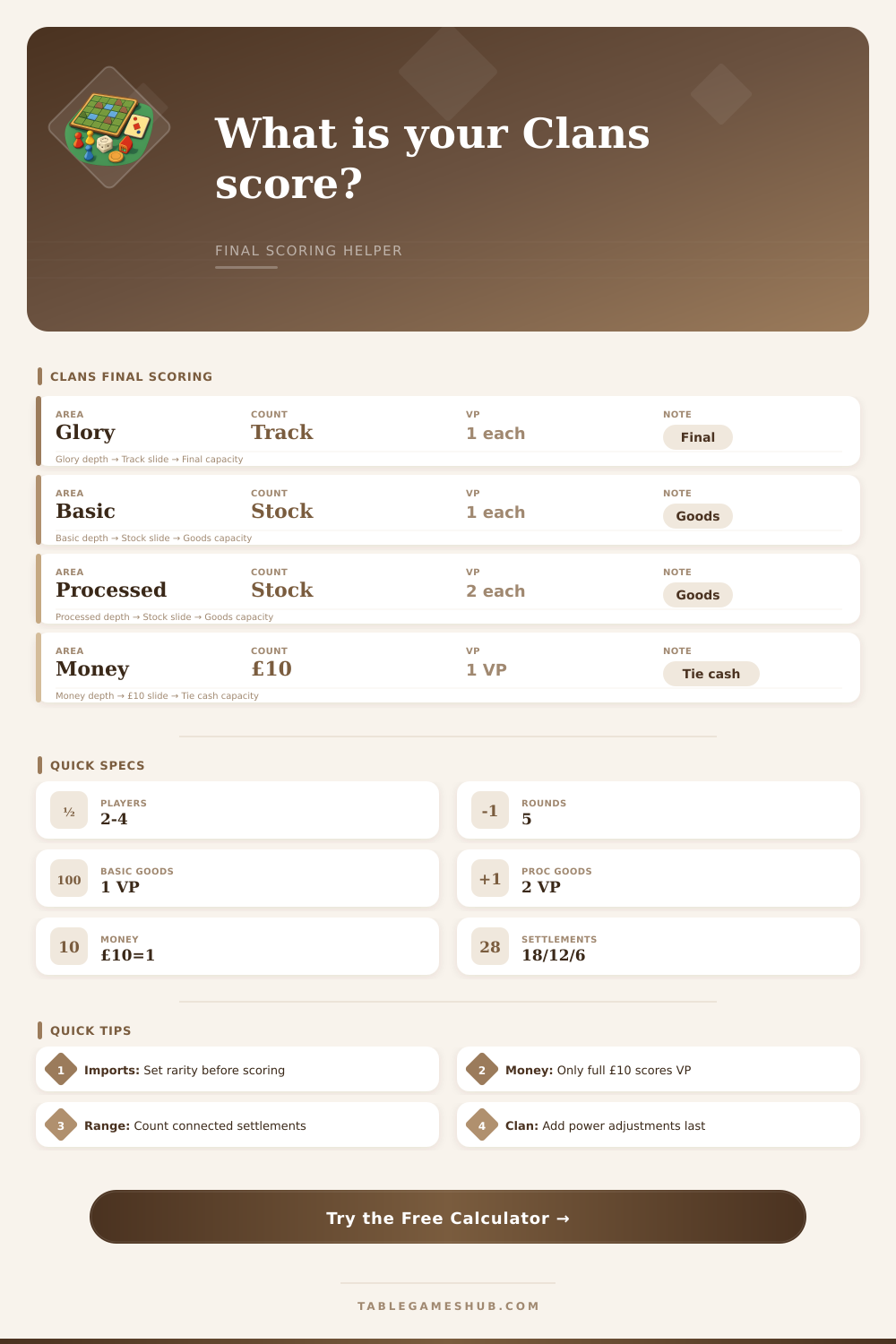
Only complete £10 groups score VP; leftover money remains a tiebreaker.
Basic goods are cattle/meat supply, sheep/wool supply, grain, milk, and similar final stock counted at 1 VP each.
Processed goods such as cheese, bread, and whisky score 2 VP each.
Use the largest group of your settlements that can reach each other by current shipping range.
Use this for agreed table corrections, scorepad adjustments, or scenario-specific VP that is not already covered above.
Enter your end-game state and calculate.
Score breakdown
| Score area | Formula | Input to use | Calculator note |
|---|---|---|---|
| Glory | 1 VP per step | Final Glory marker | Enter the scorepad value after round five scoring. |
| Basic goods | 1 VP each | All basic goods in stock | Count remaining goods once, not production capacity. |
| Processed goods | 2 VP each | Bread, cheese, whisky | Use the processed-goods input for the doubled value. |
| Money | 1 VP per £10 | Cash after all final income | Leftover pounds do not score but can break ties. |
| Imported goods | Hops 1; others 3/4/5 | Fulfilled contract imports | Set cotton, tobacco, and sugar values by the import-track rarity order. |
| Clan powers | Varies by clan | VP or money adjustment | Use the adjustment fields after resolving your clan-specific end state. |
| Rank area | 2 players | 3-4 players | Tie handling used here |
|---|---|---|---|
| Most fulfilled export contracts | 8 VP to first | 12 VP first, 6 VP second | Two-way first tie shares the top tiers shown in the inputs. |
| Connected settlements | 12 VP to first | 18 VP first, 12 VP second, 6 VP third | Use the largest connected group within shipping reach. |
| Shipping reach | Needed for settlement count | Needed for settlement count | The shipping field does not score directly; it explains the count. |
| Manual table correction | Use other bonus field | Use other bonus field | For unusual ties, enter the exact agreed difference as other VP. |
| Clan focus | What to check | Field to adjust | Why it matters |
|---|---|---|---|
| Cunningham dairy cash | Milk converted or sold through power | Extra clan money | Cash may create more full £10 VP groups. |
| MacDonald spread | Fishermen and loch placement | Connected settlements | Water placement often changes settlement reach. |
| Buchanan and MacEwen | Extra contract tempo or hops economy | Contracts and imports | Most of the score usually appears in fulfilled contract imports. |
| Stewart merchants | Extra flexibility at the finish | Goods or other VP | Resolve final conversions before entering stock totals. |
In the final round of Clans of Caledonia there’s a bit of both terror and triumph. For five rounds, you’ve shuffled worker. You’ve traded milk for cheese. You’ve argued about the most efficient route to move hops from port to port. Now it’s done. There on the board sits all those settlements in scattered groups, with some goods still yet to be changed. Who won the game? It might not be player who played best. The game will reveal that when you look at the board and add up the score.
Because if you’re looking at how far along you are on your glory track back at round three, then you’re not using Clan’s counterintuitive reward for efficiency. This page does the math for you, leaving you with the task of understanding exactly how these numbers were derived. Breaking out the total score into small parts lets you understand the value of your static stockpiles against your contract stash. This helps you distinguish between raw goods (which you may be overly impressed by) and your position in settlement chain (which others has undervalued).
How to Count Your Score
Sure, that pile of twenty basic goods sitting in storage looks good; it’s worth twenty points. But a skillfully configured set of interconnected settlements supported by a middle-tier shipment upgrade will generate at least eighteen victory points just from chain ranking bonuses. That’s what folks fail to grasp. What you possess isn’t necessarily counted, it’s calculated.
Enter in your remaining cash (and remember: The tool thinks of money differently) followed by your glory score, and then look at where it puts that money. All those ten-pound notes gets converted to one victory point. However, no points are added directly from the leftover pounds. Instead, they’re only used to break ties between people who both has the same number of points. This means you must weigh the pros and cons of putting three pounds into upgrading a small settlement now. You must compare that to the risk of losing an entire victory point during the last round’s conversion phase. Often, it is worth it.
The tool breaks out the cash conversion so you can see the exact amount of money you’ve got banked versus idling around. It’s further complicated by the import scoring: Each point isn’t an absolute number but instead depends on how common (or uncommon) something is relative to other people playing the game. Depending on what crop(s) were the most commonly fulfilled imports out of every player’s hands during any given game, cotton, sugar cane, and tobacco earn 3/4/5 points per item. To figure out the right value for them, you must first find out where you ranked relative to everyone else. Then, enter those rarity tiers into the tool afterward. This prevents someone who focused heavily on hops from accidentally over-inflating his/her own score by assuming their unique crops earned more points than they actualy did.
For example, hops are always worth just one point apiece, no matter how many you have, this explains why hop-only strategies only work at extreme scales different than nimble merchants who adapt to changing demand. The same goes for settlement connectivity. It’s not just how many markers you put down on the map; it’s which ones are in the biggest connected group that could be reached from each other given your existing shipping. So if your shipping lets you cross two rivers, then only settlements connected through that network will contribute to your rank bonus. That is, an empire that spreads out too much without good connecting links may end up scoring fewer points than a regional center where all the settlement clump tightly together.
Again, the calculator provides some peace of mind here as it lets you plug in the numbers for total settlements and how many of them are within range, so you can see how big the disconnect is between having a presence versus having influence. The last piece of the math is complicated by clan powers. For the Cunningham clan, milk conversion adds extra cash that must be added before dividing by ten to get their victory points. Other clans (MacDonald included) impact settlement placement and counting. There are spaces in the tool for these unique adjustments so you can still apply your clan’s end-game bonuses while not getting thrown off by the base score.
What was previously an audit with no structure ends up being a structure in chaos, showing whether your late-game push truly made a difference or was simply adding noise to the final tally. In the end, however, Clans of Caledonia is a game of network effects and resource timing. It wasn’t just about what you collected; it was about how well you connected those things before the clock stopped. Did chasing contract fulfillment pay more than going for raw goods? Did focusing on processed goods give you more points-per-item? Did you hit enough high-value imports to make your setup worthwhile?
Everything breaks down after the fact and lets you tinker with the inputs to see how different choices will change the sum. This isn’t just an exercise in addition, but a sort of post-game analysis: It’s the kind of thing that makes me want to play again. Ultimately, it’s only some numbers scribbled on a piece of paper or typed out on a computer screen. However, once you know what those numbers mean, you’re one step closer to preparing yourself for the following match. Your mind turns from viewing shipping upgrades as a cost and sees them as a way to increase your number of settlements. You begin to evaluate the cost of a guaranteed connection vs. That of an additional pound of cash. Before the last round even starts, you’ll be able to ask yourself the right questions, which is the real prize the calculator provides.