Arnak Expedition Leaders Calculator
Total a Lost Ruins of Arnak Expedition Leaders score from leader board progress, research, guardians, artifacts, idols, assistants, fear, and leftover resources.
Expedition Score Result
| Score area | Calculator input | Scoring logic | Why it matters |
|---|---|---|---|
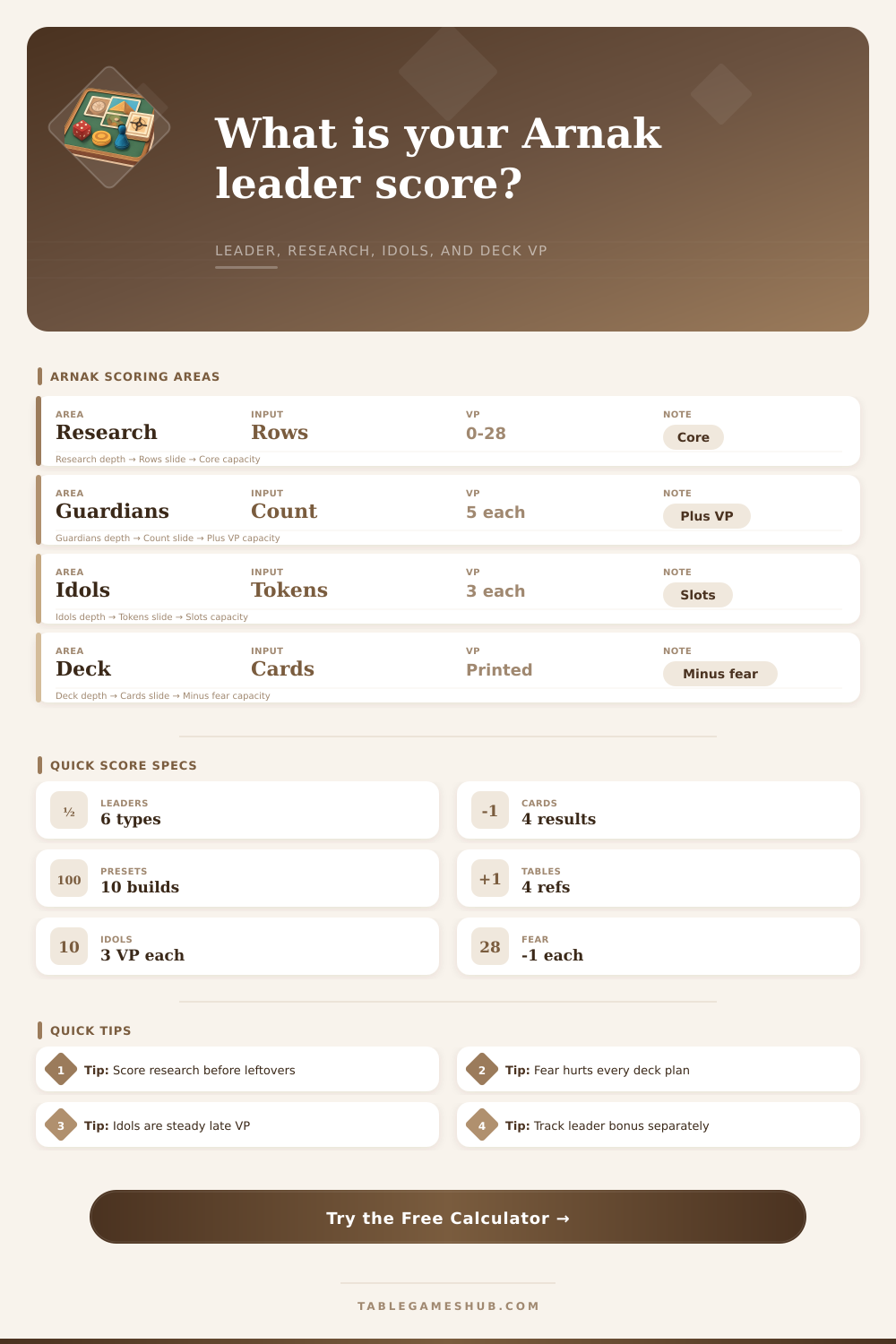
| Research track | Magnifier row, notebook row | Mapped row VP, 0 to 14 each | Usually the largest reliable end-game source. |
| Leader board | Leader and progress marks | Leader-specific progress multiplier plus cap | Captures Expedition Leaders board tempo without copying a player mat. |
| Guardians | Count and bonus VP | 5 VP each plus entered bonuses | Combines printed guardian value and route-specific add-ons. |
| Idols | Tokens and uncovered slots | 3 VP per idol plus printed slot VP | Separates claimed token value from personal board spaces. |
| Deck and support | Artifacts, items, assistants, fear | Card VP plus support VP minus fear | Highlights whether deck building helped or diluted the finish. |
| Leader | Board progress idea | Calculator rate | Suggested use |
|---|---|---|---|
| Captain | Crew and command milestones | 2 VP per mark, cap 18 | Strong when assistants and research both advanced. |
| Falconer | Falcon route and guardian reach | 2.5 VP per mark, cap 20 | Best paired with guardian-heavy scoring. |
| Baroness | Artifact tempo and bankroll setup | 2 VP per mark, cap 16 | Useful for high artifact and item VP builds. |
| Professor | Assistant upgrades and discoveries | 2 VP per mark, cap 18 | Rewards clean support engines with low fear. |
| Explorer | Site discovery and idol tempo | 2 VP per mark, cap 20 | Ideal for idol sweeps and wide exploration. |
| Mystic | Ritual marks and fear control | 2.5 VP per mark, cap 18 | Balances deck score with research pressure. |
| Preset route | Leader | Primary scoring lane | Expected range |
|---|---|---|---|
| Captain Temple Rush | Captain | Research, temple tiles, assistants | 95 to 115 VP |
| Falconer Guardian Hunt | Falconer | Guardians, idols, falcon progress | 85 to 105 VP |
| Baroness Artifact Deck | Baroness | Artifacts, items, resource cleanup | 80 to 105 VP |
| Professor Assistant Engine | Professor | Assistants, track, low fear | 90 to 110 VP |
| Explorer Idol Sweep | Explorer | Idols, slots, discovered sites | 80 to 100 VP |
| Mystic Balanced Route | Mystic | Research, deck, fear control | 88 to 108 VP |
| Resource | Official VP | Tie-break estimate | Cleanup estimate |
|---|---|---|---|
| Coin | 0 | 0.2 | 0.3 |
| Compass | 0 | 0.2 | 0.3 |
| Tablet | 0 | 0.5 | 0.8 |
| Arrowhead | 0 | 0.5 | 0.8 |
| Jewel | 0 | 1.0 | 1.5 |
With the Expedition Leaders expansion, the end game in Lost Ruins of Arnak feels more weighty. Every choice have more consequence. You are not just collecting victory points anymore. Instead, it’s about building a story across several tracks, and you must also try to keep deck efficient enough to survive until the very end. Trying to split your time between grabbing artifacts, hunting guardians and making research progress all at once makes the math a mess quickly.
And that’s where knowing what your end-game score will be before the final round comes is so important. It transforms guessing in strategy. The calculator handles heavy lifting by breaking down your total score into logical buckets like research progress, exploration gains, and deck efficiency, which helps you see where your points are actualy coming from. So it allows you to see where your points really come from. Often you may think “oh yeah I’m winning on artifacts.” But then the break down shows that in fact it was the research that got you there. That helps inform your turn planning.
How to Win at Lost Ruins of Arnak
If your leader board isn’t moving as you’d like, you won’t be able to grab enough artifact. You also won’t be able to make up for how your multipliers doesn’t match your board state. This means it’s still all about research in most games. You’ve got the notebook tracks and magnifying glass to lead the way, solid starting places that add up over time. For most people, it’s a case of going into temple tiles either too soon or too late. Really, the sweet spot is getting steady progress along your tracks and reserving space for bonus tiles at the end. That lets you avoid burning actions on marginal gain while there are large point sources available elsewhere. It’s less math than rhythm.
On the other hand, Guardians come with lots of promise (and variance). They reward five base points apiece, which can be increased by additional bonus points for victory. For an explorer or combat-oriented leader, they’re a tempting target. Yet winning them requires time and resources that might better serve to advance research or idol acquisition. It’s a double-edged sword. If your strategy is built upon rapid back-and-forth motion, then Guardians will pull you down longer than you like, making that strategy less desirable. That said, your leader preference here will either fuel your fire, or steal from it.
In the late game, the idols stay useful throughout the game and give consistent VPs. Three per token may not seem like much when most of your board has nothing in it. You start stacking up those VPs and they gets hidden as part of your total score. This compounds, and is easily overlooked until late game. Players that neglect idols early end up scrambling for them later. Of course this means the good ones are taken. Get an idol or two early and you have some wiggle room if someone spikes you.
Fear management is the silent killer in most games. Each remaining fear card subtracts from your total score. What appears to be a winning situation can turn out to be a close call if each fear card take away points. This penalty can sting at the end when it’s too late. You can manage your fear with assistants or other site effects by keeping your deck lean instead of going after that one extra resource. Clean wins over messy high score attempts all day long.
Officially, no resources have victory points; instead, they serve as a measure of cleanup potential and for breaking ties. If you wish to diagnose inefficiency once the game is over, there are ways to gauge their worth via the tool. Highlighting the leftover tablets and coins may point out areas where you were wasting money. It’s true that resources don’t win matches on their own, but if you’re wasting them it means you weren’t planning well somewhere else.
In conclusion, find a set of points to generate and make sure they play to your leaders’ strengths. If it’s idol sweeps, go after idol sweeps. If it’s guardian pressure, run Falconer. If it’s research milestones, run those things down. Mixing it up never outperforms focus, especially when it comes to scoring.
Using these tables will help explain what each leader does to grow their way into the lead. Crew support helps Captains more than other leaders. Guardian pressure supports Falconers best. Knowing this in advance prevents chasing points that aren’t suited for your board. First, determine what you want to score against your opponent’s performance and reverse-engineer the inputs from there. If one of your lanes is stalling out, adjust accordingly mid-game.
Knowing when. And how, to pivot can mean the difference between a good game and a great one. Make smart calculations, make decisive plays and use the numbers to help inform your instincts instead of telling you exactly what to do. You should of used this tool earlier.