Verdant Score Calculator
Total a finished Verdant home with plant points, pots, room matches, unique items, objectives, and remaining green thumbs.
Verdant Score Result
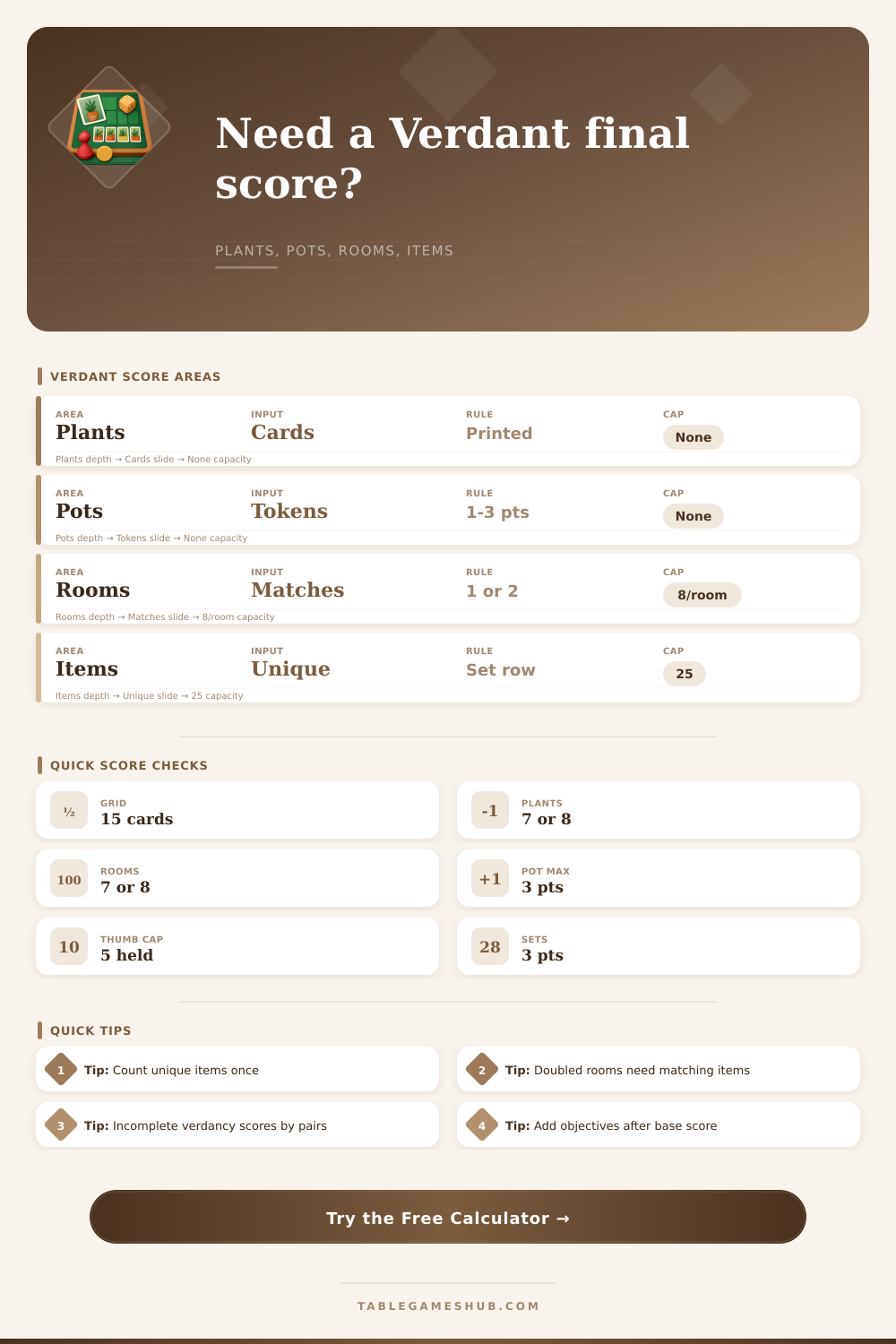
| Score category | What to count | Formula used | Common miss |
|---|---|---|---|
| Completed plants | Printed point values | Sum completed plant cards | Do not add removed verdancy |
| Incomplete plants | Verdancy still on cards | Floor tokens divided by 2 | Single leftovers do not round up |
| Bonus pots | Pot tokens on plants | 3s + 2s + 1s | Terracotta is tracked separately |
| Objectives | Advanced goal cards | User-entered points | Leave zero in standard play |
| Unique item types | Set score | Typical read | Calculator note |
|---|---|---|---|
| 1 or 2 | 1 or 3 | Small set | Duplicates do not increase this row |
| 3 or 4 | 6 or 9 | Developing set | Furniture and pets share the set |
| 5 or 6 | 12 or 16 | Strong set | Often pairs with decorator rooms |
| 7 or 8 | 20 or 25 | Collector set | Eight unique types reaches the cap |
| Room scoring case | Adjacent plant match | Item condition | Points |
|---|---|---|---|
| Basic room match | Plant type matches wallpaper | No matching item | 1 per match |
| Doubled room match | Plant type matches wallpaper | Matching furniture or pet | 2 per match |
| Room miss | Plant type does not match | Any item | 0 for that edge |
| Four-edge room | Up to 4 matching plants | Matching item doubles all | Up to 8 |
| Home focus | Best input to audit | Strong range | Reason |
|---|---|---|---|
| Plant-heavy grid | Completed plants | 6 to 8 | Printed plant points and pots stack |
| Room-heavy grid | Doubled room matches | 6 to 12 | Matching items make rooms efficient |
| Collector route | Unique item count | 6 to 8 | The item set curve accelerates late |
| Objective route | Goal card points | 8 to 16 | Advanced goals can swing final totals |
Finally, you have finished building your Verdant house, laid down the tokens like confetti, and looked it over. You say, “Okay! Time to do math.” That’s when you remember the elegant-but-messy rules. Add up some printed-out numbers? Check. Count how many things is unique? Check. How many green pairs? Check. Adjacency of room? Check. And while doing that, try not to fall asleep at the table. It’s the moment when enthusiasm meets administration fatigue.
Let the calculator above take care of arithmetic; it’ll let you spend more time wondering if your strategy was worth it or not. Verdant’s underlying mechanics revolves around this idea of efficiency through time vs. Immediate reward: the printed-on-card “points” from completed plants serve as solid foundation of your score, easy to tally up and count on. Just tack ’em together, and don’t think too much about it.
How to Score in Verdant
The catch come once you begin considering partial plant. Leftover green tokens on half-finished plants gets paired off to count one point per pair, which means any leftover individual token amount to nothing but wasted potential. It irks because it’s wasted resources, resources you didn’t turn into something valuable.
After that, it’s the rooms and pots, the part that tends to trip most people up. Direct-point bonus pot tokens exist, but they’re rare. They are a valuabel resource. How do you know when to cash them in now for a good pot versus risk losing position in hopes of getting a better room match next round? By keeping track of your room score separately from your total plants and items, the tool will tell you whether that trade-off paid off or not. It tells you how strong your overall tableau realy is, not just a bunch of numbers.
Scoring by room also brings an element of spatial complexity that requires thoughtful consideration when playing. You get points based off how many times the wallpaper in each room matches a plant (and only if it is specifically the wallpaper depicted on your card). If you put down one of your other tokens (furniture or pets) in that room, then that score is doubled for all adjacent matches. This can turn a small point gain into something substantial. This mechanic make players consider how they’re placing things before mindlessly plopping them down as well. Forethought is rewarded here and haphazard building are punished.
The items also have their own scoring curve that speeds up the longer you have unique types of them. For example, if you have one piece of furniture or pet of a particular kind in your house, you get some points. But if you have two pieces of that same kind (but not necessarily the same piece), then you get no more points; you only get points when there’s something different than what you already had. So it adds another tension to reinforcing certain rooms while still trying to collect enough different thing.
There’s a nice-looking duplicate that would of help seal off a double-match room, but it means giving up the massive jump in points for finding yet another new unique type. The tool includes a table of references that make it easy to see this curve: there’s such a huge jump after five or six different kinds of unique items. That little hurdle is where most of the difference lies between good scores and great scores.
The finishing touch comes from the wildcards of green thumbs and goals, which vary based off player style and influence the results to match. Goals incentivize certain strategies with a focused reward, and your green thumbs gives a small cushion to protect them. Balance out an apartment or go all-in on a lush sunroom, it’s up to you. With these last tweaks, it’s easy to test them out immediatly with the calculator, making the final assessment less hit-or-miss.
Verdant is, at its core, about creating an environment that’s purposeful and full of life. Each piece you place down should be there for a reason: because it adds to your plants, because it opens up new rooms, because it matches the other tokens in the room. By knowing what each token does, you’re able to make better decisions throughout the game (not out of chance), but out of understanding. At the end of the day, you stop seeing the board as simply a card grid and begin to understand it as a system of linked values. Your decisions will reflect that, no matter who wins by how many.
It’s easier to review as you’re looking down at the mess of tokens on the table again, post-game analysis isn’t work anymore so much as it’s reflection. What did you do right? What didn’t you do right? How will you do it differently than the next time around? It’s all about design, not math.