Earth Game Score Calculator
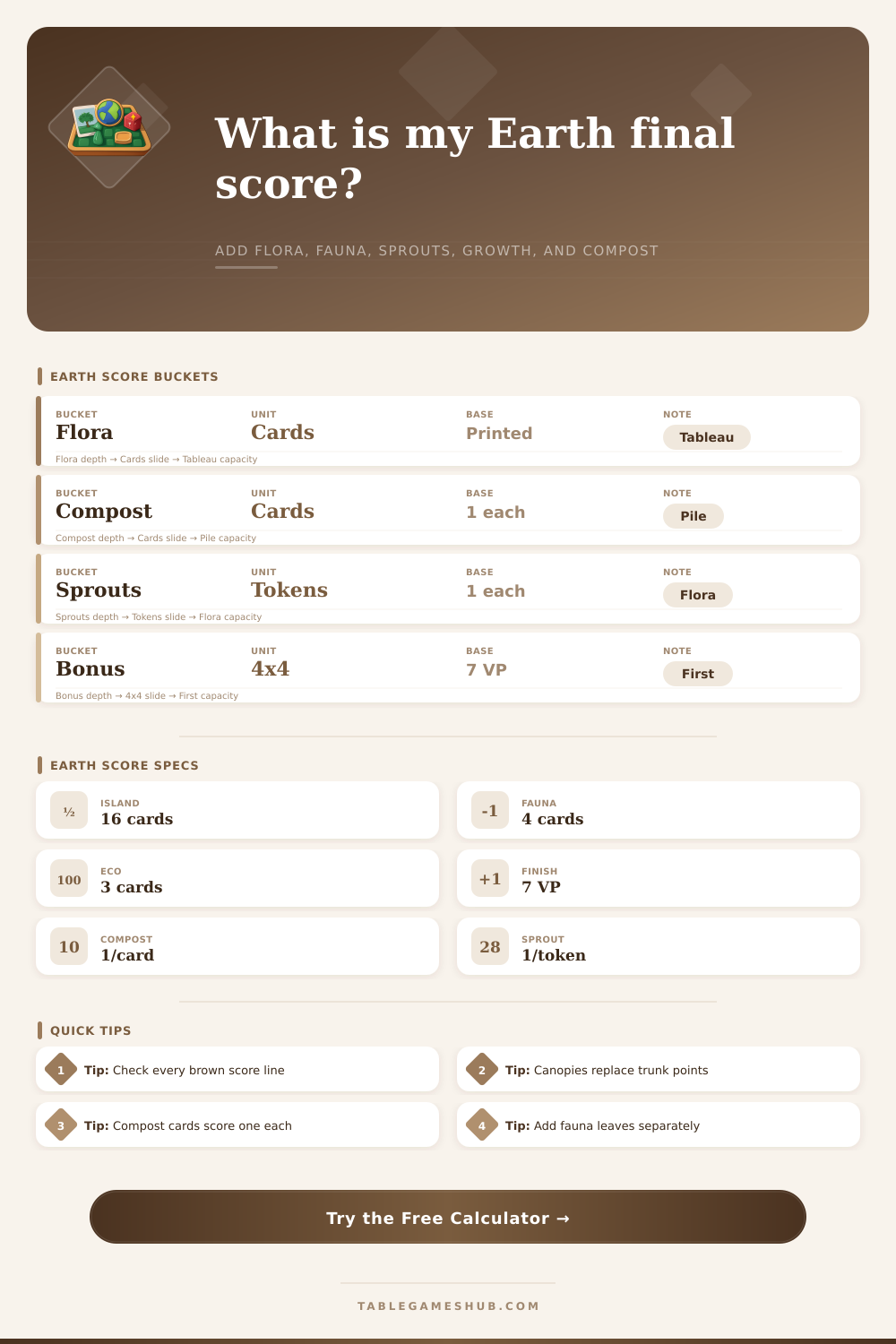
Total your final island score from flora, terrain, events, compost, sprouts, growth, canopies, fauna leaves, ecosystems, and the 4x4 completion bonus.
Final Earth Score
| Score category | What to count | Point logic | Audit note |
|---|---|---|---|
| Flora cards | Printed VP on planted flora | Add printed values | Include every card in the 4x4 island |
| Terrain cards | Printed VP plus terrain scoring text | Add fixed and conditional VP | Check rows, columns, adjacency, and card types |
| Event cards | Played events with VP boxes | Add positive or negative values | Do not count unplayed cards in hand |
| Compost pile | Cards tucked face down in compost | 1 VP per card | Count physical cards, not icons |
| Sprouts | Sprout cubes left on flora | 1 VP per sprout | Spend conversions before final count |
| Growth and canopies | Trunks and completed growth spaces | Trunks score 1 VP; canopies use printed growth value | A canopy card should not also score each covered trunk |
| Fauna claim shape | Typical points | Scorepad entry | Calculator field |
|---|---|---|---|
| One early leaf | 10 to 15 VP | Single fauna objective | Fauna leaf token points |
| Two solid leaves | 20 to 30 VP | Two objectives or high tiers | Fauna leaf token points |
| Three-leaf finish | 30 to 45 VP | Strong public objective game | Fauna leaf token points |
| Late shared claim | 5 to 10 VP | Lower remaining tier | Fauna leaf token points |
| Island style | Usually high | Usually lower | Watch for |
|---|---|---|---|
| Sprout meadow | Sprout VP and fauna | Printed flora VP | Capacity limits on sprout spaces |
| Canopy forest | Canopy growth values | Compost pile | Canopies replacing trunk scoring |
| Compost engine | Compost cards | Event VP | Cards composted by red activations |
| Terrain corridor | Terrain conditional scoring | Sprout VP | Direction, adjacency, and terrain counts |
| Event stack | Event card VP | Growth VP | Negative event boxes and played-only scoring |
| Total score band | Multiplayer read | Common source | Next audit step |
|---|---|---|---|
| Under 120 | Developing island | Few objectives or partial tableau | Check missed flora and compost points |
| 120 to 160 | Competitive table score | Balanced resources and one or two fauna claims | Review terrain conditions |
| 161 to 200 | Strong engine finish | Multiple objective buckets scoring together | Verify canopy values carefully |
| Over 200 | Explosive final island | High fauna, ecosystem, and resource conversion | Audit every duplicate scoring source |
And then there’s the panic you feel on the last round of Earth, when everything about your island no longer look like what it was just 10 minutes before. There are tall trunk and sprouts everywhere, and compost cards is stacked in little piles that suddenly don’t look so little once you realize how many there actualy are. That’s when the calculator steps in to take away some of math load from your brain. It lets you stare at board and know what numbers add up to, even if you still haven’t done any long division out loud while everyone else is watching.
Finally, the game divides its victory points between a number of different categories. Until you tally them up at scoring, they all seem unrelated. You’ve got flora cards with points printed on them (easy enough). And then you have the rest: ecosystem objectives, event triggers, and bonuses for terrain. Each contribute another component to your total, and the compost pile is especially sneaky. It’s face down and silent. Because of this, it’s easy to forget that each card in there are worth one point.
How to Count Your Points in Earth
Each one is not much on its own. But if you’ve been burning through cards and shuffling them around like a madman, those little ones can realy start to compound. That’s where the tool comes in, since it allows you to plug in each bucket separately; preventing you from accidental doubling up or neglecting some line of bonus on a terrain card.
The part that trips players up is growth scoring. Depending on what happens to your trees, the rules change. Once a column of trees get its canopy, you no longer count each piece as a separate trunk. Instead, refer only to the printed growth number on the card for that column. This distinction is important since there can be a bunch of small trees in a forest with fewer total growth than two or three big ones. So if you’ve been using height as a measure, remember to read the canopy numbers, dont just count cubes. The calculator breaks it out this way to prevent double counting the trees and then add the last growth score for the column.
The animal claims add an additional dimension, too, because they depends on placing tokens on certain cards. In essence, you’re wagering that certain parts of your island stays active throughout the game. You could of bet early and then have that card covered up or swapped out, losing all your points. Those points goes into their own total in the calculator, apart from what’s happening on the physical board. That way, you can tell the difference between your income generated by an engine versus your objective-based points. It will help you understand how you realy made progress.
Did you win big through a strong compost engine? Or did you nail down some juicy fauna claims and close out the game? Understanding the distinction will shape your strategy for next round.
Everything is connected through ecosystem objectives that reward patterns more than volume. Both public and private ecosystems encourages you to use certain combinations (or even shapes) of card types. Ignore those and leave points on the table for no good reason. These are scored in fields within the calculator. That way, their score gets tacked onto your overall score without getting buried in all the flora and fauna points.
It’s an audit tool as well as a scorer. You’ll have a clear picture of how each point was earned.
In the end, Earth is just an exercise in realizing that everything you do comes back to haunt you eventually, the sprout you dropped down three rounds ago may not mean much right this moment, but if you keep it around, then it will continue paying you benefits each round thereafter. Your score is nothing more than what you’ve built yourself; the calculator only shows you what that looks like once you input your information.
After that, the anxiety fades away. You get to see what your island realy looks like.