🃏 Dominion Victory Point Calculator
Total printed Victory cards, curses, Gardens, Duke, Vineyard, Fairgrounds, landmark points, project tokens, and deck-size scoring in one final-score sheet.
| Scoring source | Formula | Points | Read |
|---|
| Card or source | Scoring formula | Expansion context | Calculator field |
|---|---|---|---|
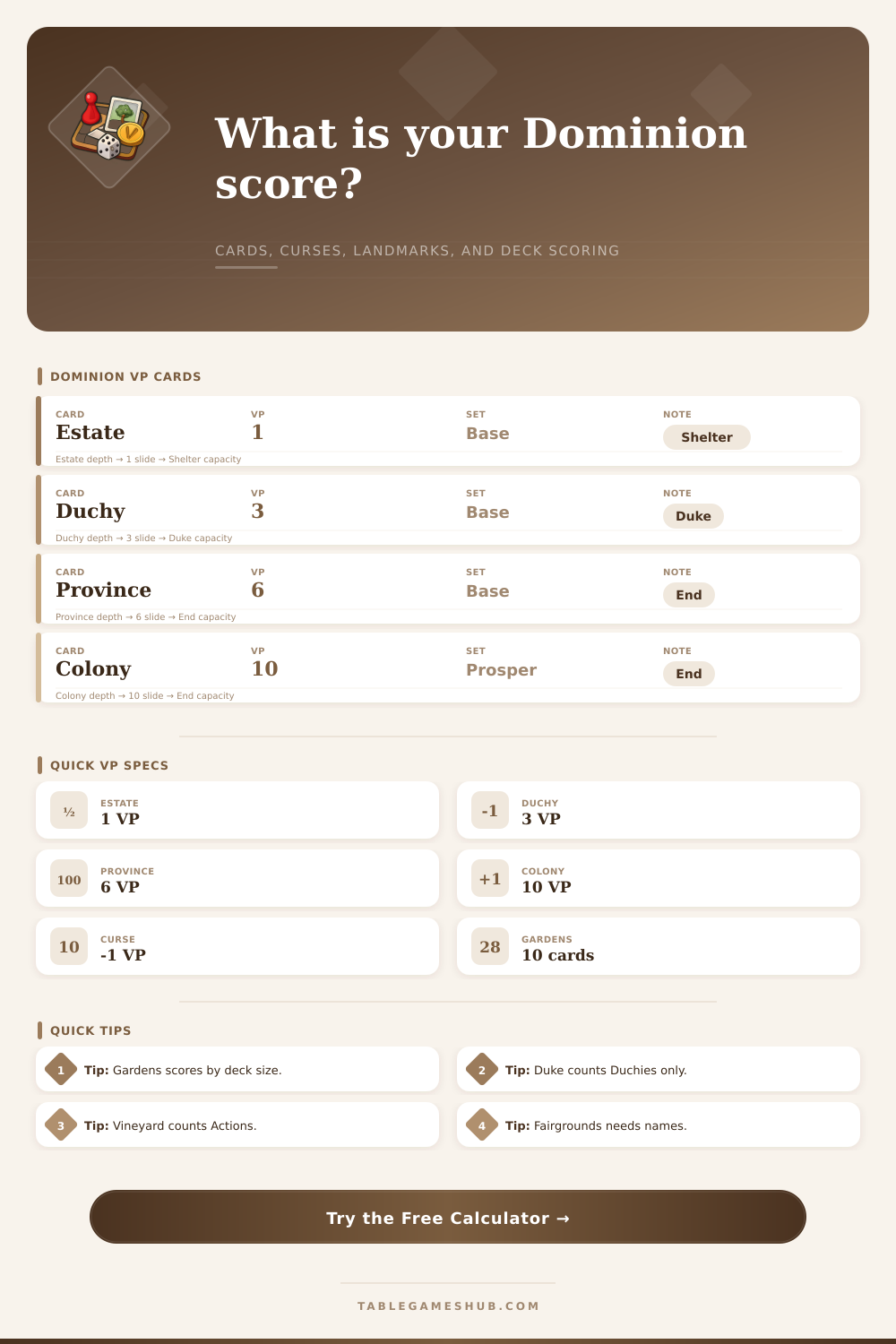
| Estate | Estates x 1 VP | Base supply, starting deck unless Shelters replace Estates | Estates owned |
| Duchy | Duchies x 3 VP | Base supply, supports Duke scoring | Duchies owned |
| Province | Provinces x 6 VP | Standard endgame pile | Provinces owned |
| Colony | Colonies x 10 VP | Prosperity games with Platinum and Colony | Colonies owned |
| Curse | Curses x -1 VP | Penalty card from attacks and kingdom effects | Curses owned |
| Variable card | Rule math | Example | Input dependency |
|---|---|---|---|
| Gardens | Each Gardens = floor(deck cards / 10) | 42 cards gives 4 VP each | Total cards in deck |
| Duke | Each Duke = number of Duchies | 4 Duchies and 3 Dukes gives 12 VP from Dukes | Duchies owned |
| Vineyard | Each Vineyard = floor(Action cards / 3) | 17 Actions gives 5 VP each | Action cards owned |
| Fairgrounds | Each Fairgrounds = 2 x floor(names / 5) | 16 names gives 6 VP each | Differently named cards |
| Manual sources | Direct point total | Island, Nobles, Pasture, Feodum, landmarks | Other points and tokens |
| Game profile | Typical finish target | Province or Colony read | Useful score check |
|---|---|---|---|
| Base game Province ending | 30 to 42 VP | Four to six Provinces often decide the table | Compare total to 36 VP benchmark |
| Prosperity Colony ending | 50 to 80 VP | Colonies create a higher ceiling | Compare total to 60 VP benchmark |
| Alt-VP kingdom ending | Variable | Gardens, Duke, Vineyard, or Fairgrounds can replace Province focus | Check variable VP share |
| Landmark and token ending | Variable | Token piles and landmarks may swing the final table | Check token share of total |
| Score pattern | Main signal | Density read | Deck note |
|---|---|---|---|
| Province-heavy deck | Printed VP is most of total | Usually above 0.8 VP per card | Thin decks make each Province carry more density. |
| Gardens deck | Deck size drives score | May be lower per card but wide in total | Every 10-card band matters for each Gardens. |
| Duke deck | Duchy count feeds Duke | Middle to high when pairs align | Each extra Duchy also adds 3 printed VP. |
| Vineyard engine | Action count feeds Vineyard | Rises with engine payload | Count Actions after all gained cards are included. |
| Fairgrounds deck | Unique names feed score | Improves in 5-name bands | Duplicate copies do not add names. |
Band scoring check
Gardens, Vineyard, and Fairgrounds all use rounded-down bands. Add deck cards, Action cards, and unique names before multiplying by the number of scoring cards.
Separate manual sources
Put token, landmark, project, and unusual card totals in the manual fields so the printed-card breakdown stays readable at the end of the game.
When a Dominion game ends because the Province pile is empty, you must calculate your total score. Determining your total score is necessary to calculate victory points, as there can be a variety of point types in the game. Some card provide you with a specific number of fixed points.
However, there are other cards that provide you with points based on you’re decks composition. Therefore, calculating your total score is essential to determine if you have won or tie with another player. Victory points are earned primarily from the cards that you play.
How to Count Victory Points in Dominion
The value of victory points for each type of card is fixed. Estates are worth one victory point each, Duchies provides three victory points each, and Provinces provide six victory points each. These values do not change, so you must only count the number of each of these types of cards that you own.
Additionally, if you used Colony cards instead of Provinces, these victory point values would be more higher. This would provide every player in the game with a higher total score. To calculate these victory points, players can use a calculator to multiply the number of each type of victory point card that a player owns by its point value.
Additionally, players can use a calculator to also subtract curse cards from the total victory point value that the player has earned. Additionally, there are curse cards that reduce victory points. Each curse card reduces a players total score by one point.
Curse cards are often played early in a game, so it is likely that players will forget these points when the game end. Therefore, players must count how many curse cards are in there deck. Each of these curse cards will reduce a player’s victory point total by one point.
Another type of point that can be earned in Dominion is variable scoring cards. These scoring cards provide points for specific criteria related to the player and there deck. Additionally, these points require more calculations than victory point values.
For example, Gardens cards provide points for the total number of cards in a players deck. Therefore, if a player plays Gardens into their deck, they will have a larger number of total cards than a player that does not play Gardens. Other variable scoring cards include Duke cards, which provide points for the number of Duchies that a player owns.
Additionally, other variable scoring cards in Dominion include Vineyard cards, which provide victory points for the number of Action cards within a players deck. Furthermore, Fairgrounds provide victory points for the total number of unique name of cards in a players deck. Each of these variable scoring cards must be calculated separately in the final round of Dominion games.
When there are many variable scoring cards within a game, the calculation become more challenging for each player. For instance, if a player has Gardens, Duke, and Vineyard cards in their deck, the player must calculate the number of victory points that they will earn from each of these variable scoring cards. In addition to these points from the variable scoring cards, players must also calculate the token that they have earned from the landmarks within the game.
The tokens that are earned from these projects are separate from the player’s deck, so players must calculate these points separately to avoid making mistake in their final score for the game. Another specific measurement of the deck that a player must calculate is the size of their deck. To find the total number of cards within a players deck, they must count the number of cards that are in their hand, the discard pile, and the play area on the game board.
Additionally, if a player is calculating victory points for Gardens cards, they must also include the score pile in their total deck size. If they do not include the score pile, their calculated victory point total from their Gardens cards will be incorrect. If players are using Vineyard cards, for example, they must count every card in their deck that has the Action type.
Even if a player played an Action card during the game, it may still be within their deck. For example, when calculating the total number of unique names in a player’s deck for Fairgrounds, a player should not count each card with the same unique name as a separate unique name of a card. Finally, there are victory points from other sources that players must calculate.
These points are from the tokens earned from the projects and landmarks in the game. Unlike victory point cards, these victory point tokens are earned through different action, and they are separate from the supply piles of Dominion cards. Many Dominion players make mistakes when calculating their total game score.
For example, one of the most common error is to forget that some cards provide variable points, instead of the fixed number of points that other cards provide. Additionally, players may make another mistake if they do not remember the different requirements of each variable scoring card. To avoid both of these mistakes, players can calculate their victory points by calculating the total points from each type of card separately.
First, calculating victory point values from fixed type of cards, then calculating the victory points that their variable cards provide, and then adding the tokens and subtracting the curses from the total number of victory points earned by players in that game. The total number of victory points that a player will earn in a game will depend on the rules for that specific game. For example, a score in the mid-thirties will win a standard game of Dominion.
However, for games that use Colony cards instead of Provinces, the winning score will be higher. Additionally, in games with alternate victory point values, it is possible for a player’s score to be lower. However, it is also possible that the score will win the game for that specific player, since all players are using the same alternate victory point rules for their games.
Additionally, the calculated victory point total can help players determine if their deck performed according to the strategy that they used to build their deck. For instance, if a player used their deck to enable them to play Gardens, they should calculate whether or not the Gardens provided them the extra victory points that they had hoped for would be earned. Similarly, for players who built their deck to contain a large number of Duchies to enable them to play Duke cards, they should calculate whether or not those Duchies provided them the number of victory points that they had calculated that they should earn from playing those cards.
Overall, calculating victory points accurately will allow a Dominion player to understand if their deck executed according to the strategy that they used when constructing their deck.